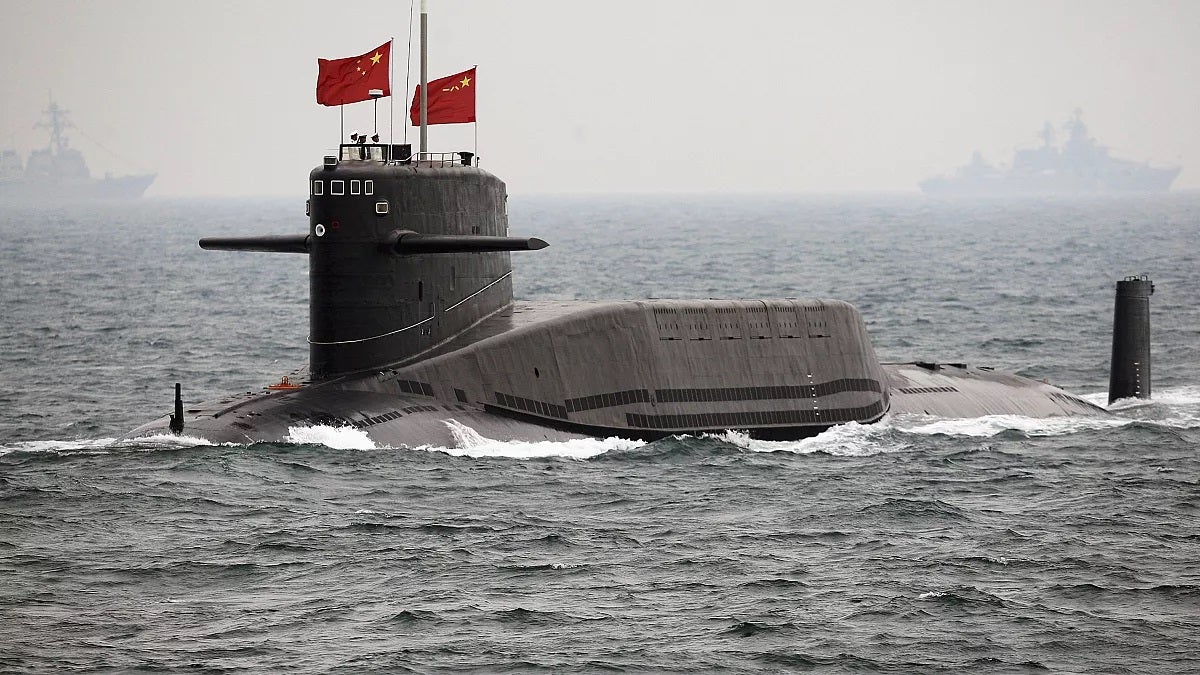
Recent satellite imagery has unveiled significant military advancements in China, revealing a previously hidden submarine base in Qingdao, Shandong Province.
This facility reportedly houses at least six nuclear submarines and is strategically located for direct access to key maritime regions, including the Yellow Sea and the Sea of Japan.
Notably, this discovery comes amidst a period of intensified scrutiny regarding China’s military capabilities.
China’s Strategic Shift: Nuclear Submarines at Newly Discovered Base
The findings, highlighted by naval analyst Alex Luck, suggest that the First Submarine Base of Qingdao has become a focal point in China’s expanding naval capabilities.
Among the visible vessels are two Type 091 submarines, two Type 093A submarines, one unidentified submarine, plus a Type 092 currently decommissioned. This base, once shrouded in secrecy, reflects China’s strategic shift towards enhancing its naval deterrence through a diversified submarine fleet.
China’s nuclear arsenal is estimated at around 600 warheads, a number significantly lower than the United States’ over 5,000. However, experts underscore that China’s growing reliance on its submarine fleet for nuclear deterrence marks a critical evolution in its defense posture.
As Beijing shifts away from land and air-based nuclear capabilities, its focus on modernizing and expanding its underwater fleet is indicative of a concerted effort to strengthen its military presence.
The development of China’s submarine force, which includes a mix of nuclear and diesel-electric submarines, illustrates a strategic pivot that could reshape the Western Pacific’s geopolitical landscape. As the People’s Liberation Army Navy (PLAN) seeks to expand its fleet to 65 submarines by 2025 and potentially 80 by 2035, the implications for global security remain profound.
Observers can note that this increase in maritime deterrence capacity may elevate tensions among regional powers and fundamentally alter existing power dynamics.