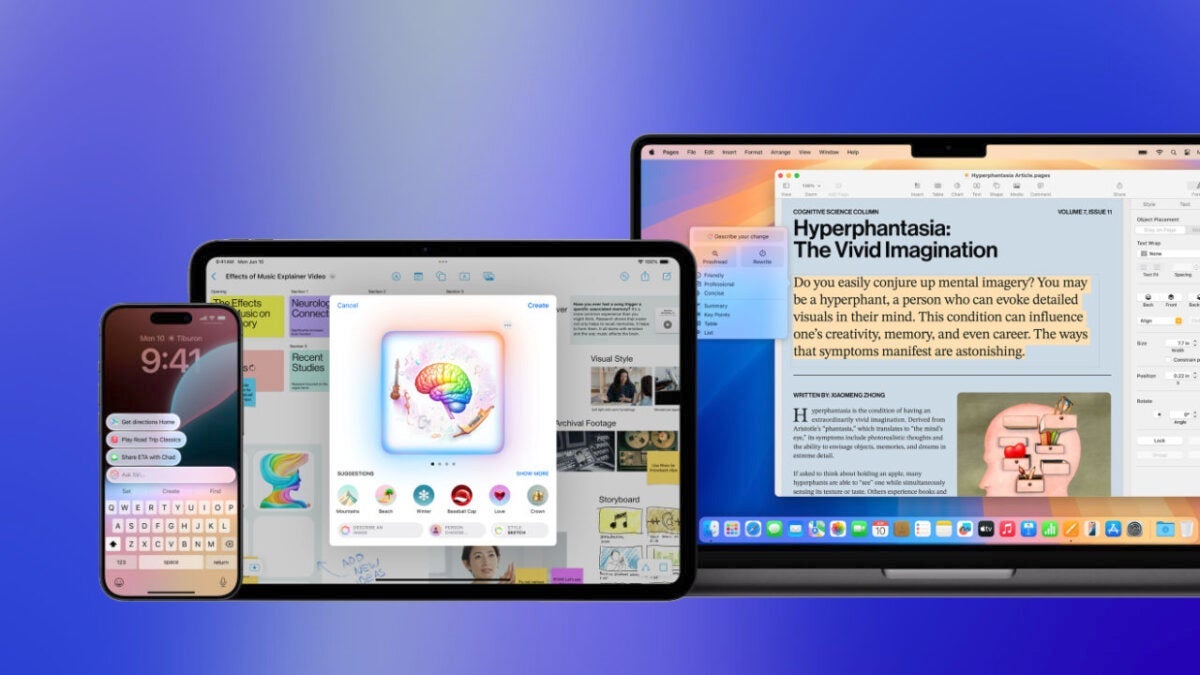
The highly anticipated launch of Apple Intelligence is just around the corner, according to the latest leaks. From what we know, Apple plans to release iOS 18.1, the first version to incorporate Apple’s artificial intelligence features, on October 28. This information comes from Mark Gurman in his weekly newsletter, also stating that although the update was initially scheduled for early October, Apple has decided to delay it a few weeks to ensure its deployment, while also preparing its cloud servers to handle the expected increase in traffic with the arrival of these new features.

Less time left for iOS 18.1, less time left for Apple Intelligence
With the launch of iOS 18.1, Apple Intelligence will take its first steps with a series of tools aimed at making our daily tasks easier while introducing new features. Apple Intelligence will offer us the ability to rewrite, summarize, and correct texts.
Apple’s virtual assistant, Siri, will receive a visual and functional update. The new interface is more intuitive and allows for more efficient interaction. Thanks to Apple Intelligence, iOS 18.1 will also bring notification summaries for key apps like Messages and Mail.
Finally, for now, Apple Intelligence will allow us to remove unwanted elements from our photos with a simple touch. Whether it’s a person interfering in an image or an object that disrupts the composition, the photo editing process is greatly simplified.
A progressive rollout to ensure its success
According to Gurman, iOS 18.2, expected in December, will include support for ChatGPT, allowing us to interact with this popular AI model directly from our Apple devices. Additionally, Image Playground will be launched, a tool that will use generative intelligence to create images and emojis.
On the other hand, the complete update of Siri, which will include greater control over applications and personalized responses according to the context, is not expected until early 2025.
As we know, one of the main reasons for the slight delay in the release of iOS 18.1 is the need to properly prepare Apple’s cloud servers. The new Apple Intelligence features will require a significant amount of cloud processing, especially for complex tasks such as image generation and advanced natural language processing. Apple wants to ensure that its infrastructure is ready to handle this increase in demand, thus avoiding performance issues or disruptions.
While Apple Intelligence will not change anything in Apple’s most ambitious project, we are on the brink of what promises to be one of the biggest revolutions in the way we interact with our iPhone, iPad, and Mac. Although there are still features to come in future updates, the launch of Apple Intelligence marks a before-and-after in the company’s ecosystem.
