Video has become the center of almost every campaign. There are still image formats, text-only formats, and even audio-only formats, of course, because the same idea needs to show up in ads, landing pages, social posts, vertical videos, and podcasts, and it also needs to be adapted for each market, channel, and test variation. But as of right now, the foundation of the workload is the video. What might have been an extra feature a few years ago is now the norm. And if we add the fact that the pace of today’s campaigns is faster than ever, we need to find a different way of producing if we want to keep up with deadlines comfortably.

In that context, the most interesting shift is no longer necessarily having more editors, but about producing content with a smarter system. Adobe Stock fits precisely there, because it gives us a huge catalog of assets ready for commercial use, advanced search, and, most importantly, access to a complete AI-powered personalization system. Adobe Stock AI Studio gives us a way to test color direction, generate music that follows the cut, and animate still assets without opening parallel workflows or adding more specialized production layers to the process.
That flexibility, along with a connected workflow with our edition apps, translates to a scalability that appears when we stop thinking about filming everything and start thinking about selecting, adapting, completing, and launching faster.
Video is now the norm, and creating it is the biggest bottleneck
When our day-to-day work revolves around the creation of campaigns, we can quickly see that the production bottleneck is rarely a lack of ideas. The pressure starts to build when every channel demands its own version of the message: a short cut for paid social, a more emotional and relatable piece for awareness, a vertical adaptation for stories, a loop for the product page, or a version with different copy for an A/B test on the client’s website. Every output requires different execution, even when it starts from the same strategy, and that means the bottleneck builds up in production.
On small teams, that pressure becomes obvious very, very quickly, because one person is often coordinating copy, design, legal review, publishing, and analysis alone. On larger teams, the bottleneck is less visible and less rigid, yes, but once the volume increases, so does the difficulty of properly coordinating alignment and approvals. In both cases, the calendar gets more packed week after week, and the real requirement is no longer measured by our ability to produce one great hero piece, but by our ability to maintain visual consistency across every point in the campaign journey.
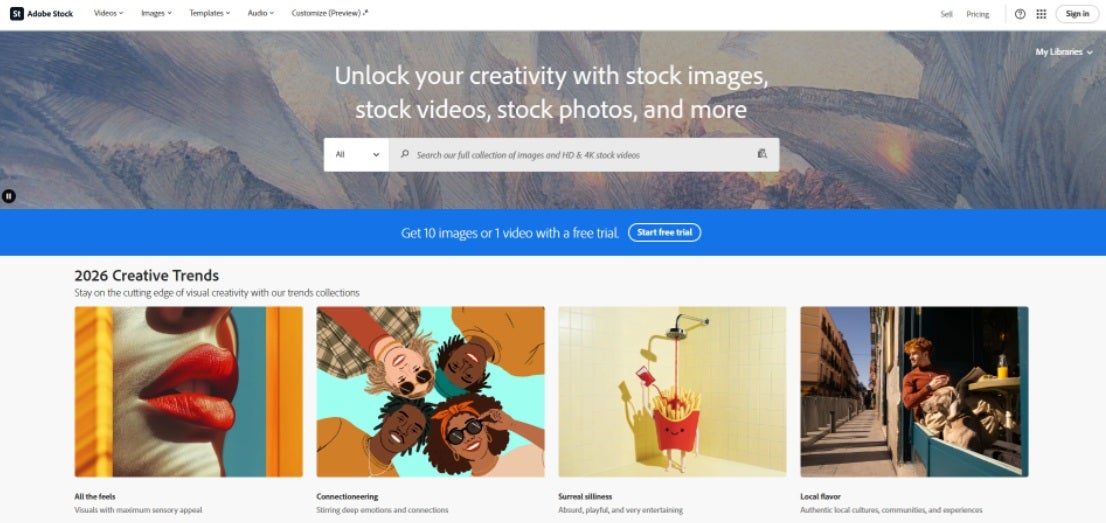
Does that sound complicated? Let’s add the fact that a campaign-ready piece now includes an entire conversation around formats, versions, and context of use, and it also needs to account for speed of adaptation and iteration. And here is where the new Adobe Stock AI Studio tools shine. Because instead of treating color, sound, and image animation as post-production tasks, we can make those decisions while the campaign structure is still taking shape.
Adobe Stock AI Studio: Change Color, Audio Match and Animate Image
The current pace of marketing requires tools that let us select, adapt and launch with far greater speed. That’s where Adobe Stock AI Studio comes in, and we are highlighting three of its features: Change Color, Audio Match and Animate Image.
Change Color lets us work on the visual look of a clip before we even license it. This is essential, because even when experience helps us gauge fit in advance, not every clip can sustain the style shift needed to fit our current production. We can change the color palette to test different looks, enter up to five HEX codes to align the result with our specific brand, or pull the color palette from another Stock video to maintain the continuity across our scenes.
Audio Match extends that same logic to the sonic side of our campaigns. Sound is something we can’t afford to overlook if we want to deliver a quality product, yet finding a track that matches the rhythm of an edit tends to eat up much more time than we usually expect. With Adobe Stock AI Studio’s tools, we start from our own video and generate an original soundtrack that fits its energy, cuts and cadence. We can adjust the style and tempo to fine-tune the result to match whatever tone we’re going for in the campaign.
Animate Image rounds out Adobe Stock’s AI toolkit for video edits by addressing another very common need: getting more out of certain still images when a project would clearly benefit from more movement. The days of pans, zooms or graphics to disguise an inherently static image are long gone. The camera movement is smooth and the final result is more than enough to bring a product image, a landscape, a visual background or other social media content to life.
Does traditional production still make sense in this context? Yes, but…
Traditional production still represents enormous value in key brand moments. A major launch, a corporate piece, or a campaign with a strong narrative component will almost always need shooting in order to take shape properly. Even so, when we are talking about volume, cameras, locations, lighting, casting, scheduling, travel, and post-production, multiple review rounds all come into play. Every new version adds extra layers of work and coordination that keep piling onto the project long after the campaign’s core idea has already been properly defined.
Traditional production works especially well in projects where we are aiming for a very specific and precise result. For always-on campaigns, market adaptations or social media assets, however, the pace calls for a different kind of strategy. In those scenarios, what adds the most value is speed, always guided by clear judgment: getting there quickly, testing, adjusting and publishing again.
The nature of the content we need to produce also plays a major role in the decision. Within the context of a campaign, we often need support shots, contextual assets, visual backgrounds, transitions, lifestyle clips and product details that reinforce and add value to the core message itself. These are highly useful materials, of course, but at the same time they are repetitive in how they are produced. That is exactly where a change in mindset pays off most: moving from building every fragment from scratch to assembling with both visual and commercial intention.
A real workflow: a campaign ready in 24 or 48 hours
Adobe Stock AI Studio helps us pressure-test the material before the campaign is fully locked. Change Color can tell us whether the selected clips can pivot toward the same brand palette, Animate Image can give movement to still elements we may want to use in the mix, and Audio Match can frame the sonic direction we want the piece to carry.
Then we refine the final product. We reach the review stage and, while we already have a campaign-ready piece, we can still sharpen it. It is common to spot a scene that could enrich the whole project or make it flow better. Maybe we need an animated packshot, an atmospheric shot, an opening with more movement to grab attention, or a transition that fits the product universe more closely. Animate Image handles that moment extremely well because it allows us to generate the clip from a still image.
AI Studio is also there to keep the process leaner. Instead of reopening the pre-production conversation, we can refine what we already have: unify the palette with Change Color or generate a new audio track that follows the revised cadence with Audio Match, if needed.
The second day can be used for variations, approvals and rollout planning. Starting from a base edit, it becomes very easy to produce 6-, 15- or 30-second versions, adapt the copy, shift the message hierarchy, prepare the loop for the client’s landing page or adjust certain content for another market.
We have changed the unit of measurement. We have gone from thinking about a campaign as the sum of shoot days and post-production hours to seeing it as a system of selection, assembly and adaptation. The team remains essential, of course, but each person can cover far more ground with the same amount of time.
A strategy with many advantages
With this production system, marketing teams first notice the improvement in speed, autonomy and visual consistency, and the final output reflects it. When access to materials, previewing, licensing and adaptation all coexist within the same ecosystem, cycles become shorter, we gain more time for better review, and, crucially, many more creative variations become possible. At the same time, the team can handle many day-to-day assets internally without relying on custom productions, while still maintaining a coherent visual language across all formats, versions and markets.
With that in mind, this approach works especially well with creative and video professionals, because all of these scenarios demand ever-faster iteration, a high number of versions and a constant adaptation pipeline. When sustaining the pace matters as much as maintaining quality, a solid visual foundation, combined with integrated generation and editing tools, makes it possible to scale production without expanding resources.
Adobe Stock allows us to deliver campaign-ready video without expanding production resources
All in all, Adobe Stock feels much closer to a production engine than to a simple asset library. The breadth of its catalog, licences allowing commercial use, advanced visual search system and excellent direct integration with the tools we already use allow us to work in a way that is more aligned with the real needs of marketing. And when we add Animate Image to generate or retouch B-roll, support clips or missing scenes, or Audio Match to generate the soundtrack, the system gives us enormous flexibility. Today, video moves through a smarter workflow, and that workflow translates into selecting, adapting and publishing with remarkable speed.
For teams that want to produce more while keeping the same structure, exploring Adobe Stock as a foundation, trying Adobe Stock AI Studio to fill a few gaps, and connecting the work with the tools that we already use is the right move. Being able to scale video production effectively means launching sooner, adapting better and getting more out of every asset, with campaign logic, brand consistency and a pace much closer to what the market now demands.
