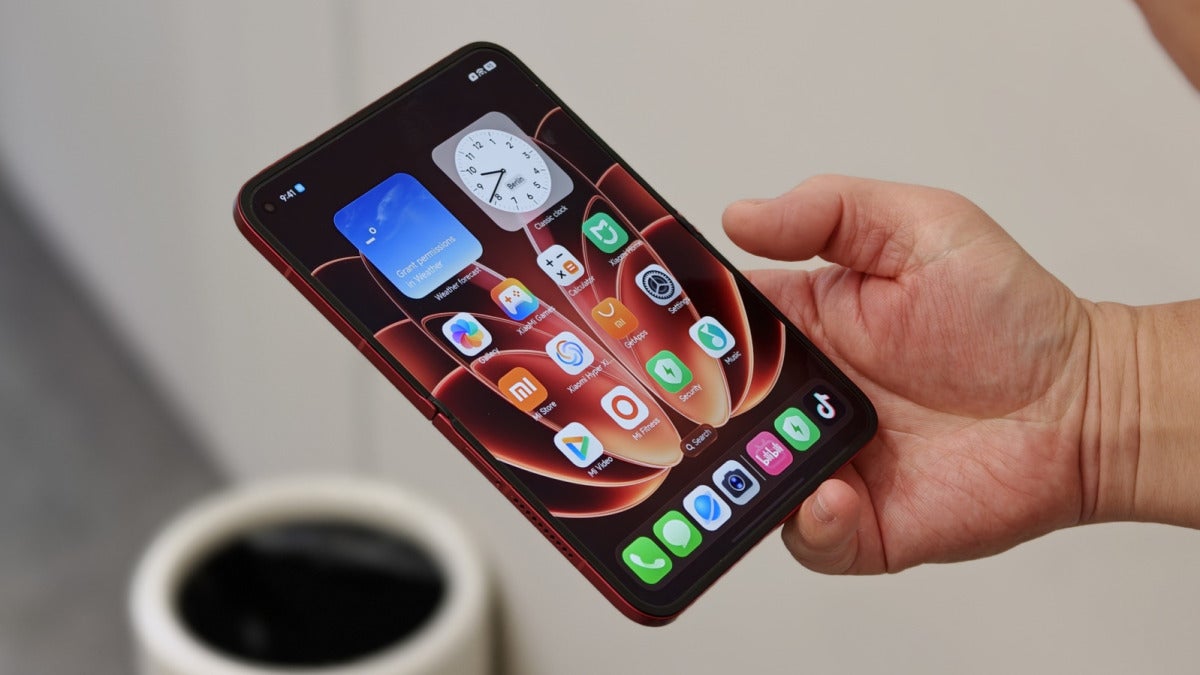
Xiaomi has launched the Xiaomi 18 Fold in China, and the foldable is already on sale there. The company is pitching it as its first mid-size foldable: a passport-style wide-fold phone with a 3nm XRING O3 chip, a 6,000mAh battery, Leica-branded cameras, and a starting price of CNY 10,999, which works out to about $1,600.
Xiaomi says the 18 Fold is meant to land somewhere between flip phones and the bigger book-style foldables. It has a 5.38-inch outer display and an inner screen of about 7.6 inches, both using an A4-like aspect ratio so the jump from one screen to the other feels more natural.
It also doesn’t weigh much for this category. At 219g, Xiaomi says the 18 Fold is its lightest foldable so far, and both HyperRGB LTPO panels use full RGB subpixels, support refresh rates from 1Hz to 120Hz, and hit 4,000 nits of peak brightness. The company also says the phone uses an aluminum alloy frame, Shield Glass 3.0, and a new three-link hinge.
Inside, Xiaomi is packing in a 10-core CPU, a 16-core GPU, LPDDR6 support, and what it claims is a 45% jump in NPU decoding performance. Charging is rated at 67W wired and 50W wireless. Camera hardware includes a Leica triple-camera setup with a 200MP main sensor, a 50MP periscope, and a 50MP ultra-wide, which Xiaomi says helps it sidestep the usual trade-offs that come with foldables.
If you’ve been waiting for a wider foldable and you’re in China, the Xiaomi 18 Fold has a lot going for it, especially with Apple’s foldable rumored to be on the way and Samsung’s Galaxy Z Fold 8 already adding more pressure in a market that’s getting crowded fast.
The Xiaomi 18 Fold starts at CNY 10,999, or roughly $1,600, and it’s available in China now. Xiaomi hasn’t said anything yet about an international release.

Author: Manuel Bosque
{
"social": {
"email": "",
"facebook": "",
"twitter": "",
"linkedin": ""
},
"ja-JP": "",
"de-DE": "Manuel Bosque schreibt bei Softonic über Software: Desktop-Programme, Produktivitätswerkzeuge und kleine Tools, die ein Problem wirklich lösen. Sein Maßstab ist praktisch — was ein Programm tatsächlich leistet, was es dafür verlangt und für wen es sich lohnt —, deshalb misstraut er Funktionslisten und testet lieber selbst. Er gehört zum Team, das festlegt, wie Software auf der Seite behandelt wird, und arbeitet täglich mit KI-Werkzeugen in der redaktionellen Produktion.",
"en-US": "Manuel Bosque covers software at Softonic: desktop programs, productivity tools and the small utilities that solve one problem well. His approach is practical — what a program actually does, what it asks in return and who it is for — which is why he distrusts feature lists and prefers to test. He is part of the team that decides how software gets covered on the site, and works daily with AI tools applied to editorial production.",
"es-ES": "Manuel Bosque se ocupa de la cobertura de software en Softonic: programas de escritorio, herramientas de productividad y utilidades pequeñas que resuelven bien un solo problema. Su criterio es práctico —qué hace realmente un programa, qué pide a cambio y a quién le sirve—, y por eso desconfía de las listas de funciones y prefiere probar. Forma parte del equipo que decide cómo se cuenta el software en la web y trabaja a diario con herramientas de IA aplicadas a la producción editorial.",
"fr-FR": "Manuel Bosque couvre les logiciels chez Softonic : programmes de bureau, outils de productivité et petits utilitaires qui résolvent bien un seul problème. Son approche est pratique — ce qu'un logiciel fait vraiment, ce qu'il demande en échange et à qui il s'adresse —, d'où sa méfiance envers les listes de fonctionnalités et sa préférence pour l'essai. Il fait partie de l'équipe qui définit la manière de traiter le logiciel sur le site et travaille au quotidien avec des outils d'IA appliqués à la production éditoriale.",
"it-IT": "Manuel Bosque si occupa di software su Softonic: programmi per il desktop, strumenti di produttività e piccole utility che risolvono bene un solo problema. Il suo criterio è pratico — cosa fa davvero un programma, cosa chiede in cambio e a chi serve — e per questo diffida degli elenchi di funzioni e preferisce provare. Fa parte del team che decide come si racconta il software sul sito e lavora ogni giorno con strumenti di IA applicati alla produzione editoriale.",
"nl-NL": "Manuel Bosque schrijft bij Softonic over software: desktopprogramma's, productiviteitstools en kleine hulpprogramma's die één probleem echt oplossen. Zijn maatstaf is praktisch — wat een programma werkelijk doet, wat het daarvoor vraagt en voor wie het nuttig is — en daarom wantrouwt hij functielijstjes en test hij liever zelf. Hij maakt deel uit van het team dat bepaalt hoe software op de site wordt behandeld en werkt dagelijks met AI-tools in de redactionele productie.",
"pl-PL": "Manuel Bosque zajmuje się oprogramowaniem w Softonicu: programami na komputer, narzędziami do pracy i niewielkimi aplikacjami, które dobrze rozwiązują jeden problem. Jego kryterium jest praktyczne — co program naprawdę robi, czego wymaga w zamian i komu się przyda — dlatego nie ufa listom funkcji i woli sprawdzić sam. Należy do zespołu, który decyduje, jak pisać o oprogramowaniu w serwisie, i codziennie korzysta z narzędzi AI w produkcji redakcyjnej.",
"pt-BR": "Manuel Bosque cobre software na Softonic: programas para desktop, ferramentas de produtividade e pequenos utilitários que resolvem bem um problema só. Seu critério é prático — o que um programa realmente faz, o que pede em troca e para quem serve — e por isso desconfia de listas de recursos e prefere testar. Faz parte da equipe que define como o software é abordado no site e trabalha diariamente com ferramentas de IA aplicadas à produção editorial."
}
View all posts by Manuel Bosque