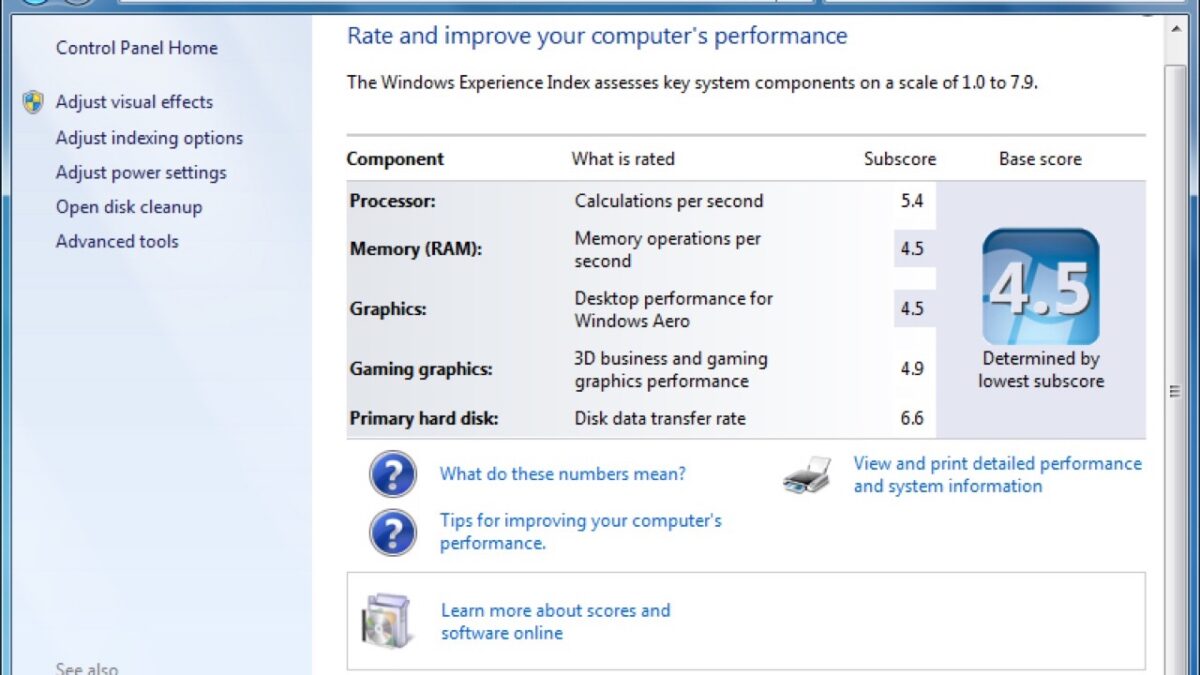
For years, Windows offered a curious built-in feature that rated your PC’s performance: the Windows Experience Index. It gave users a numeric score between 1 and 9.9, evaluating key components like the CPU, RAM, GPU, and hard drive. What seemed like a simple number quickly became a source of comparison, pride, and debate across tech forums and user communities.
How the Windows Experience Index worked
The system assessed five main components: processor speed, RAM operations, desktop graphics, gaming graphics, and disk data transfer rate. Introduced with Windows Vista and refined in Windows 7 and 8, this index allowed users to identify bottlenecks in their systems—a low score on your hard drive could hint that it was time to upgrade.
Microsoft adjusted the scoring scale as newer, more powerful components hit the market. This meant older PCs, once top-tier, could see their scores drop over time. What was once an “elite” 7.5 might later become a modest average, pushing users to reconsider their setups.
A tool for fun, or a fair benchmark?
Many shared their scores online, triggering playful rivalries and discussions about hardware upgrades. But critics questioned the fairness of the system. Not all components weighed equally, and the final score was limited by the lowest-performing part—an SSD-less rig might tank your total, even if your CPU and GPU were excellent.
Although the feature disappeared from plain sight after Windows 8, it still lingers in Windows 11 via a terminal command. Yet its relevance has faded, as it no longer reflects modern hardware advancements or the current performance landscape.