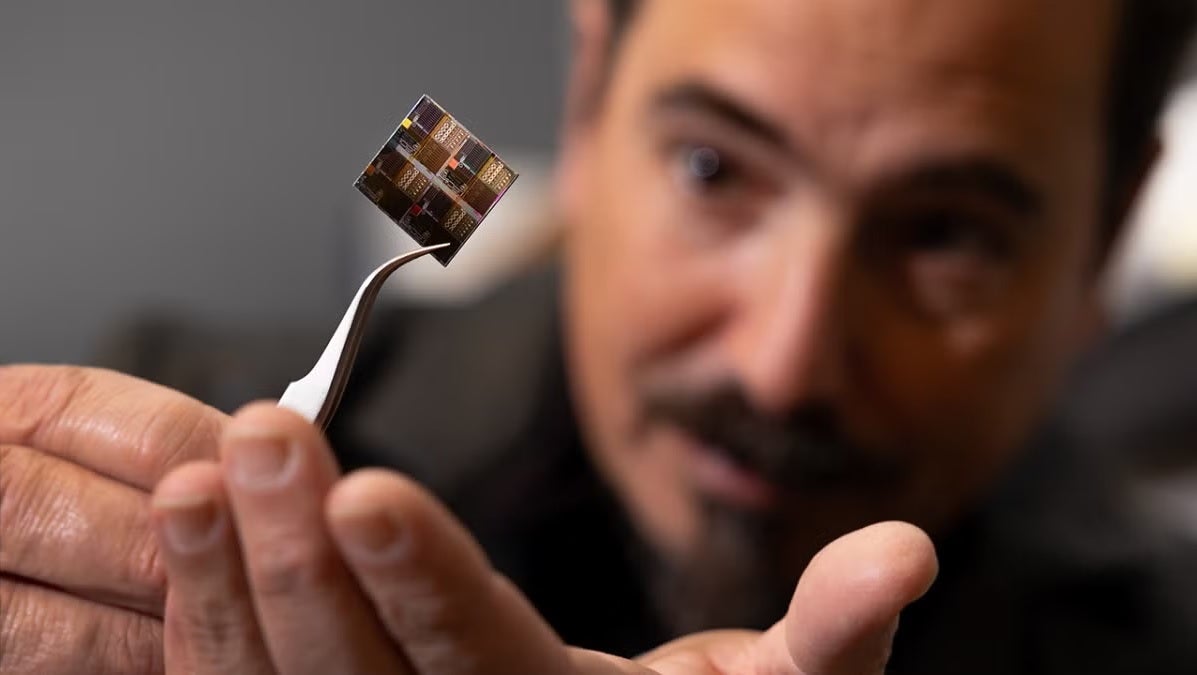
Researchers from the University of Pennsylvania and the University of Michigan have made a significant breakthrough in the field of robotics by developing a programmable autonomous microrobot that measures approximately 210 by 340 micrometers, making it almost imperceptible to the naked eye.
This small device is capable of perceiving its environment and processing information without the need for external intervention, an innovative feature that has so far presented significant technological challenges.
The microrobot integrates computing systems, memory, sensors, communication, and locomotion into a single platform, allowing it to execute algorithms autonomously and modify its behavior in real-time based on its environment.
Small but mighty: the future of robotics and biomedical applications
This advancement is particularly noteworthy, as until now, similarly sized robots relied on external equipment for data processing and decision-making.
One of the biggest challenges in creating these devices at the micrometric scale is their movement in fluids, where viscosity and drag forces become predominant, complicating their locomotion.
In addition, energy consumption is a critical factor, with a limit of around 100 nanowatts. To achieve this, the researchers used a 55-nanometer CMOS process and subthreshold digital logic, incorporating photovoltaic cells and other functional components into the robot’s design.
The locomotion of the microrobot is equally unique, based on the use of electric fields that generate currents in the surrounding fluid, eliminating the need for moving parts that could fail. This minimalist approach extends to its communication, using movement patterns to transmit data such as the measured temperature.
The success of this microrobot could be a first step towards the creation of more complex autonomous robots, with potential applications in fields such as biomedicine, where they could operate in the fluid environments of the human body. Although there is still a long way to go, researchers emphasize that this development could be the foundation for future innovations in microtechnology and robotics.