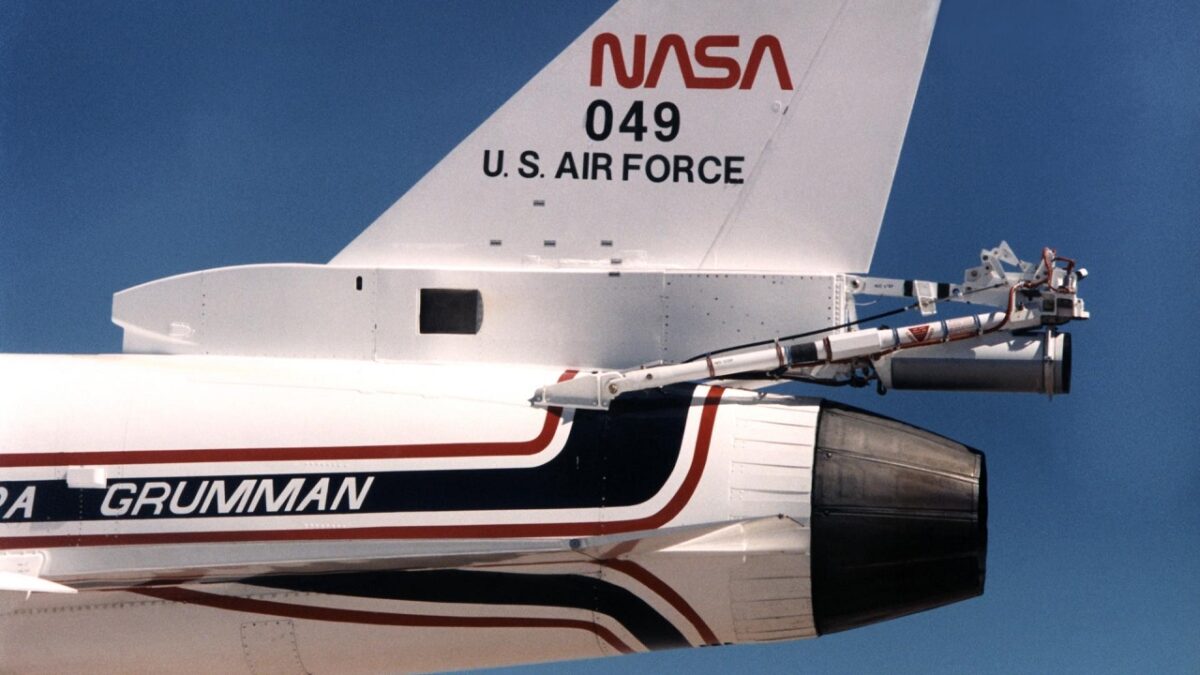
The Grumman X-29 looks like a plane that a child assembled from a model kit without reading the instructions, hence the wings of the plane were, for the first time, placed in the opposite direction. Dear reader, innovation is not always necessary.

Subscribe to the Softonic newsletter and get the latest in tech, gaming, entertainment and deals right in your inbox.
Subscribe (it's FREE) ►This model can only be seen at the National Museum of the United States Air Force in Dayton, Ohio, or the NASA Armstrong Flight Research Center in Edwards, California, where there are prototypes of one of the strangest aircraft that have ever come off the drawing board.
For those who don’t know it, this plane (the Grumman X-29 of the United States Air Force) was born during the 1980s and is a fighter whose main attraction is that it has reverse wings. Let’s tell its story.
When did the idea of inverted wings arise?
In the 1930s, aeronautical engineers experimented with all kinds of wings. There were box wings, tube wings, cantilever wings, rotating wings, and wings that looked like Venetian blinds. If you could imagine a wing, someone was building it. This, in general, is the best way to break with the established norms.
One proposal was to sweep the wings forward instead of backward. The idea was that such a wing would reverse the usual flow over it. While in a backward-swept wing the air flows from the root to the tips, in a forward-swept wing the air flows from the tips to the roots. This reduces drag, increases maneuverability, and allows for flying at a steeper angle of attack.
As explained in New Atlas, the concept was put into practice by Germany during World War II with the Junkers Ju 287 jet tactical bomber. It was later incorporated into the civil aircraft Hansa Jet HFB-320 in the 1960s, but in both cases, the wings were far from successful due to the tendency of the wings to be unstable because of excessive wing flexing.
How the technology for the final design of the X-29 was achieved in 1970
In the 1970s, DARPA, the U.S. Air Force, and NASA decided to revisit the concept thanks to the development of new carbon composites that promised to make forward-swept wings more rigid without adding too much weight.
The result was the X-29, which flew for the first time in 1984 and served as a testbed until 1992. Two prototypes were built and from the beginning they had a strange but familiar profile.
The strange wings were located far back on the fuselage and, instead of tail stabilizers, they had ailerons located in front of the wings. The familiarity was due to the fact that the designers saved money by basing the design on the fuselage of an F-5 Freedom Fighter with the landing gear of an F-15.
The X-29 had quite decent performance. Its General Electric F404-GE-400 engine produced a maximum of 16,000 pounds of thrust, giving it a top speed of Mach 1.5, an operational ceiling of 50,000 feet (15,000 m), and a range of about one hour of flight.
However, as expected, it was very unstable. And this instability made it very difficult to pilot.

Grumman’s response to the antisocial degree of aerodynamic instability of the X-29 was to install a state-of-the-art system that corrected the aircraft’s flight 40 times per second.
In many ways, the X-29 was a great success, as it provided American engineers with tons of data that would be used in subsequent aircraft designs. However, the wing design did not succeed and died with the X-29.
