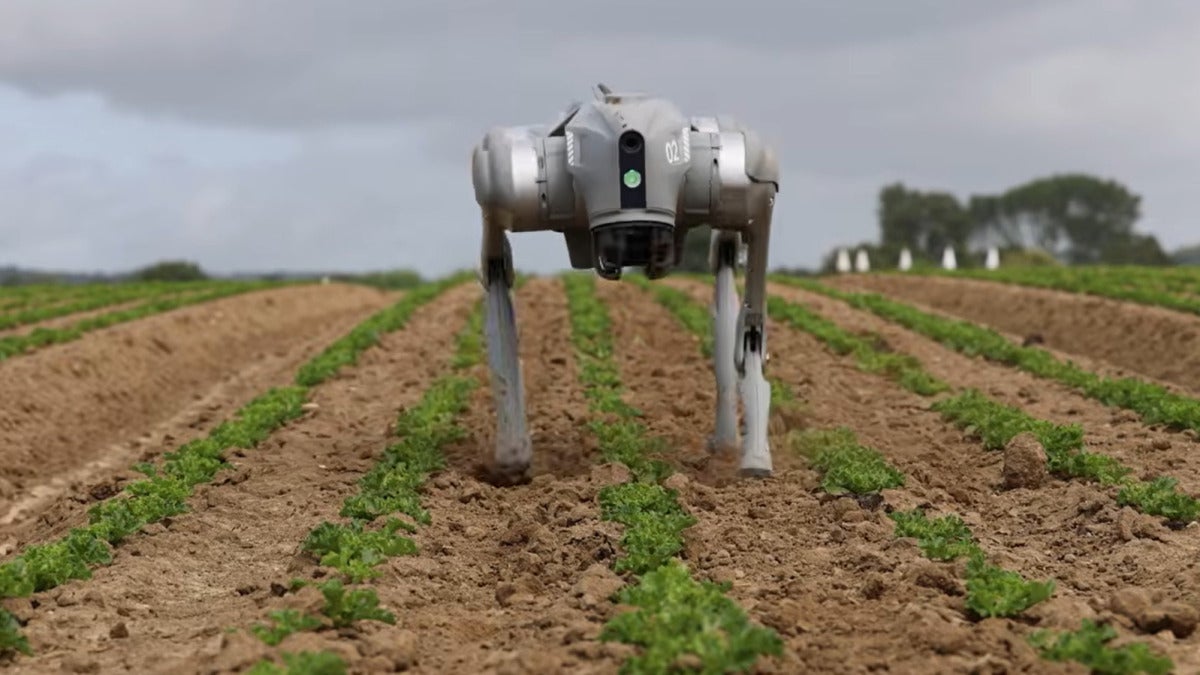
Robot dogs are showing up on farms and in greenhouses in 2025, where they’re being used to monitor high-value crops, gather field data, and send real-time alerts. Farmers have had other tools for this job for years, satellites, drones, and plain old walking the rows, but each one comes with gaps. Satellites miss fine detail. Drones get grounded by weather and only stay up so long. Flying them inside greenhouses can be more trouble than it’s worth. And hand checks take time. A robodog can move through uneven ground and squeeze between tight rows, giving growers a crop-level view with less chance of damaging plants than heavier equipment.
Most of these systems carry a mix of thermal electro-optical, and high-resolution cameras, along with LiDAR and onboard graphics processors. That setup lets them build 3D maps and run analysis on the spot for weeds, invasive pests, leaf disease, phenotyping, and other precision agriculture tasks.
Syngenta and the University of Nottingham are working on one that uses cameras and spinning LiDAR to spot small, early-stage threats hiding under the canopy, the kind satellites or drones often miss. If you keep an eye on farm automation, this one is worth watching. One market forecast says the sector could top $100 billion within eight years, and North America is expected to make up 38.45% of the market in 2025.
Trial results already being cited are pretty striking: 95% fewer adjustment errors and 90% accuracy in Chilean grape trials. DEEP Robotics, for its part, says manual workloads can drop by 70%. Even so, plenty of growers still aren’t ready to jump in. In a 2025 study, 53% of farmers said they’d wait for reviews, pointing to cost, know-how, connectivity, privacy, bias, and worries about the workforce, even as these systems keep rolling out on farms and in greenhouses as crop scouts.

Author: Manuel Bosque
{
"social": {
"email": "",
"facebook": "",
"twitter": "",
"linkedin": ""
},
"ja-JP": "",
"de-DE": "Manuel Bosque schreibt bei Softonic über Software: Desktop-Programme, Produktivitätswerkzeuge und kleine Tools, die ein Problem wirklich lösen. Sein Maßstab ist praktisch — was ein Programm tatsächlich leistet, was es dafür verlangt und für wen es sich lohnt —, deshalb misstraut er Funktionslisten und testet lieber selbst. Er gehört zum Team, das festlegt, wie Software auf der Seite behandelt wird, und arbeitet täglich mit KI-Werkzeugen in der redaktionellen Produktion.",
"en-US": "Manuel Bosque covers software at Softonic: desktop programs, productivity tools and the small utilities that solve one problem well. His approach is practical — what a program actually does, what it asks in return and who it is for — which is why he distrusts feature lists and prefers to test. He is part of the team that decides how software gets covered on the site, and works daily with AI tools applied to editorial production.",
"es-ES": "Manuel Bosque se ocupa de la cobertura de software en Softonic: programas de escritorio, herramientas de productividad y utilidades pequeñas que resuelven bien un solo problema. Su criterio es práctico —qué hace realmente un programa, qué pide a cambio y a quién le sirve—, y por eso desconfía de las listas de funciones y prefiere probar. Forma parte del equipo que decide cómo se cuenta el software en la web y trabaja a diario con herramientas de IA aplicadas a la producción editorial.",
"fr-FR": "Manuel Bosque couvre les logiciels chez Softonic : programmes de bureau, outils de productivité et petits utilitaires qui résolvent bien un seul problème. Son approche est pratique — ce qu'un logiciel fait vraiment, ce qu'il demande en échange et à qui il s'adresse —, d'où sa méfiance envers les listes de fonctionnalités et sa préférence pour l'essai. Il fait partie de l'équipe qui définit la manière de traiter le logiciel sur le site et travaille au quotidien avec des outils d'IA appliqués à la production éditoriale.",
"it-IT": "Manuel Bosque si occupa di software su Softonic: programmi per il desktop, strumenti di produttività e piccole utility che risolvono bene un solo problema. Il suo criterio è pratico — cosa fa davvero un programma, cosa chiede in cambio e a chi serve — e per questo diffida degli elenchi di funzioni e preferisce provare. Fa parte del team che decide come si racconta il software sul sito e lavora ogni giorno con strumenti di IA applicati alla produzione editoriale.",
"nl-NL": "Manuel Bosque schrijft bij Softonic over software: desktopprogramma's, productiviteitstools en kleine hulpprogramma's die één probleem echt oplossen. Zijn maatstaf is praktisch — wat een programma werkelijk doet, wat het daarvoor vraagt en voor wie het nuttig is — en daarom wantrouwt hij functielijstjes en test hij liever zelf. Hij maakt deel uit van het team dat bepaalt hoe software op de site wordt behandeld en werkt dagelijks met AI-tools in de redactionele productie.",
"pl-PL": "Manuel Bosque zajmuje się oprogramowaniem w Softonicu: programami na komputer, narzędziami do pracy i niewielkimi aplikacjami, które dobrze rozwiązują jeden problem. Jego kryterium jest praktyczne — co program naprawdę robi, czego wymaga w zamian i komu się przyda — dlatego nie ufa listom funkcji i woli sprawdzić sam. Należy do zespołu, który decyduje, jak pisać o oprogramowaniu w serwisie, i codziennie korzysta z narzędzi AI w produkcji redakcyjnej.",
"pt-BR": "Manuel Bosque cobre software na Softonic: programas para desktop, ferramentas de produtividade e pequenos utilitários que resolvem bem um problema só. Seu critério é prático — o que um programa realmente faz, o que pede em troca e para quem serve — e por isso desconfia de listas de recursos e prefere testar. Faz parte da equipe que define como o software é abordado no site e trabalha diariamente com ferramentas de IA aplicadas à produção editorial."
}
View all posts by Manuel Bosque