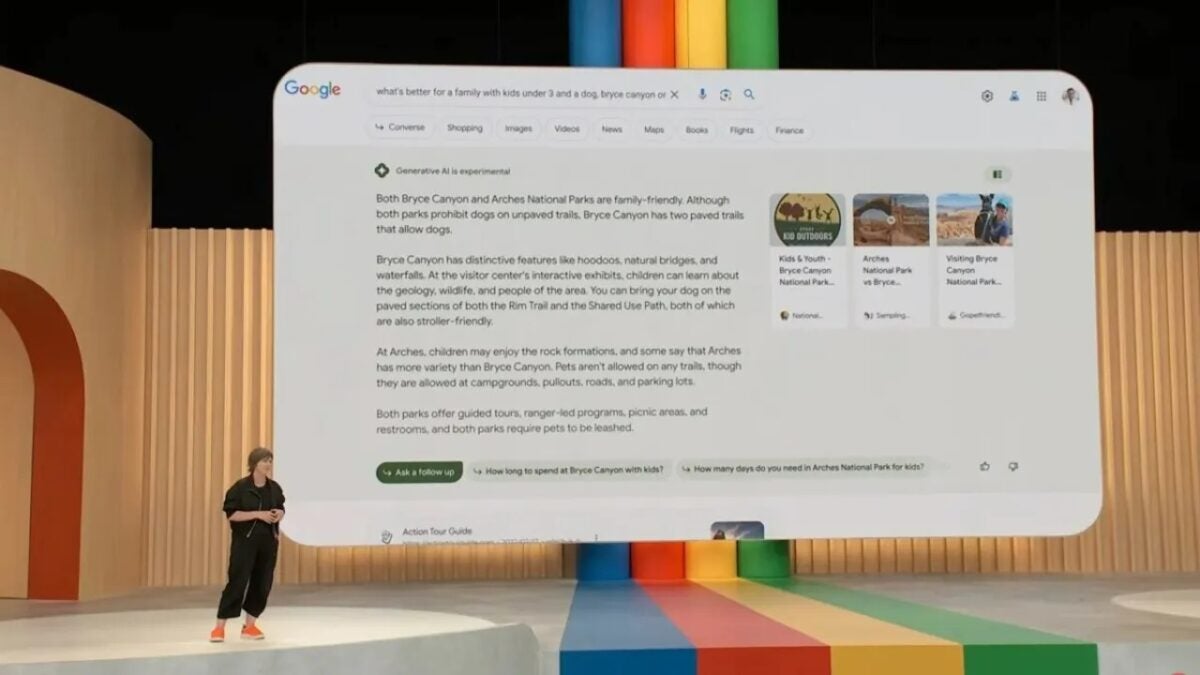
Last week, Google made available to millions of users their search results based on artificial intelligence. The goal was to offer a better search experience… with controversial results.

However, AI yielded all sorts of strange results, such as people should put glue on pizza so that the cheese sticks and thus eat stones.
Google quickly removed some inaccurate results from AI, which it calls AI Summaries, but the damage -and the memes- were already done.
Google explains the reasons for the failures of its search AI
Now, in an article published on Thursday on the blog of the company by Liz Reid, Google’s search lead, the tech giant blames “data gaps” for inaccurate results, along with people who make up strange questions, and doubles down by claiming that AI results are leading to “greater satisfaction” with search.
Reid argues that, in general, AI results do not hallucinate (a term used when AI goes crazy), but sometimes they misinterpret what is already on the web.
“There’s nothing like having millions of people using the feature with many novel searches,” he writes. “We have also seen new nonsensical searches, apparently intended to produce incorrect results.” And he rightly points out that a “large number of fake screenshots” of AI summaries have been spread on the Internet.
And Google forced millions of people to use this feature, which caused many negative reactions and even led to articles explaining how to improvise a way to disable it.
Reid’s blog also explains how Google is fixing AI summaries by limiting when they appear for “meaningless” queries and satires. Part of Reid’s blog also compares AI summaries to another long-standing search feature called featured snippets, which highlights relevant information from a web page without using generative AI.
Ultimately, Google’s introduction of AI summaries has been another PR mistake for the company. Meanwhile, Google rushes to compete against OpenAI and new AI search startups like Perplexity, which is already rumored to be worth $3 billion.
If Google wants to compete, it needs to act quickly. But it also needs to maintain the trust of its users. It could be difficult to regain it after AI Overviews told us all to eat Elmer’s glue.
