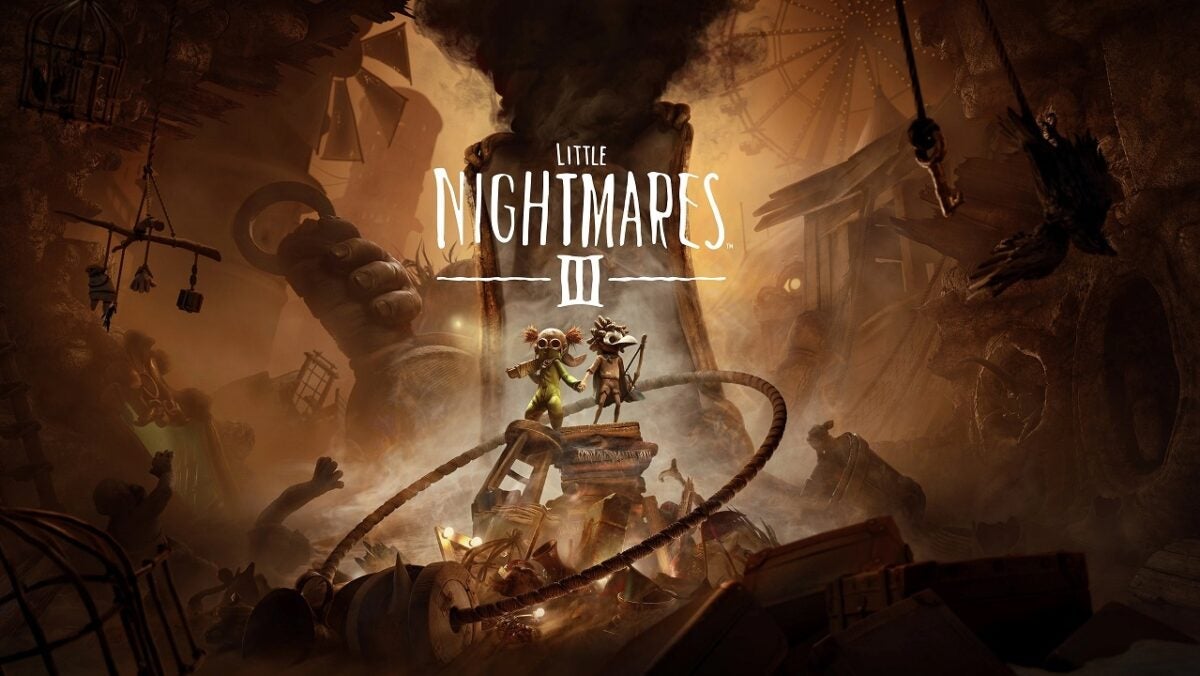
I think it happened to all of us, but I must confess that when it was announced that Supermassive Games would replace Tarsier Studios to create Little Nightmares 3, something inside me stirred.
Yes, Supermassive created Until Dawn, one of those horror games that changed the landscape a bit. On the other hand, it’s a very high bar after two brilliant installments of Little Nightmares and this horror saga is completely different from what they were used to at Supermassive.
I can tell you that while I liked it, Little Nightmares 3 is not up to the level of its predecessors, as it retains some flaws that I hoped would be corrected and does not take advantage of the new features that could have taken the series in new and exciting directions.
A third installment that embraces its predecessors too tightly
Little Nightmares has always been a series that compensates for its clumsy controls and superficial gameplay with a meticulously crafted atmosphere: the imposing sense of scale, the wonderfully macabre creatures, and the delicate lore behind it all.
This release came out in the perfect month, which is October, and it doesn’t matter if I feel compelled to jump from platform to platform between chase sequences and tedious puzzles. I play these games for the atmosphere.
But with Little Nightmares 3, I expected innovations like cooperative mode, a gliding umbrella, and a bow and arrows to give me more than just an atmosphere to immerse myself in, but after the final credits, I’m not sure it even gave me that.
The highlight of Little Nightmares 3, the ace up its sleeve that alone makes it worth buying and playing the title, is The Carnevale, much of which had already been seen previously in the game’s trailers.
When I step out of one of the uniformly gloomy environments of Little Nightmares 3 into this comparatively vibrant and colorful playground, it feels like a breath of fresh air. Much of this game feels like trudging through the same claustrophobic pipes, sneaking between the same nervous mannequins, and fleeing from generic spider-like humanoids, and well, The Carnevale at least looks different.
You continue wandering, occasionally walking crouched to avoid enemies that, when activated, pounce on you and devour you, and solving rather uninteresting puzzles, but at least you have something different to look at while playing.
And there lies the true nightmare: tedium. Little Nightmares 3 is a tedious game. The umbrella? You might think you could use the updrafts to navigate obstacles or glide randomly over a puddle of murderous hands that scratch at you. The gliding mechanic is gold for platforming games, even when implemented lazily, but no, in Little Nightmares 3, the umbrella only takes you against the wind to higher platforms. And it completely disappears halfway through the game.
The additions do not bring the gameplay we expected
But the bow and the wrench! Surely, the new protagonists, Low and Alone, bring something new in terms of gameplay, right? Technically, yes, Low has a bow and Alone has a wrench. But the limits of the functionality of the tools are insultingly simplistic. The bow shoots things and the wrench hits things, and that’s it.
The worst: many of the game’s puzzles are based on these mechanics. Don’t know where to go? See a weak point in a wall? Hit it with your wrench. Can’t reach a high platform? Shoot the rope that suspends the box hanging from the ceiling with Low’s ranged attack.
The cooperative mode is probably the biggest disappointment of Little Nightmares 3. The decision to leave out local cooperative mode is a baffling mistake. The series has always seemed ready for a second player, but specifically someone who is in the same room as you. Unfortunately, even if the game offered split-screen, I’m not sure the experience would be any less monotonous.
In any case, the cooperative option, which does not allow offline multiplayer mode and must be committed to from the beginning of each game, only hinders solo play. I can’t count the times I’ve died simply because Low, my partner, hasn’t done her part on time.
For the rest, once again, it is simply about shooting at strings, hitting objects, and, too often, opening something together, jumping in tandem to break the ground or move a heavy box.
Now do it over and over again, until something chases you. The chase scenes are intense and, by far, the scariest parts of the game, but also the most frustrating. Many of these encounters feel like “gotcha” moments where you don’t know what the game wants you to do until you die.
A second half that leaves a good final taste
The game improves considerably in its second half, starting from the carnival level. I’m not going to reveal anything, but there were moments in the last two chapters where I had to put down the controller for a moment to take a break from the tension. But again, it is an irritating tension that is both the result of questionable design and intentionally distressing scenarios.
There is a lot of stealth action in these parts, weighed down by the same monotony of learning the enemy’s behavior through failure, which often seems inevitable, turning it into a guessing game that quickly becomes exhausting rather than frightening.
Even so, I was relieved that the first half, frankly boring, transformed into a quite exciting, thrilling, and even experimental ending, where physical light is played with and non-linear exploration is done in really fun ways, especially when an object is equipped that blurs the line between nightmare and reality.
For better or for worse, Little Nightmares 3 definitely feels like a game from the saga. The scenes, even those that seem monotonous in retrospect, are spectacular.
There is a playful, mischievous atmosphere, but ultimately oppressive, so unique in the series created by Tarsier that I love to find intact, but there are also rough edges that still need to be polished. The distant perspective and dim lighting that characterize the franchise make it difficult to determine from where to approach a platform from a ledge, which again leads to deaths that often seem unjustified.
There are space platform puzzles, with no environmental or narrative relevance, that test the limits of your patience to rearrange vertical stacks of platforms until they are in the exact position. In other parts of the game, I put down the controller to take a breather from the anxiety.
A third part that respects its history
There is a lot of love in the story that I cannot mention, but I applaud Supermassive for their sincere and largely successful attempt to balance unsettling and distressing themes with childlike and romantic characters.
Although I would have liked to see more variety, what is shown stands out as one of the best environmental designs of the series and, especially in the second half, it is a scarier game than one might expect.
There are flashes of brilliance reflected in the construction of the world of Supermassive and in the cinematic and emotionally resonant narrative, but in all other aspects, Little Nightmares 3 is a sequel that plays it too safe and is half-hearted.
