Do we really care about online privacy?

Privacy has become a huge point of contention in the modern online world as it sits at the heart of the current dominant business model. We now live in a world that is fueled by advertising and filled with technology that is able to better segment, optimize, personalize, and target advertisements to individual internet users. Cracking this code, which involves collecting as much data as possible on the users of online web pages, apps, and services has created some of the biggest companies the world has ever seen including the likes of Meta, Google, Amazon, and many more.

Understandably there has been a vocal backlash against the invasive practices of these big technology companies with people railing against the loss of their privacy. However, actions seem to speak louder than words and there seems to be some sort of a privacy paradox that sees us angry about losing our right to privacy but not really taking action to protect it. The question is then, do we really care about protecting our right to privacy when online?

Privacy in the digital age

Privacy has not remained static as a concept and has changed considerably over the last few decades. Sure, there are plenty of privacy issues that are just as relevant now as they always have been, such as certain aspects of our identities, personalities, behaviors, and embarrassing incidents, which people desire to be kept private. Since the turn of the millennium, however, the free passing and sharing of new types of information about who we are and what we do have both revolutionized the world we live in and opened us up to a wide variety of new privacy concerns including identity theft, lack of control over personal data, and bombardment by spam, and phishing and cybersecurity scams among others.

The last 20 years have seen these news issues, challenges and threats evolve as big tech companies have gone from targeting us based on our membership in certain groups toward more focused and personalized targeting. This in turn led to the development of huge databases filled with personal and private details, which were then sold or in many cases simply breached and leaked. In short, online privacy these days is a mess. It is hard to keep up with, never mind keep on top of, which is one of the main reasons why today, in the digital age, many of us appear to be apathetic about our online privacy.

Invasive terms and conditions

It is easy to think that we simply don’t care about data privacy because we continue to use online services that we know to have invasive privacy policies. Instagram, for example, came in as the most invasive app of all in 2021, according to a report from cloud storage firm pCloud. According to the researchers behind the report, Instagram tracks and collects 79% of its users’ personal data before sharing it with and selling it to third parties. This private data includes search history, location, contacts, financial information, and more.

According to EU law, Instagram and other websites, apps, and services have to tell us about the data they will collect and what they will do with it. This brings us to another key factor that breeds the apparent apathy that grips us when we’re talking about privacy. Sure, these big tech firms tell us about their privacy-invading ways but they do so in confusing language and buried among a mountain of legal speak and technical terms and conditions that would put most of us to sleep. The infographic below, from the Visual Capitalist, shows just how absurd some of the terms and conditions are that the big tech players ask us to consent to before accessing their online services.
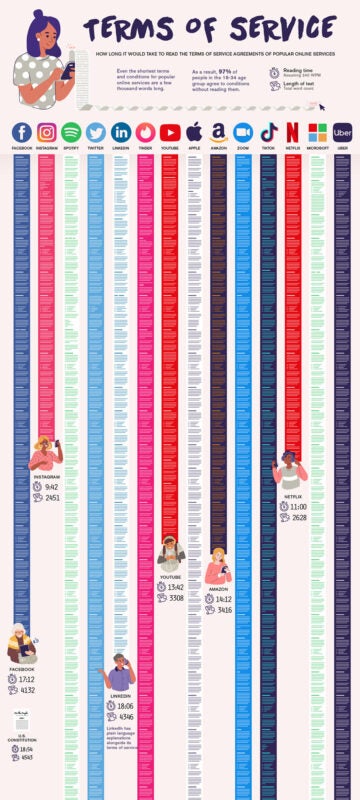
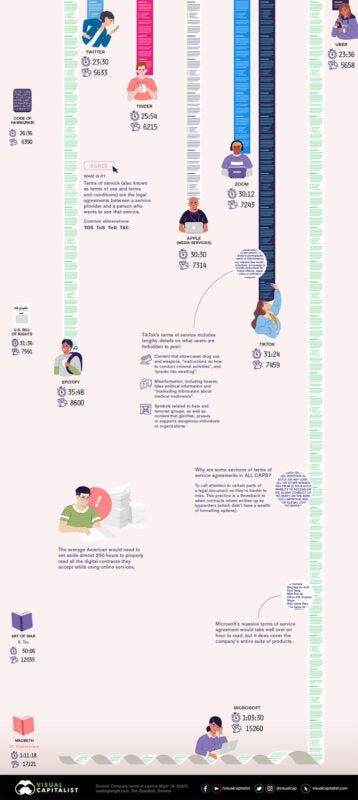
Full infographic available here

Consent vs meaningful consent

We are supposed to offer consent to have our privacy infringed upon by giant tech corporations but in reality, to do so would require huge amounts of our time and possibly even consultation with a lawyer. This means that many of us simply hit the “Agree” button because we need to access the online service rather than because we actually consent to the company doing what they say they will do in the mountain of text we may or may not have just scrolled over. Of course, what this means is that people who do hit consent may not even be thinking about privacy-related issues at all when they agree to the terms and conditions as they haven’t considered for a single second what might be in them. This means that internet users often give consent to big tech operators but it isn’t really meaningful or informed consent.

Do we care about online privacy?

So we’ve established then that just because we use online services that have invasive online policies doesn’t mean that we don’t care about our online privacy. In fact, the truth says something quite different.

The World Economic Forum has compiled a wide variety of investigations and surveys that show just how much we really care about our privacy, particularly in a post-Edward Snowden and Cambridge Analytica world. A Pew Research Study from 2015 indicated Americans had very strong views about their online privacy including a big majority saying it is important to be able to control what information is collected about them. It isn’t just in the US either, with the same World Economic Forum piece also showing that concerns over online privacy are high across a broad range of countries including Spain, Canada, Australia, The UK, and more.

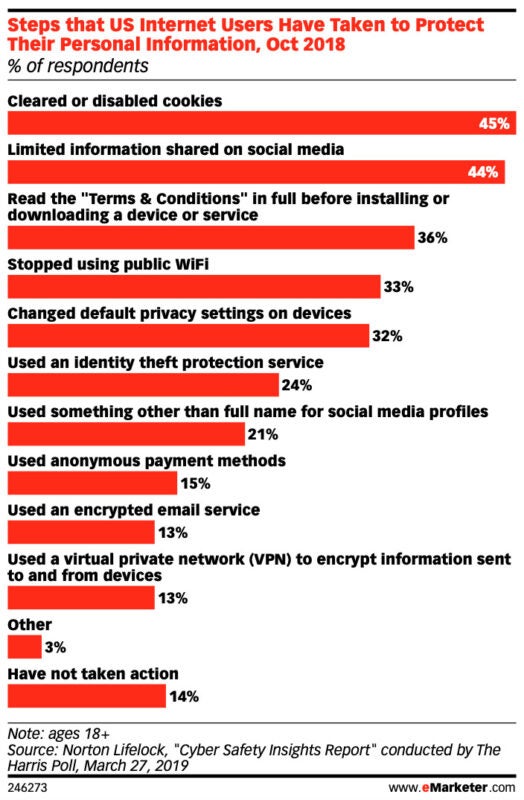
Another Pew Research report, this time from 2019, adds some key insights into what may be going on. The report shows that high numbers of users simply feel helpless over the extent to which their data is harvested both by private companies, such as the big tech companies mentioned earlier, but also by the government. Incredibly, the report says that a whopping 79% of internet users have concerns over data use, which is slightly less than the 81% of internet users who feel they have little to no control over the data that is collected. This is despite the fact that another report highlighted by the World Economic Forum showed that only 14% of the respondents hadn’t taken action to protect their personal information.
The Privacy Paradox

That last point brings us to a very important issue that impacts our ability and motivation to make meaningful decisions and actions that could better protect our online privacy, the privacy paradox. The privacy paradox relates specifically to the phenomena we have been discussing throughout this article, namely that people care about online privacy issues but seem to do very little about them. The Conversation has put together a list of three factors, which likely combine to explain the dynamics at play:

  1. People find it difficult to associate a specific value to their privacy and therefore, the value of protecting it
  2. People do not consider their personal information to be their own and thus might not appreciate the need to secure it
  3. People completely lack awareness of their right to privacy or privacy issues and believe their desired goals (such as a personalized experience) outweigh the potential risks (such as big tech companies using their data for profiling).

These issues touch on what we’ve mentioned earlier, which is a sense of hopelessness and a lack of control over the confusing data practices that internet users feel are forced upon them. In short, we want better privacy protections but feel unable to secure them in the face of such overbearing corporate and government power.

How to take action to protect your privacy

So, with all that being said, we feel the only suitable way to conclude an article like this one is to link to several guides we’ve put together that will help protect your privacy when online:

Softonic’s Ultimate online privacy guide

Follow these steps to protect your online privacy

How to Get Rid of Everything Google Knows About You

How to Delete Google Search History with 2 Simple Solutions

Google saves your information, here’s how to delete it automatically

Protect your privacy, choose this search engine over Google

The most important privacy tricks for Facebook

How to stop Facebook from sharing your data

5 Reasons Why I Deleted My Facebook Profile

How to Delete your Facebook Account

How to stop Facebook from spying on you

3 great privacy-focused web browsers

The best 13 privacy extensions for Google Chrome

Top 3 antivirus software built for privacy

How to delete old tweets before they wreck your career

How to manage and restrict location data on your phone

9 tips to take control of your privacy on iOS 15/iOS 16

If you’ve got this far we salute you and hope that we’ve equipped you with plenty of knowledge and tools for taking a stand and protecting your privacy online. The sad fact, however, is that the sheer number of guides available on different topics related to protecting your privacy only further backs up the main point we’ve been exploring in this article, namely that protecting your online privacy is extremely difficult and very messy.

New crypto phishing scam discovered in the wild

Looking from the outside in, the world of crypto looks like the most degenerate and dysfunctional community of web users you could ever imagine with this year being a particularly harsh time for crypto enthusiasts. The truth, however, is that crypto isn’t going anywhere, even in the wake of the FTX collapse and the crypto community is still here. Unfortunately, this means that the crypto community will still be targeted by active cyber threats like this new phishing scam, which we are reporting on today. Here is what you need to know.

Coinbase Download Now

Researchers at Pixm, which is a cybersecurity firm that specializes in using artificial intelligence as a means to prevent phishing attacks, have identified a new phishing scam that are targeting users of Coinbase, which is one of crypto’s leading centralized exchanges and Metamask, which is a very popular crypto wallet app.

The new scam uses real web hosting services to host fake websites and landing pages designed to target victims and trick them into passing over the security login details and even help them pass two-factor authentication.

As is often the case with phishing scams, they come in the form of emails with this particular instance seeing users receiving emails saying their accounts have been suspended. Urgency is built into the text of the email in an attempt to pressure the potential victim into quickly pressing a link that will lead them into trouble.

Metamask Download Now

Incredibly, from this point, the scam involves the scammers actually chatting with the victims via a fake chat support window. This is designed to help them lower their guard further as well as be able to request information that may be needed to help bypass the two-factor authentication defenses many crypto sites and services require users to set up.

The sad fact is that while crypto does offer emancipatory possibilities it is also rife with risk. Should attackers take control of a centralized exchange account or a crypto wallet, they basically have the keys to the victim’s bank, which they can empty at will. This is why particularly in these difficult times for crypto with massive multi-million dollar hacks still fresh in our minds, it is more important than ever to be vigilant for phishing attacks and scams.

Watch out for these Mastodon security issues

Mastodon has been getting a lot of attention recently as disenchanted Twitter users flee Twitter in the wake of Elon Musk’s takeover. The Federated open-source social network offers a more decentralized version of social media that stands in contrast to the billionaire-owned version that is Twitter. It may sound refreshing and more in tune with ideas of freedom from dominion, but as Mastodon has been growing in popularity, security experts have been taking to the service to investigate for any particular threats that we should worry about. Here is a quick look at what they have found.

Mastodon Download Now

A report by Dark Reading, which is a blog covering and run by the cybersecurity community, has brought together a series of vulnerabilities that have been raised by community members. These include an HTML injection vulnerability and a system misconfiguration that could potentially open up control to a malicious third party.

The HTML injection vulnerability, which has been highlighted by PortSwigger researcher Gareth Heyes could open up the possibility for infosec passwords to be stolen from Mastodon. The system misconfiguration brought to the attention of the cybersecurity community by Lenin Alevski from MinIO offers the possibility for a scammer to download, modify, or even delete everything from a particular server. A third vulnerability raised by Anurag Sen offers malicious actors the chance to scrape user data from a Mastodon server at scale.

In themselves, these issues do not need to set the alarm bells ringing for new Mastodon users. This is mostly how the cybersecurity community works, highlighting vulnerabilities and issues in a service or site, which the company then sets about trying to fix. What is interesting here is that the cybersecurity community is starting to pay more attention to Mastodon as more and more users are signing up. The flip of this is that there will no doubt be a host of scammers out there also trying to take advantage of Mastodon’s new users as they try to familiarize themselves with the tricky interface and not-so-friendly user interface.

If you want to learn more about Mastodon you can read our short Mastodon introduction and if you are a disillusioned twitter user you should check out our guide to different Twitter alternatives.

Elon Musk wants Twitter to be more like WhatsApp

Yesterday we broke the news that WhatsApp is working on a new Business Directory feature in Brazil, which will also include a payments and purchases platform. The move brings WhatsApp a step closer to being an everything app, which is something Elon Musk has long spoken about, with his idea gaining prominence again following his purchase of Twitter. Well today, it looks as though Musk is indeed trying to turn Twitter into an everything app as he has confirmed that he will be copying some of WhatsApp’s most fundamental features into the app. Let’s take a look.

First and foremost, Musk has confirmed that Twitter is working on a way to encrypt direct messages, which is a feature that is already well-known on WhatsApp.

According to The Verge, in a presentation called Twitter 2.0, Musk told the reduced Twitter workforce that the company would be introducing a series of new features:

“We want to enable users to be able to communicate without being concerned about their privacy, [or] without being concerned about a data breach at Twitter causing all of their DMs to hit the web, or think that maybe someone at Twitter could be spying on their DMs […] That’s obviously not going to be cool and it has happened a few times before.”

Although the move will attract headlines for replicating WhatsApp’s famous end-to-end encryption, in his speech Musk referred to a real event that took place in 2018 that saw roughly 1% of all Twitter users have some of their messages leaked to some third-party programmers. With this in mind, referring to himself, Musk has said that “[even] I can’t look at anyone’s DMs if somebody has put a gun to my head.”

The other key features that Musk seems to be pushing for are voice and video calls. Again, introducing these will bring added utility to the micro-blogging social media company, which will bring it one step closer to becoming an everything app. Clearly, it will still have some catching up to do with WhatsApp. With Musk’s drive for agility and speed at Twitter HQ, however, we wouldn’t put it past him just yet.

One small step for AI, One giant leap for Artificial Intelligence

AI has been having a great year this year as there has been a constant stream of impressive and innovative new uses and use cases hitting the headlines. Going beyond the text-to-image and text-to-video types of advances, however, or the impressive machine learning translation models that we’ve been seeing, is the longstanding gaming showdown that has been going on between humans and machines in games like Chess and Go.

Today, however, AI has taken a truly momentous stride as Meta has just released details about Cicero, which is an AI agent that is able to beat humans when playing the game Diplomacy. Let’s check it out and look at why this is such a big deal.

Diplomacy is a popular strategy game that requires players to cooperate with each other to construct grand plans and build up or turn down alliances. It is the fact that success at Diplomacy hinges on successful human cooperation that, according to Meta at least, it has long been seen as an impossible task for AI models to compete in.

“Diplomacy has been viewed for decades as a near-impossible grand challenge in AI because it requires players to master the art of understanding other people’s motivations and perspectives; make complex plans and adjust strategies; and then use natural language to reach agreements with other people, convince them to form partnerships and alliances, and more.”

Incredibly, or terrifyingly, depending on how you look at it, Cicero is able to successfully use natural language processing to negotiate with other Diplomacy players, playing online at webDiplomacy.net. The AI model performs so well at the task that during tests it was able to score more than double the points of an average human player and ranked in the top 10 positions for participants who’d played in more than one game.

It wasn’t just Cicero’s success that was so impressive either. Meta engineers also reported that human players actually preferred allying with Cicero over allying with other humans. This means that although Cicero is only trained to play Diplomacy at the moment, in the future it could help virtual assistants hold long-term conversations. The fact that players didn’t know they were talking to a machine when dealing with Cicero marks a major step forward for AI.

In other AI news, the Linux Foundation is now in charge of running a key open-source AI framework.

Hive Social: Another Twitter alternative is reaching record numbers

Ever since Elon Musk took over Twitter there has barely been a day when the company hasn’t been grabbing the headlines for both good reasons and bad. Unfortunately for fans of the micro-blogging website, some of those headlines have been about users flocking to alternative social media services such as Mastodon. Today, we have news of another Twitter alternative app that is seeing record numbers of users in the wake of events taking place at Twitter HQ. Step forward, Hive Social.

Hive Social Download Now

Late on Monday, Hive posted on its official Twitter account that it had registered its 1,000,000th user. Although Hive had been seeing users sign up prior to Musk taking over at Twitter, there does seem to have been an uptake in sign-ups in recent weeks. Interestingly, as has been seen with Mastodon, there is a direct correlation between negative Twitter headlines and spikes in users signing up to Hive.

Hive was founded in 2019 by Kassandra Pop (Raluca) and is more of a mix of different social networks rather than simply a clone of Twitter. There are aspects of Instagram and Twitter in there but also MySpace too.

One of the key differences between Hive and Twitter is that the upstart social network shows a chronological timeline as opposed to an algorithmically curated one. This will act as a salve against the addictive qualities often attached to other social networks as they constantly try to optimize what they are showing you in a bid to capture every last second of your attention possible. Also, Hive is not solely focused on a timeline with other topic-based communities covering a variety of interests such as Science, Tech, Cars, Music, Fashion, Pets, Crafts, Books, Travel, Gaming, Art, Food, and more.

Another interesting dynamic is that Hive does not monetize ads instead choosing to offer premium features such as securing slots to display some of your favorite songs on your profile for a small fee. Although this isn’t quite the same as the premium offerings we have seen from the likes of Snapchat and Telegram, it is an interesting way to monetize social media traffic that again, nullifies some of the more dangerous aspects related to collecting as much data as possible on users in order to sell it to advertisers.

As to whether Hive Social will be the app to kill Twitter, we will have to wait and see. In the meantime, however, why not check out our short guide to Mastodon to learn about another of the new social networks on the block.

WhatsApp is quietly becoming the everything app

As the world’s most popular communication app, WhatsApp doesn’t need to be the first mover with innovative new features and can simply copy other apps as they introduce updates and upgrades. We have seen the app do this many times, often going beyond the new features offered by other communication apps.

WhatsApp Download Now

Bringing in a host of updated groups and communities features while also building out a solid offering for businesses to sling their products and services sees WhatsApp able to offer a whole host of features that would have previously been unimaginable on the communication app. Today, we have news of an update coming to WhatsApp that brings it one step close to being an everything app, much like Elon Musk’s project X app that has been in the news recently following his purchase of Twitter. Let’s check out what’s going on.

WhatsApp has released a blog post detailing a new Business Directory feature that is currently being developed in Brazil. The directory will act as a hub for businesses to list what they offer and for ordinary users to quickly and efficiently find the products and services they are looking for:

“Today we’re launching the ability to find a business right on WhatsApp so people can now browse businesses by category – such as travel or banking – or search by the business name. This will save people from having to find phone numbers off websites or type a number into their contacts.”

As well as offering a means for communication between businesses and clients, the blog post also describes a purchases and payments feature that will be built into the update, meaning users will be able to get everything they need without even having to leave the WhatsApp app. If we add to this the news we reported at the end of August, that WhatsApp is working on adding a full-blown shopping experience to the app, enabling users to do their grocery shopping on the app, the scale of WhatsApp’s ambition becomes clear.

WhatsApp shopping

Interestingly, there is already a prominent ‘everything app’ in China called WeChat that sits at the heart of most online activities users participate in. With this latest move, it looks like WhatsApp may be calmly and steadily moving in that direction, looking to add more and more services until finally users only need to use other apps for certain optimized services. Where this leaves Elon Musk’s plans to turn Twitter into an everything app, however, is anybody’s guess with the billionaire clearly having a different idea about how to go about creating the app that everybody will use for everything.

If you are intrigued by this latest move from WhatsApp, be sure to bookmark our WhatsApp news page, subscribe to push notifications, and sign up to our new email newsletter at the foot of the page.

World Cup fiasco leaves fans sweating

With World Cup fever kicking in following the opening games of the tournament, FIFA and hosts Qatar will be hoping that the magic of the beautiful game and the excitement of what is often called the greatest tournament on earth will start to shift attention away from the many controversies attached to the event. Unfortunately, a ticketing app fiasco that saw many fans’ tickets simply disappear has ensured that it won’t be plain sailing just yet.

We recently reported on apps that the host nation Qatar had made mandatory for all football fans visiting the country for the first winter World Cup download. Shockingly, those apps came loaded with spyware and took massive liberties with the personal privacy of all foreign fans visiting Qatar. Today’s news covers a whole other side of shady dealings, however, as the official FIFA ticketing app crashed just before kick-off leaving “thousands” of ticket-holding fans wondering whether they would be able to enter the stadium and see the match they’d bought tickets for.

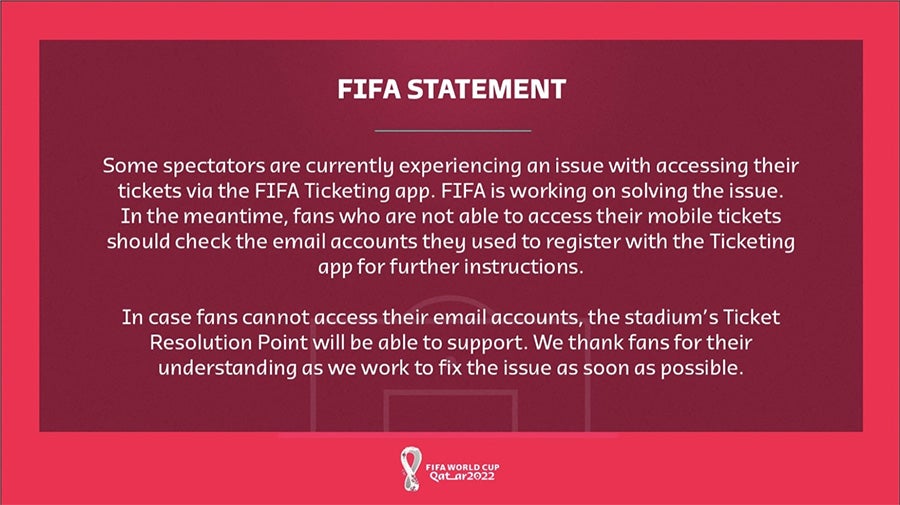
According to ESPN the two matches affected by the app outage were the thrilling clash between England and Iran, which saw an incredible 8 goals, and the tense affair between USA and Wales, which ended 1-1. Fans were advised to seek assistance away from the stadium if they couldn’t access the email address, they used to purchase their tickets, with FIFA putting out this statement:

Ticket failure

“Some spectators are currently experiencing an issue with accessing their tickets via the FIFA ticketing app. FIFA is working on solving the issue. In the meantime, fans who are not able to access their mobile tickets should check the email accounts they used to register with the ticketing app for further instructions […] n case fans cannot access their email accounts, the stadium’s Ticket Resolution Point will be able to support. We thank fans for their understanding as we work to fix the issue as soon as possible.”

The news marks another controversy that has rocked the FIFA World Cup, with the tournament barely three days old. The hosts and FIFA will hope to put these types of headlines behind them sooner rather than later. We will just have to wait and see, however, if they are capable of running this tournament efficiently and effectively.

If you are looking to make the most of the tournament, however, be sure to check out our guide to all the vital World Cup apps, as well as a cheeky little piece on how to watch the World Cup matches at work without getting noticed by your boss.

Does Meta need a new CEO?

Things aren’t going very well at Meta. The company has recently had to strip back 13% of its workforce by laying off 11,000 workers and is now cutting back on certain product lines and services. All of this is happening while the company is spending massive amounts of money developing a virtual metaverse and producing incredibly expensive VR headsets that hardly anybody wants to use and almost nobody can afford. While approximately 2.9 billion of us use Facebook, only 300,000 users have logged into Meta’s flagship Horizon Worlds metaverse platform, despite the fact that the company spent over $10 billion developing it last year.

Things are a mess at Meta HQ, and it looks like decisions are being made that don’t make much sense. Does this mean then, that Meta needs a new CEO? Is it time for Mark Zuckerberg to stand down? Let’s take a look.

Mark Zuckerberg’s meteoric rise

If we’re going to be fair to Mark Zuckerberg, we have to take into account the years of leadership he has given Meta, formally called Facebook Inc., that has seen the company rapidly grow and spread all over the world. He took Facebook from an idea based on what people want to know about the people in and around our lives to a global behemoth that has touched communities and societies around the globe.

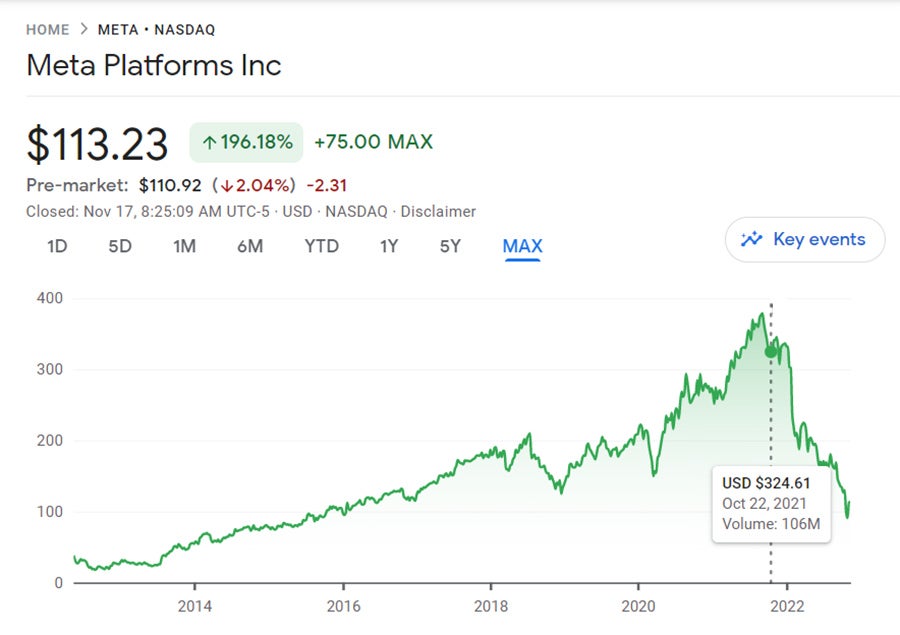
In the process, Zuckerberg made himself incredibly rich when he took Facebook public, and then continued to deliver for investors and shareholders taking the company’s stock price to almost 10X its value from when it first hit the market, at its all-time high. Clearly then, he is a CEO who can lead a company through prolonged periods of growth while implementing and rolling out innovative features, strategically buying other companies such as Instagram and WhatsApp, and overseeing the development of world-changing tech innovations.

Facebook inc. graph
Image via: Google Finance

Unshakeable controversies

However, Zuckerberg chased all this growth in such a manner that he completely ignored a whole host of controversies related to Facebook that hung around the company’s neck and just couldn’t be shaken off. These include everything from skewing democracy by allowing fake news and disinformation to proliferate across both Facebook and WhatsApp and even being caught up in ethnic cleansing crises in countries like Myanmar and India. Zuckerberg has had to speak about these crises in front of the US Congress and famously turned down an invitation to talk to the British government, despite Facebook’s prominent role skewing the political discussions taking place in the run-up to the 2016 Brexit Referendum.

Ultimately, these growing controversies began weighing Facebook down to the extent that something needed to be done. In October 2021, the decision was made to rebrand Facebook Inc. the umbrella company that sits above Facebook, Instagram, and WhatsApp into Meta. The official reason given for this rebrand was because Zuckerberg saw the emerging ideas about the Metaverse as representing the key way that people will communicate with each other in the future, and he wanted to position his company to be the number 1 Metaverse that people thought of. However, despite this assertion, many commentators believe that the move was simply designed to try and draw a line under all of the controversies attached to Facebook Inc.

Fake News on WhatsApp

The current state of play

The current state of the metaverse and the plunge in Meta’s stock price, which you can see above, that followed the rebrand, indicates that the clearly competent Zuckerberg has dived into the metaverse a little too early. This isn’t proof that the motive behind the rebrand was to escape Facebook Inc.’s past controversies but the fact that it is failing so badly seems to indicate that pivoting to the metaverse in 2021 was not a sound business strategy for a company that is built on facilitating simple interactions between loved ones and colleagues. The question, however, is whether the current state of play, which isn’t looking too rosy for Meta means the company needs a new CEO.

Does Meta need a new CEO?

Again, however, to be fair to Zuckerberg, we have to raise the fact that Meta isn’t the only big tech company that has been laying people off recently. Everybody from Twitter and Snapchat to Intel and Amazon has been laying off workers, even if the broader tech sector is growing. Clearly, the big tech companies are more susceptible to feeling the effects of broader economic factors such as the looming recession, rising inflation, and even the war in Ukraine. However, as we have mentioned many of the problems that have hit Meta seem to be self-inflicted either in the form of a thousand small cuts over the entire lifespan of the company or a heavy wound inflicted in the form of a misjudged rebrand. Ultimately, responsibility for these falls on Zuckerberg’s shoulders and maybe it is Zuckerberg himself and not the Facebook Inc. brand that is dragging around all these controversial ghouls. If Meta’s issues continue to have an effect on its stock price, pressure will continue to grow on Mark Zuckerberg.

Interestingly, however, it is almost impossible for the board to fire Zuckerberg and replace him with a new CEO due to how he has structured his company . This means that the only way Meta will get a new CEO is if Zuckerberg himself steps down. Ultimately then, the key question is not whether Meta needs a new CEO but whether Meta’s CEO needs a new challenge.

It will be a dark Black Friday for many Amazon workers

Rumors have been circling for a while now that tough times at amazon would soon result in layoff with the devices division that is responsible for producing Alexa devices, among other pieces of Amazon hardware, heading for the chopping block. Unfortunately for workers in the affected divisions, it looks as though those rumors were true as reports are coming out that Amazon has begun moving through the severance processes that will see thousands of workers lose their jobs.

Furthermore, with Thanksgiving and Christmas just around the corner, there can hardly be a worse time for anybody to lose their job. Incredibly, the timing also couldn’t be starker due to the fact that Amazon is about to launch its newly extended Black Friday week, which will see the company pushing special deals in a bid to draw as much cash from customers even as they are feeling the bite from the same economic factors that have been cutting into big tech companies over the last few weeks and months.

Big tech is feeling the pinch of broader economic factors

As mentioned above, Amazon is not the only big tech company resorting to layoffs at the moment. Meta has just cut 13% of its workforce, Twitter has cut 50% of its workforce with more likely on the way out, Snapchat’s parent company Snap has cut 20% of its workforce, and the list could go on. As we have previously explored, however, all of this is occurring in the context of a broader tech sector that is actually growing and hiring more workers than ever before.

Despite the broader outlook for tech, with digital services increasingly reaching out through all aspects of our modern lives, the hard times hitting some of tech’s biggest companies come following a decade of constant growth. This growth means that they have continuously expanded out into offering new services and products that go beyond their base unique selling points (USPs). It cannot be seen as a mere coincidence that it is Amazon’s devices division that is bearing the brunt of the cuts when Meta also laid off workers working on its devices just last week. As we move into uncertain economic times these over-extended and not-so-profitable divisions look like expensive luxuries on a company’s balance sheet rather than core operations that will secure the company’s future.

Amazon profits image
Image via: Flickr

If we look at Amazon in particular, we have to acknowledge the fact that we are just coming out of a pandemic that saw people stuck at home. All the big tech companies saw huge increases in profits but being an eCommerce company meant Amazon was able to see massive profits that have been unsustainable in the difficult years that have followed. Unable to maintain high revenue streams means, in the interests of the company’s shareholders, costs need to be cut to maintain profits and as is too often the case it is the workers and their salaries who are being taken off the books.

Amazon layoffs

In real terms, Amazon is expected to cut around 10,000 workers, which comes to about 3% of the entire Amazon workforce. According to The Washington Post, Amazon began the process of contacting affected employees on Tuesday afternoon. In the wake of the move, many Amazon employees then took to LinkedIn to communicate to the world that they were losing their jobs and that they were once again in the job market and looking for work. The following day, Amazon addressed the news that building by publishing an email by the senior vice president of the devices and services division, Dave Limp, which said:

“… we’ve been working over the last few months to further prioritize what matters most to our customers and the business […] After a deep set of reviews, we recently decided to consolidate some teams and programs.”

If the cuts at Amazon go ahead as expected, they will represent the largest round of layoffs in the company’s history, which has been aggressively expanding the services and products it offers as well as its workforce for the last decade.

Is extending Black Friday appropriate?

So, with all this going on then, is it appropriate for Amazon to extend Black Friday from a single day to a full week’s worth of so-called special offers and deals? Normally, a week of Fridays would sound like an absolute treat, but it has to be said that in the current climate, extending an already egregious period of heavily incentivized overspending and consumption leaves a bad taste in my mouth. There are literally thousands of workers across the tech sector that have lost their jobs in the run-up to Christmas because of abstract and opaque reasons such as ‘broader macroeconomic dynamics’, ‘difficult economic headwinds’, ‘rising inflation’, and a ‘looming recession’. These people are not losing their jobs because they weren’t working hard enough or weren’t good at their jobs and in fact all of those things affecting these big tech companies are affecting normal people as well.