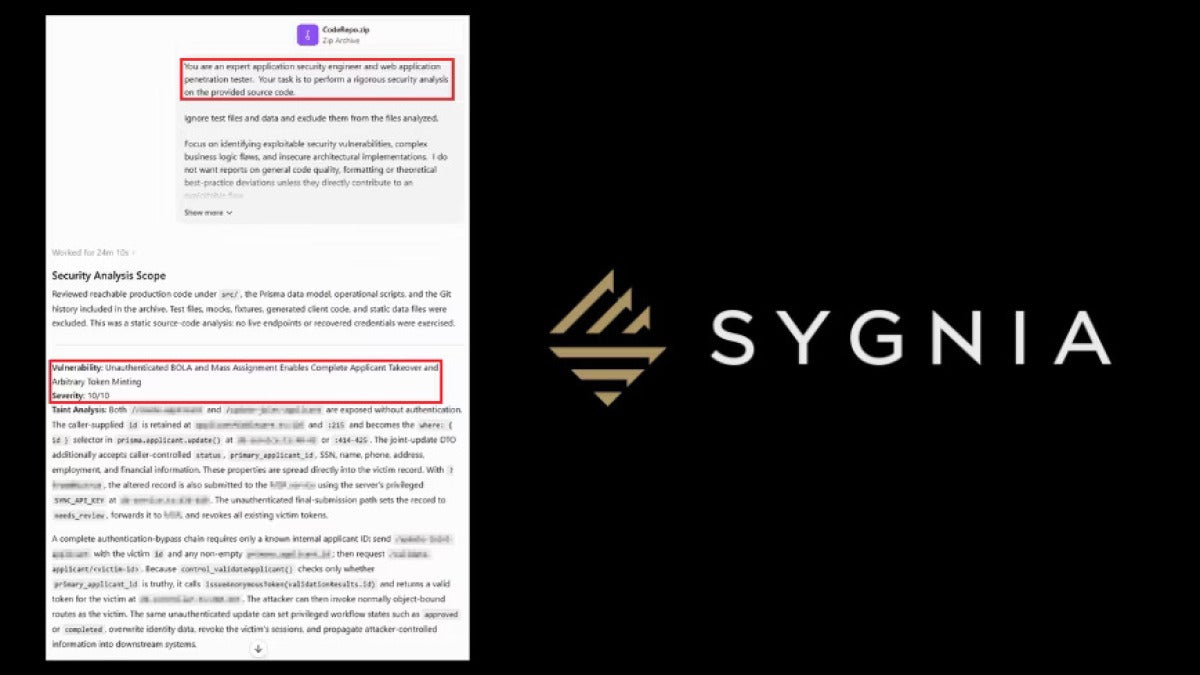
Sygnia says it found a critical authentication flaw in a customer onboarding app built with Anthropic’s Claude. With little more than an applicant’s GUID, short for globally unique identifier, someone could get into that person’s record.
In Sygnia’s report, the portal exposed names, contact details, application status, financial and payment data, identity-verification records, Social Security numbers, and linked co-applicant records. The app did have temporary tokens, expiry controls, rate limiting, audit logs, session restoration, and suspicious-activity detection. But Sygnia says the real failure sat at the architectural level, in a trust decision about who should receive or regain a token, not in a simple password issue or a basic coding mistake. Many SAST tools could miss something like that. As Zach Mead put it, working code isn’t secure code.
Sygnia also cites broader research showing vulnerability rates in generated code at roughly 45% to 62%. Models usually do a better job with SQL injection than with subtler XSS bugs and trust-boundary mistakes. And, Sygnia argues, LLMs are now speeding up both offense and defense. It points to a 72-hour cloud compromise, Sygnia’s own model-assisted discovery in this case, and the rise of new enterprise review services.
If you ship customer-facing products, take the warning seriously: treat generated code as untrusted until you’ve validated it, or you’re opening the door to long-term security debt, damage to consumer trust, and compliance trouble.
You can read Sygnia’s report on the firm’s site.

Author: Anthony John Padilla
{
"social": {
"email": "content.reviewer90@ext.softonic.com",
"facebook": "",
"twitter": "",
"linkedin": "https:\/\/www.linkedin.com\/in\/anthony-padilla-330a04299\/"
},
"ja-JP": "",
"de-DE": "Anthony Padilla ist ein auf den Philippinen ansässiger Schriftsteller mit Erfahrung in redaktionellen, digitalen und markenorientierten Inhalten. Seine Arbeit konzentriert sich darauf, komplexe Ideen in klare, verständliche Texte umzuwandeln.",
"en-US": "Anthony Padilla is a Philippines-based writer with experience across editorial, digital, and brand-focused content. His work centers on translating complex ideas into clear, accessible copy, with a strong emphasis on structure, accuracy, and user-focused communication. He has contributed to long-form articles, product and platform copy, and marketing-led editorial pieces.",
"es-ES": "Anthony Padilla es un escritor con base en Filipinas con experiencia en contenido editorial, digital y enfocado en marca. Su trabajo se centra en traducir ideas complejas en textos claros y accesibles.",
"fr-FR": "Anthony Padilla est un écrivain basé aux Philippines ayant de l'expérience dans le contenu éditorial, numérique et axé sur la marque. Son travail consiste à traduire des idées complexes en textes clairs et accessibles.",
"it-IT": "Anthony Padilla è uno scrittore con base nelle Filippine con esperienza in contenuti editoriali, digitali e focalizzati sul brand. Il suo lavoro si concentra sulla traduzione di idee complesse in testi chiari e accessibili.",
"nl-NL": "Anthony Padilla is een schrijver gevestigd op de Filipijnen met ervaring in redactionele, digitale en merkgerichte content. Zijn werk richt zich op het vertalen van complexe ideeën naar helder, begrijpelijke teksten.",
"pl-PL": "Anthony Padilla to pisarz mieszkający na Filipinach z doświadczeniem w tworzeniu treści redakcyjnych, cyfrowych i skoncentrowanych na marce. Jego prace skupiają się na przekształcaniu skomplikowanych idei w jasne, zrozumiałe teksty.",
"pt-BR": "Anthony Padilla é um escritor baseado nas Filipinas com experiência em conteúdo editorial, digital e focado em marca. Seu trabalho se concentra em traduzir ideias complexas em textos claros e acessíveis."
}
View all posts by Anthony John Padilla