How many times have you wanted to write the proper name of a city or a friend and the autocorrector changed it without asking you first. For example, the name Raúl, very common in the Spanish-speaking world, is always corrected by Apple to Raül, a name that doesn’t even exist.
Well, now people whose names are misinterpreted by autocorrect have urged technology companies to solve the problem once and for all.
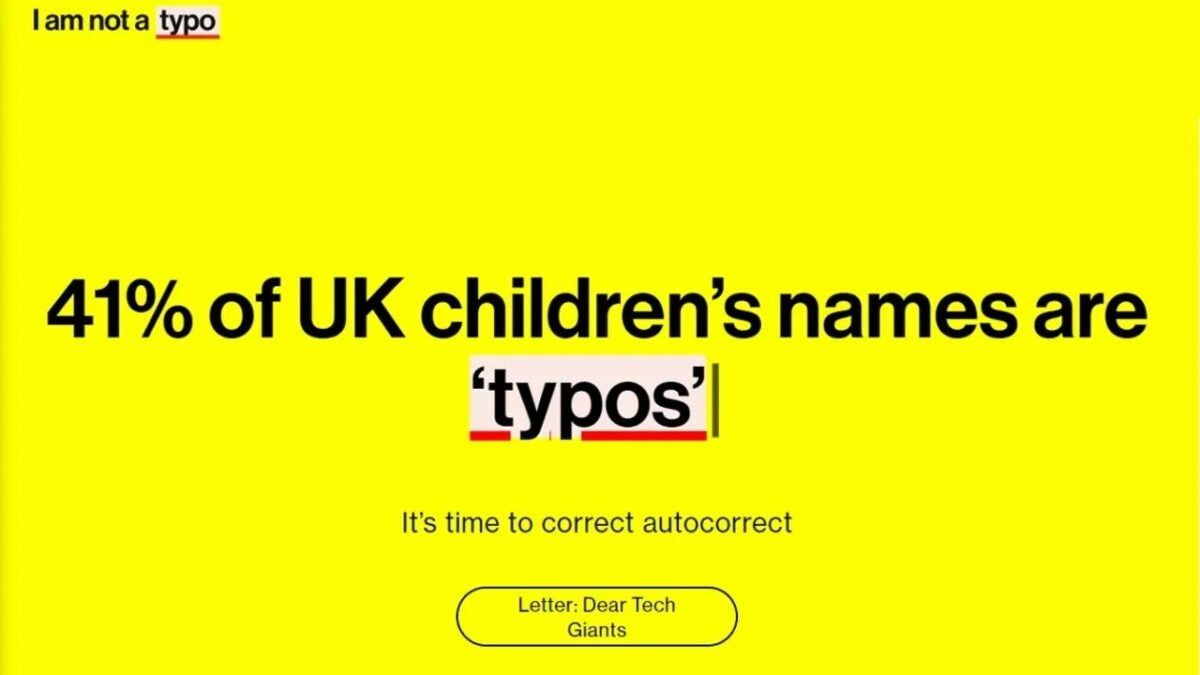
People with Irish, Indian, and Welsh names are some of those who are demanding improvements in the systems that work on phones and computers as part of the campaign “I am not a typographical error”.
For a more inclusive technology
“It is important for technology to be more inclusive,” says 34-year-old Savan-Chandni Gandecha to The Guardian, a British content creator of Indian origin whose name, which means monsoon moonlight, has been autocorrected to Satan.
The campaign has calculated that four out of ten baby names born in England and Wales in 2021 were considered “incorrect” or “unacceptable” when checked in the Microsoft English dictionary.
Dhruti Shah, a journalist, has supported the campaign after seeing how her name was autocorrected to “Dirty” and “Dorito”. “My first name is not even that long – only six characters – but when it appears as an error or is misunderstood and considered an unknown entity, it’s like saying that it’s not just your name that is wrong, but it’s you,” she explains.
The campaign group – created by a group of people working in the creative industries of London – wrote an open letter to tech companies, pointing out that between 2017 and 2021, 2,328 people were born named Esmae, compared to 36 Nigels. Esmae autocorrects to Admar, while Nigel remains unchanged.
“There are so many diverse names in the global majority, but autocorrect focuses on Western and white names,” says Gandecha.
Microsoft has already released an inclusive spell checker in its Office 365 software, which can be activated to ask the user, for example, to change “director” to “principal”, “maestro” to “expert” and “mano de obra” to “workforce”.
Last year, People Like Us, a non-profit organization, carried out a billboard campaign that highlighted the bias of the autocorrect in favor of British heritage and related the issue to the ethnic wage gap.
Karen Fox, whose children are named Eoin and Niamh, said about autocorrect: “The red line bothers me: I didn’t choose the ‘wrong’ name for my child. Tech companies update dictionaries with slang all the time and I think it should be something easy to do and definitely a priority.”
