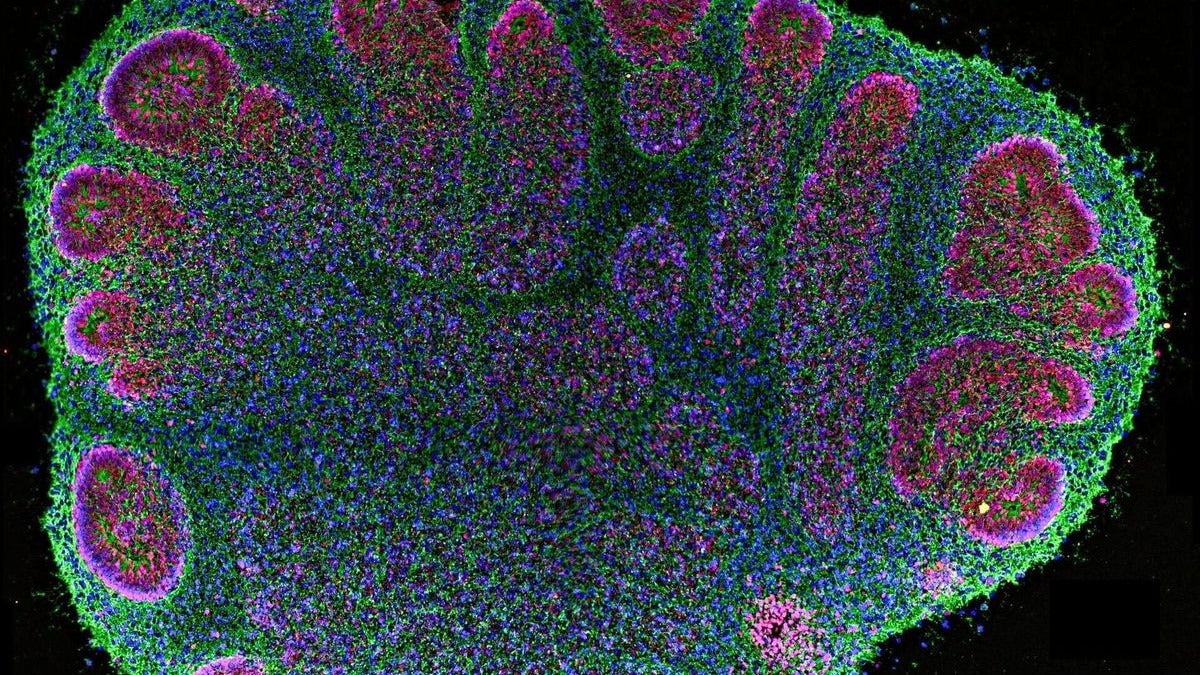
A newly published brain organoid study fed Braille letter patterns from a tactile sensor into lab-grown human neural tissue, and the tissue sorted them by letter class.
If you follow biocomputing, this paper is worth downloading. Liu’s point wasn’t that the organoids were reading Braille in any human sense. What makes the result interesting is that living neural networks were taking in real-world sensory signals and doing something measurable with them.
The team trained stem-cell-derived organoids on all 26 Braille letters. One 10,000-neuron organoid reached 61% accuracy. An ensemble of three got to 83%, which suggests some gain from distributing the task, though it’s still well short of anything you’d call reliable.
The setup itself is part of the story. The researchers scanned Braille dots with a tactile sensor, turned those patterns into electrical stimulation, and sent the signals into sub-millimeter organoids sitting on electrode arrays. Those arrays both stimulated the tissue and recorded its responses, so the whole system worked as a hybrid of touch hardware and wetware.
This falls into the larger organoid intelligence line of research. Earlier studies had organoids recognizing Japanese vowels and handling Pong-like tasks. Johns Hopkins University, Indiana University, and Brainoware have also reported learning, memory, speech recognition, and training times that were 90% lower than software, at least in some experiments, partly because, as those researchers argue, biological computing may be energy efficient.
The caveats are hard to miss. These organoids are tiny, less complex than actual brains, and unpredictable. Durability is still a problem. So are scaling and building in richer cell types. Then there are the ethics questions around consciousness, sentience, moral status, and the Baltimore Declaration. Read the paper online as a proof of concept, not as usable hardware yet.

Author: Jesús Pina
{
"social": {
"email": "",
"facebook": "",
"twitter": "",
"linkedin": ""
},
"ja-JP": "",
"de-DE": "Jesús Pina verfolgt, was künstliche Intelligenz an der Software wirklich verändert, die wir täglich benutzen — und trennt dabei, was schon funktioniert, von dem, was bisher nur eine Ankündigung ist. Ihn interessiert die praktische Wirkung: welches Werkzeug echte Zeit spart, welches auf halbem Weg stehen bleibt und welches man sich vor der Installation zweimal ansehen sollte. Er arbeitet täglich mit KI-Modellen mitten im redaktionellen Prozess von Softonic und kennt deren Grenzen deshalb recht genau.",
"en-US": "Jesús Pina follows what artificial intelligence is actually changing in the software people use every day, telling apart what already works from what is still only an announcement. What interests him is the practical effect: which tool saves real time, which one stops halfway and which one deserves a second look before you install it. He works daily with AI models inside Softonic's own editorial process, so he knows their limits fairly well.",
"es-ES": "Jesús Pina sigue lo que la inteligencia artificial está cambiando de verdad en el software que usamos cada día, separando lo que ya funciona de lo que por ahora solo es un anuncio. Le interesa el efecto práctico: qué herramienta ahorra tiempo real, cuál se queda a medias y cuál conviene mirar dos veces antes de instalarla. Trabaja a diario con modelos de IA dentro del propio proceso editorial de Softonic, así que conoce bastante bien sus límites.",
"fr-FR": "Jesús Pina suit ce que l'intelligence artificielle change réellement dans les logiciels du quotidien, en distinguant ce qui fonctionne déjà de ce qui n'est encore qu'une annonce. Ce qui l'intéresse, c'est l'effet pratique : quel outil fait gagner du temps, lequel s'arrête à mi-chemin et lequel mérite un second examen avant installation. Il travaille au quotidien avec des modèles d'IA au cœur du processus éditorial de Softonic, et connaît donc assez bien leurs limites.",
"it-IT": "Jesús Pina segue ciò che l'intelligenza artificiale sta davvero cambiando nel software di ogni giorno, distinguendo quello che già funziona da quello che per ora è solo un annuncio. Gli interessa l'effetto pratico: quale strumento fa risparmiare tempo, quale si ferma a metà e quale conviene guardare due volte prima di installarlo. Lavora ogni giorno con modelli di IA dentro il processo editoriale di Softonic, e per questo ne conosce bene i limiti.",
"nl-NL": "Jesús Pina volgt wat kunstmatige intelligentie echt verandert aan de software die we dagelijks gebruiken, en scheidt daarbij wat al werkt van wat nog slechts een aankondiging is. Wat hem interesseert is het praktische effect: welke tool echt tijd bespaart, welke halverwege blijft steken en welke je beter twee keer bekijkt voordat je hem installeert. Hij werkt dagelijks met AI-modellen binnen het redactieproces van Softonic en kent daardoor hun grenzen vrij goed.",
"pl-PL": "Jesús Pina śledzi to, co sztuczna inteligencja rzeczywiście zmienia w programach używanych codziennie, oddzielając rozwiązania, które już działają, od tych, które są na razie tylko zapowiedzią. Interesuje go efekt praktyczny: które narzędzie naprawdę oszczędza czas, które zatrzymuje się w połowie drogi, a które warto sprawdzić dwa razy przed instalacją. Codziennie pracuje z modelami AI wewnątrz procesu redakcyjnego Softonica, więc dobrze zna ich ograniczenia.",
"pt-BR": "Jesús Pina acompanha o que a inteligência artificial está realmente mudando nos programas que usamos todos os dias, separando o que já funciona do que ainda é apenas anúncio. O que lhe interessa é o efeito prático: qual ferramenta economiza tempo de verdade, qual para no meio do caminho e qual merece uma segunda olhada antes de instalar. Trabalha diariamente com modelos de IA dentro do próprio processo editorial da Softonic, e por isso conhece bem seus limites."
}
View all posts by Jesús Pina