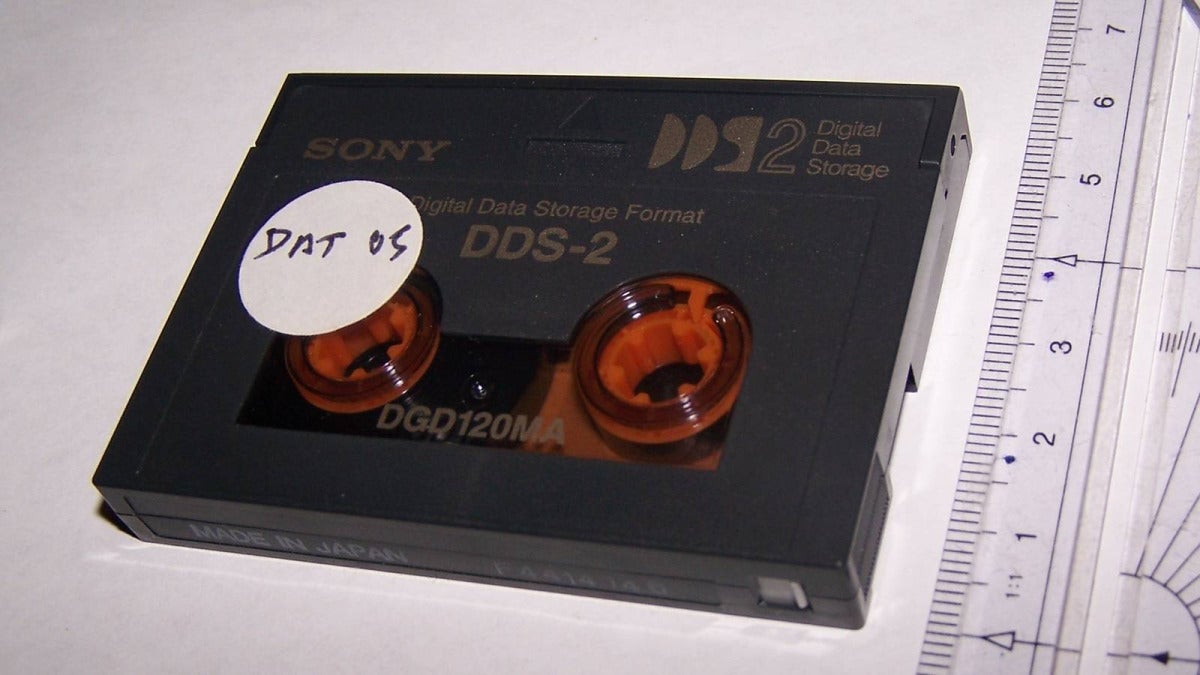
Sony launched Digital Audio Tape, or DAT, in 1987. It was supposed to be the digital heir to the compact cassette, offering CD-quality recording in a small, portable shell that looked like it might change the way people recorded music.
It sounded like the future on paper, but consumers never really embraced it. DAT machines were expensive, and record labels pushed copy controls like the Serial Copy Management System (SCMS). Professional audio went a different way. Studios and field recordists adopted DAT for its clarity and portability, even with the fragile helical-scan mechanism and the fact that tapes recorded on one machine didn’t always play back cleanly on another.
DAT ended up mattering much more in another role, when the same tape technology was turned into Digital Data Storage (DDS). That gave IT departments a compact backup format that started at roughly 2GB uncompressed and grew to 20GB by DDS-4 at the end of the 1990s.
The cartridges were small, easy to carry off-site, and well suited to disaster recovery. For a lot of IT teams, DAT became a familiar, fairly affordable backup workhorse before growing data volumes pushed companies toward Digital Linear Tape (DLT) and later Linear Tape-Open (LTO).
When people talk about forgotten formats, DAT is easier to remember for the server backups it quietly handled than for the music revolution it never pulled off.
Sony ended DAT hardware in 2005, but the format’s legacy is still easy to spot in tape systems like LTO, where air-gapped storage still has real value against ransomware.

Author: Jezca Felarca
{
"social": {
"email": "",
"facebook": "",
"twitter": "",
"linkedin": ""
},
"ja-JP": "",
"de-DE": "Jezca Felarca ist Content-Writerin mit Erfahrung in der Bewertung von PC-Software, mobilen Anwendungen und digitalen Diensten. Sie erklärt technische Themen auf verständliche Weise für ein breites Publikum.",
"en-US": "Jezca Felarca is a content writer experienced in reviewing PC software, mobile applications, and digital services. She brings clarity to technical topics, making them accessible for a broad audience.",
"es-ES": "Jezca Felarca es redactora de contenidos con experiencia en la evaluación de software para PC, aplicaciones móviles y servicios digitales. Hace accesibles los temas técnicos para todo tipo de público.",
"fr-FR": "Jezca Felarca est rédactrice de contenu expérimentée dans l'évaluation de logiciels PC, d'applications mobiles et de services numériques. Elle rend les sujets techniques accessibles à un large public.",
"it-IT": "Jezca Felarca è una content writer esperta nella valutazione di software PC, applicazioni mobili e servizi digitali. Rende i temi tecnici accessibili a un pubblico vasto e variegato.",
"nl-NL": "Jezca Felarca is een content writer met ervaring in het beoordelen van pc-software, mobiele applicaties en digitale diensten. Ze maakt technische onderwerpen toegankelijk voor een breed publiek.",
"pl-PL": "Jezca Felarca jest doświadczoną content writerką w zakresie recenzji oprogramowania PC, aplikacji mobilnych i usług cyfrowych. Sprawia, że tematy techniczne stają się przystępne dla szerokiego grona odbiorców.",
"pt-BR": "Jezca Felarca é redatora de conteúdo com experiência em avaliações de software para PC, aplicativos móveis e serviços digitais. Ela torna temas técnicos acessíveis para o público em geral."
}
View all posts by Jezca Felarca