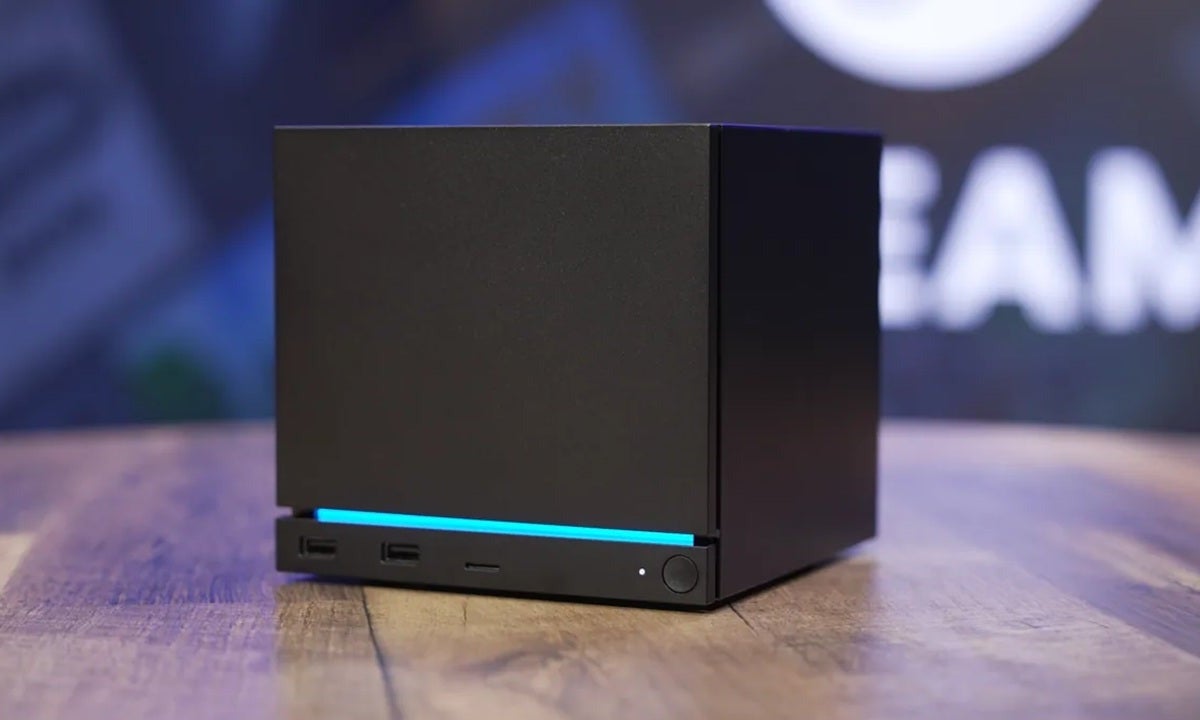
Valve dropped the Steam Machine on June 22 with no warning, and the first detail that made people do a double take was the price. Based on the configurations Valve announced, this living-room gaming PC starts at €1,039 without a controller and climbs to €1,428, which makes it hard to tell who, exactly, it’s supposed to be for.

Valve is one of the most admired companies in gaming. Every publisher has good stretches and bad ones, and most of them have a hard time earning real affection from players. Valve has always sat a little outside that pattern.
Everyone likes Steam. Nobody has much of a bad word for Half-Life, Portal, or Left 4 Dead. There’s a broad feeling that gaming would be poorer without Valve, and while Steam’s business practices do get fair, repeated criticism in some areas, the pushback is nowhere near as constant or as heated as it is for almost any other company. Not even Nintendo, which has one of the most devoted and vocal fan bases in the business, has managed to build that kind of almost universal goodwill.
That doesn’t mean Valve always gets it right, or that every decision it makes should get a free pass. Valve can read the market wrong, miss problems until they’re right in front of it, and make bad calls. Valve can even trip over itself in ways nobody sees coming.
It’s happened before, though never in a way that really put the company in danger. This time, though, Valve may have stepped into something bigger than it expected. The Steam Machine looks nothing like what people had in mind.
A machine with no clear audience
Valve says the entry-level Steam Machine starts at €1,039, comes with 512 GB of internal storage, and doesn’t include a controller. There are four versions in total. The priciest model, which comes with 2 TB of storage and the Steam Controller, costs €1,428. So the first question is pretty simple: is it worth that kind of money?
On paper, the specs don’t do much to justify the sticker shock. Valve says the Steam Machine uses a 6-core AMD Zen 4 processor, AMD RDNA 3 graphics, 16 GB of DDR5 RAM in a single stick, and 8 GB of GDDR6 VRAM.
In real-world terms, the closest comparison is a standard PlayStation 5, and not even a PS5 Pro. Right now, Sony lists the standard PlayStation 5 at €589, controller included. That’s a little over half of the €1,108 Valve asks for the cheapest Steam Machine bundle with a controller.
Put it next to other PCs and the gap doesn’t look quite so brutal. Building something with roughly the same specs would land somewhere around €900 in parts, so the Steam Machine’s price isn’t pulled out of thin air.
Against current hardware prices, it more or less makes sense, especially if what you’re buying is a prebuilt system with Valve handling assembly and quality control. But here’s the hitch. Valve is packaging this as a console-style device for the living room, even though it’s still a PC underneath. Once you frame it that way, people are going to judge it against consoles.
And that’s where it starts wobbling. Most people who’d been waiting on a Steam Machine weren’t trying to replace their desktop PC. They wanted something that could take the place of a console. The pitch was supposed to be easy to grasp: a gaming PC for the TV that behaves like a console. Right now, it’s hard to argue Valve has really nailed that.
Expectations that don’t hold up
The Steam Machine’s biggest problem is straightforward enough. At this price, you can buy whichever current console you want. In some cases, more than one.
At current retail prices, what you’d spend on the Steam Machine alone could realistically get you a PlayStation 5 or an Xbox Series X|S and still leave room for a Switch 2. And once you factor in that Nintendo’s machine costs less than half of Valve’s new system, delivers similar or better performance, and also doubles as a handheld, it’s tough to point to a clean, obvious advantage for Valve here.
There is one advantage, to be fair: Steam itself. The Steam Machine stands or falls on the strength of its library. Your Steam games are already waiting for you, and the idea of playing them from the couch is a real draw.
Still, how far does that draw actually go? Given the Steam Machine’s limited horsepower, a lot of AAA games aren’t going to run as well as they should. And the next wave of big releases is likely to look better on competing hardware than it does on Valve’s box.
That’s the issue more than anything else: nobody can quite pin down what the Steam Machine is for. It’s a convenience machine for people who want a console-like PC hooked up to their TV so they can play the Steam library they already own, even if that doesn’t mean the newest releases or the most demanding games, and it still costs much more than every other console on the market.
Then there’s the part that’s harder to ignore. In many of the countries where Valve plans to sell the Steam Machine, the price sits above not just most people’s rent or mortgage, but even the monthly minimum wage.
So what could Valve have done instead? Two obvious options come to mind: subsidize it, or wait. Valve could’ve launched it at €700 or €800, taken the loss on each unit, and used the boost to its image to present it as a much more serious alternative to the other consoles.
The other path would’ve been patience. Valve could’ve held the launch until 2027, waited to see whether the component crisis cooled off, and brought the price down to something easier to swallow. In that version of events, the launch price wouldn’t be hanging over the whole product the way it is now.
Nobody can say with certainty whether the Steam Machine will land or flop. What is already clear is that it’s an expensive piece of hardware with no sharply defined audience.
The Steam Machine may still carve out a market for itself, but right now almost everything around it is working against it. From where things stand today, Valve hasn’t made a particularly smart move with the Steam Machine.
