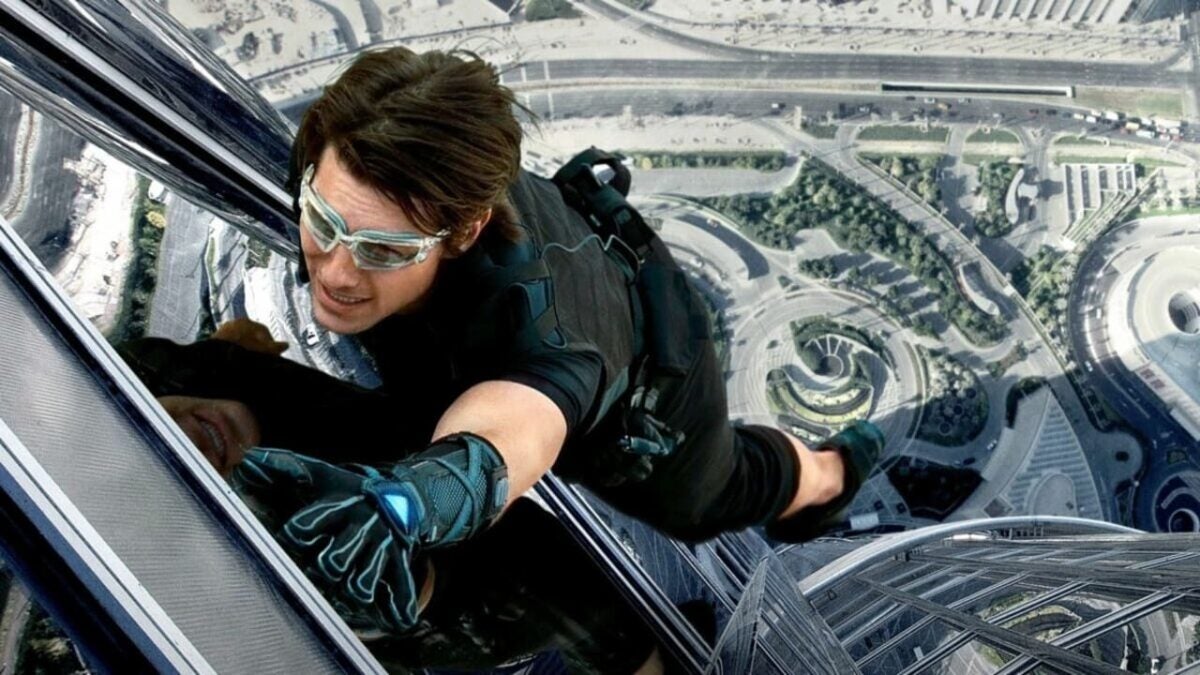
Nothing is impossible for Tom Cruise. Not even a mission labeled as impossible. That’s something he’s already proven to us on six different occasions over three decades, determined to prove it to us soon with a new installment of the Mission: Impossible franchise. Because if Ethan Hunt had been any other actor than Cruise, the Mission: Impossible Force wouldn’t have lasted this long.

That’s why we have decided to make a ranking from worst to best with the Mission: Impossible movies. A mission not as difficult as those usually undertaken by the most valuable IMF cash, but that has brought us more than a headache, because it is really difficult to decide which of these missions did not go as well as they should. But following the noble example of Tom Cruise, here we bring you our list, not letting any mission daunt us, no matter how impossible it may seem.
Mission: Impossible III
J.J. Abrams’ arrival to the franchise marked his directorial debut and what is probably the franchise’s lowest moment. Released in 2006, the film begins in medias res with Ethan Hunt in a life or death situation, where after everything takes seemingly the worst possible course of events, we see how he got there. The problem is that until we get to that situation we have to witness a film with a lethargic pace, a strange obsession with jumping from one country to another without much apparent reason and all that feels like a mere excuse to get to what the beginning of the film had promised us.
What could this be due to? Perhaps to the fact that the film suffered numerous delays due to creative problems. The first director was David Fincher, who left in favor of another film citing creative differences over the direction the franchise was taking, and then came Joe Carnahan, who left after fifteen months of work due to a dispute over the tone of the film. All of that could explain the film’s problems and why, at the end of the day, J.J. Abrams would end up signing the franchise’s flimsiest and most personality-less installment.
Mission Impossible 2
If Mission: Impossible 2 is to be defined in any way, the best way to do it is with an adjective. That adjective is “delirious”. In this installment, Ethan has to face a group of international terrorists who have seized a dangerous virus capable of causing a pandemic that could destabilize the world powers. From this point on, we must understand that the film offers us a constant delirium. Insane action scenes, an absolutely masterful chase, the most absurd use of all kinds of machinery ever seen in the saga, and villains who like themselves almost as much as Tom Cruise does.
Its biggest drawback is that, in a saga made by and for Tom Cruise, it is a film where the director, John Woo, shines the most. Even though it is not among his best films, practically all the outstanding aspects of the movie fall on the immeasurable personality of the Hong Kong director. The insane action scenes, the introduction of humorous elements and the perfect mix of high voltage and calm moments are the director’s trademark. Unfortunately, much flatter characters and not very inspired performances make this Mission: Impossible 2, as a Mission: Impossible movie, cannot be appreciated as other more fortunate installments in that sense.
Mission Impossible: Rogue Nation
The fifth film in the series is in an odd place on this list. If we were being fair, it probably should be higher up, but if we’ve left Mission: Impossible 2 in the penultimate spot due to its lack of iconicity by not giving more weight to Tom Cruise, then it would be unfair for Secret Nation to be ranked higher than the next list for this film. Because while it’s true that Christopher McQuarrie was able to get the tone in the direction of the series, with a terrorist group looking to create a new world order and Ethan Hunt being the only one capable of stopping it, it’s no less true that the film doesn’t come off as immense and memorable as later installments.
At the end of the day, it feels more like a good jumping off point to build future installments of the franchise than a title that stands on its own. It works, it’s fun, it’s a spectacle, but it doesn’t feel as immense as its sequel or as particular as some of the previous installments. Something that leaves this Mission Impossible: Secret Nation in this strange, mid-table place.
Mission Impossible
You have to respect the classics. Mission Impossible is by far not Brian de Palma’s best film, but it is undeniably a Brian de Palma film. Its first twenty minutes could only have come from his mind, and anyone who says that the success of the franchise, and what the first film is so well remembered for today, is not due in part to the scene at the American embassy in Prague, would be lying. The other element it would be remembered for is the seemingly endless charisma of a young Tom Cruise and how he knew how to exploit it both in his relationship with the other actors and in some of the most memorable action scenes in movie history.
Its problem is that, by today’s standards, it is an oddly paced film, with scenes that are more tense than spectacular, where Tom Cruise is not an absolutely infallible hero, and which strays from what is the current Mission Impossible mythology. While both this film and the John Woo film set the stage for everything that would follow, and if we were to speak in terms of cinema alone they are the two best films in the franchise by far, they still don’t capture what the saga stands on today. That Tom Cruise makes the impossible possible.
Mission Impossible: Fallout
The latest Mission Impossible movie so far is a movie that knows everything the saga should be. Tom Cruise has the bulk of the lead and does things that are hard to believe are possible for a human being, even more so for a human being of his age, but he also signs an action movie where the characters and the things that happen to them matter.
In the end, Mission: Impossible – Fallout is a movie made by and for Tom Cruise. Everything revolves around him. The action scenes, the plot, the emotional moments. It almost seems to be more about him as an actor than Ethan Hunt as a character, and there comes a point when that’s not a problem. It’s his franchise. It’s his showcase. It’s the place where he shows up to prove what he’s capable of, and in Fallout he proves to us that he’s capable of continuing to define what modern action cinema should be. Action cinema in the image and likeness of Tom Cruise.
Mission: Impossible – Ghost Protocol
Fast paced, hard-hitting action scenes, high-tech gadgets, attractive people being attractive on screen and constant tension that leaves you on the edge of your seat. If that’s what we expect from Mission Impossible, Mission Impossible: Ghost Protocol is the film that manages to take it to a new level. In a way, creating the visual identity that all subsequent films will follow, and that J. J. Abrams would attempt to achieve, but fail in the attempt.
It is partly to the credit of the director, Brad Bird, best known for such notable films as The Incredibles or Ratatouille, but it is also because the film is built on the shoulders of giants. He drinks from the first two films without complexes, knows how to take what works from Mission: Impossible III, and give it a perfect wrapping that will define to a large extent everything that will be the action movies of the 00s and a good part of the 10s in Hollywood. A certain Michael Bay feel, although less chaotic; a much more marked militaristic tinge; and a hero who suffers to achieve what he does, but always survives, no matter how hard the circumstances are. Because that’s Mission: Impossible: a sample of how modern Hollywood action cinema has evolved.
Some of the links added in the article are part of affiliate campaigns and may represent benefits for Softonic.
