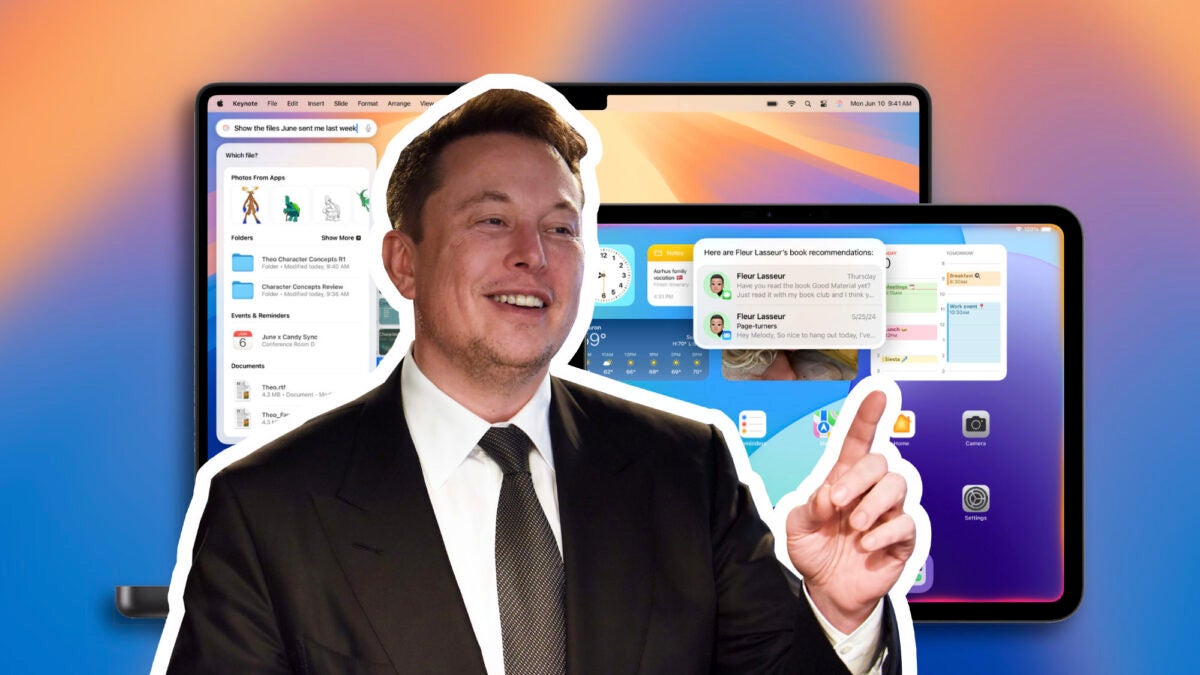
The recent announcement by Apple regarding the integration of ChatGPT into its operating systems iOS 18, iPadOS 18, and macOS Sequoia has been very well received. However, Elon Musk has expressed strong opposition to this integration, going so far as to threaten to ban the use of Apple devices in his companies. This reaction is somewhat surprising, especially if you carefully review the privacy measures and think about the functioning of said integration.

The privacy of Apple’s new artificial intelligence
Much of the attention at yesterday’s inaugural WWDC 2024 Keynote was focused on Apple Intelligence. It’s an artificial-intelligence system that permeates the entire system and helps users with tasks like text summarization, search, photo editing, creating Emojis, and much more. And when you need more power – for example, for complex queries – Siri can use ChatGPT for that, but only if you give it explicit permission.
Craig Federighi, Senior Vice President of Software Engineering at Apple, stated that users will have full control over when ChatGPT is used; furthermore, the data shared with OpenAI will not be stored permanently or used for training. The integration is designed to provide richer and more contextual responses without having to open the ChatGPT application.
One of Musk’s main concerns is data security. However, Apple has repeatedly emphasized that the data use will be minimal, will only be shared with the user’s explicit consent, and that these interactions are designed to be secure. OpenAI has stated that requests are not stored and users’ IP addresses are hidden.
Apple Intelligence is based on an approach that combines on-device processing and private cloud computing. As we’ve mentioned already, for more complex requests that require greater processing power, Private Cloud Computing extends the privacy and security of Apple devices to the cloud, unlocking more intelligence without compromising our privacy at any time. Apple has stated multiple times that independent experts are able to inspect the code running on Apple servers, verifying the privacy of its entire operation.
Elon Musk’s reaction
Despite these robust privacy measures, Elon Musk has expressed his opposition on his social platform X (formerly Twitter). Musk stated that “if Apple integrates OpenAI at the operating system level, Apple devices will be banned in my companies”. He argues that this represents an unacceptable security violation and compromises Apple’s ability to ensure the security of the data once it’s handed over to OpenAI.
Taking it one step further, Musk indicated that visitors would have to leave their Apple devices at the entrance, where they’ll be stored in a Faraday cage to prevent any data transmission. A rather extreme measure that seems to ignore the guarantees of privacy and security promised by Apple and OpenAI.
The most interesting thing about the situation is that Apple plans to support other AIs in addition to ChatGPT. Google Gemini is the first candidate, but Gork, Twitter’s AI, could also be one. Will Musk eventually oppose the use of all Apple devices in his companies?
Another interesting fact is that Apple devices have been able to communicate with ChatGPT for months. Since the launch of the app for this purpose, talking to ChatGPT is as easy as opening the app or using a Shortcut to do it directly through Siri. So, it’s striking that Musk has only now decided to speak out.
Elon Musk’s stance seems more like a quick reaction than an evidence-based evaluation. Apple has set a new standard for privacy in artificial intelligence, ensuring that user data is protected and that any interaction with ChatGPT is under explicit user control. The security measures implemented by Apple and the transparency they offer, combined with the fact that there are many other devices and means to access ChatGPT to request help or get information on photos and other content, raise many questions about Musk’s decision to ban them in his companies.
