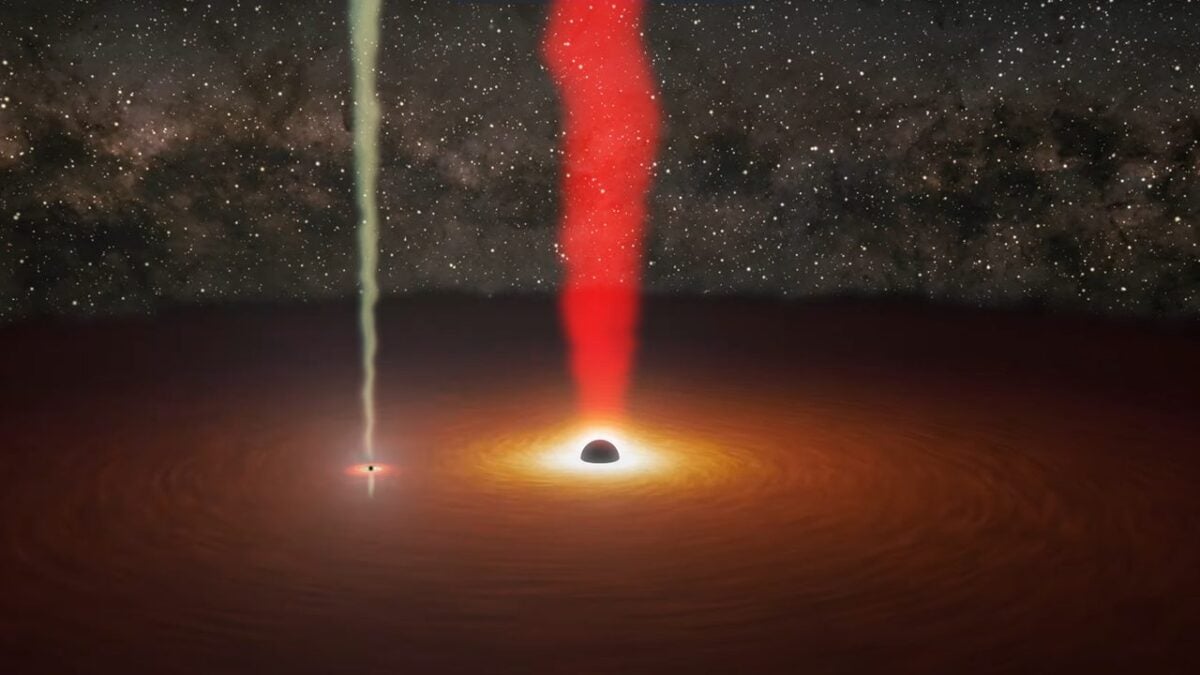
A team of astronomers has discovered a binary system of supermassive black holes in a galaxy located about 4 billion light-years away from Earth. The finding was made by the NASA spacecraft TESS, which observed how one of the black holes in the OJ 287 galaxy crossed the accretion disk of the other, creating a double quasar for a brief moment.

The quasar, an extremely active core of a distant galaxy, is the product of a supermassive black hole that consumes vast amounts of matter. Part of this matter is expelled in a magnetically collimated jet, creating an intense brightness when observed head-on known as a blazar.
The observations of the galaxy OJ 287, one of the closest examples of a blazar, date back to the late 19th century, being visible with a simple amateur telescope. Every 12 years, the brightness of OJ 287 intensifies, a phenomenon that Pauli Pihajoki, a doctoral student at the University of Turku, attributed in 2014 to the presence of a second, less massive black hole orbiting the primary in an elongated orbit.
Pihajoki also suggested that the secondary black hole could steal part of the matter from the primary’s accretion disk and produce its own quasar jet for a short period of time. This prediction was finally confirmed on November 12, 2021, when TESS detected a brightness increase in OJ 287, accompanied by observations from NASA’s Swift and Fermi gamma-ray telescopes. “Now we can say that we have ‘seen’ an orbiting black hole for the first time,” stated Mauri Valtonen from the University of Turku.

The observations also confirmed that the primary black hole has 18.35 billion solar masses (1 solar mass is equivalent to 332,946 times the mass of the Earth), while the secondary, much smaller, has “only” 150 million solar masses. In addition, it is known that the event produced as much energy as 100 average galaxies in 12 hours.
According to Achamveedu Gopakumar, from the Tata Institute of Fundamental Research in India, the smallest black hole could reveal its existence through nano-Hertz gravitational waves, which could be detected by pulsar timing systems in the coming years.
The mergers between supermassive black holes, which emit gravitational waves, are a key factor in their growth. Although these waves have a frequency too low to be detected by the Laser Interferometer Gravitational-Wave Observatory (LIGO), a new space detector, called LISA (acronym in English for “Laser Interferometer Space Antenna”), could observe these mergers in the future.
Source: Space.com
