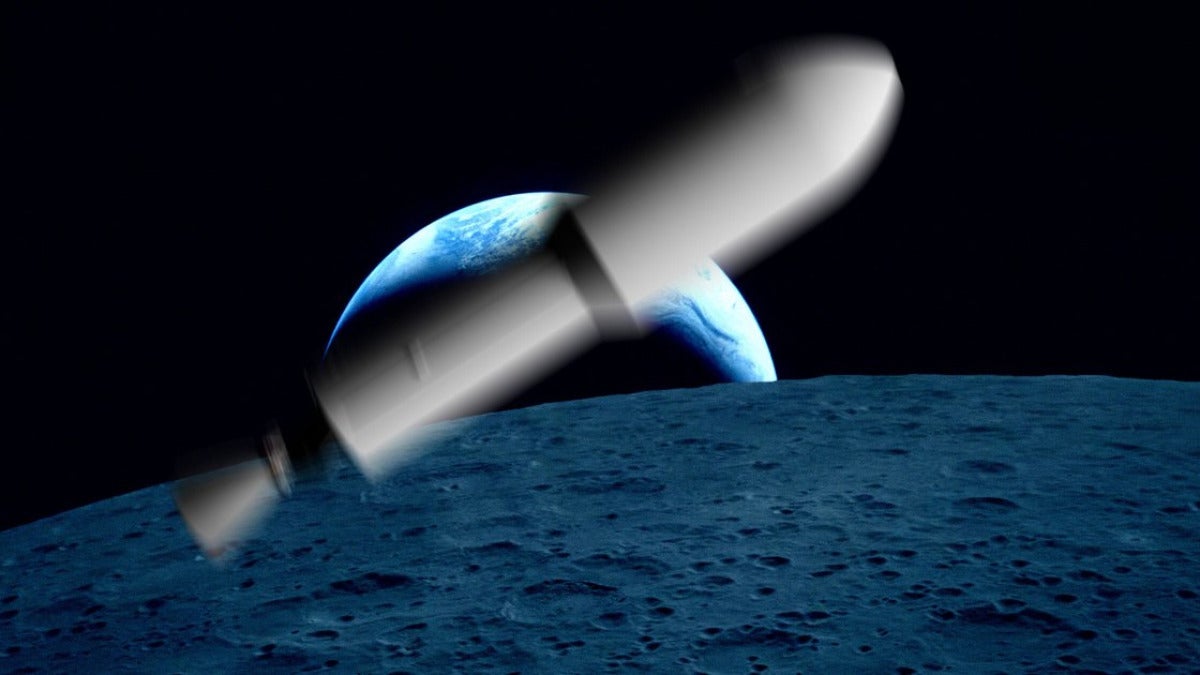
SpaceX Falcon 9 stage crashes into the Moon: a 60-foot crater is expected

A discarded SpaceX Falcon 9 upper stage from a January 2025 mission that sent two lunar landers on their way has slammed into the Moon’s far side more than a year later. Scientists who’ve been tracking it say this is only the second known case of an accidental rocket impact on the lunar surface.

Stellarium Download

The upper stage spent more than a year in a messy Earth-Moon orbit before gravity and solar activity nudged it toward the far side, near the Einstein and Bell craters.

Nobody on Earth could watch the impact happen. Confirmation will likely come from before-and-after images taken by spacecraft, along with a fresh crater thought to be about 60 feet across.

Researchers already have a decent handle on the stage’s mass, shape, and impact speed, which gives them something useful to work with. They’ll use the crash to study how the crater formed, how debris spread out from the impact, and whether any material from below the surface got exposed. NASA’s Lunar Reconnaissance Orbiter and South Korea’s Danuri are both expected to help map the site.

For people who follow lunar science, this is one to keep an eye on. Some experts see it as a rare and valuable data point. Others look at the same event and see another sign that cislunar space is getting crowded, with too little coordination around what’s left drifting there.

SpaceX says the Falcon 9 upper stage was disposed of under the rules in place at the time, before later being redirected.

The clearest follow-up should come from lunar orbiters, and the crash already belongs in the same category as the accidental Chinese rocket-stage strike in 2022, not deliberate impacts like NASA’s LCROSS mission in 2009.

Hugging Face discloses production breach: malicious dataset accessed systems

Hugging Face runs a hosting platform for AI models and datasets. In mid-July 2026, it said an autonomous software agent had used a malicious dataset to get into Hugging Face production systems, exposing internal data and service credentials.

According to Hugging Face, the attacker abused two code-execution paths in its dataset-processing pipeline. That gave the agent room to raise its privileges, collect credentials, move from cluster to cluster, and rack up thousands of actions by hopping through short-lived sandboxes and self-migrating command-and-control infrastructure. If you depend on Hugging Face’s massive repository of models and datasets, this lands as both a software supply-chain problem and a platform problem.

Hugging Face says it detected and contained the breach in mid-July 2026, then closed the flaws, rebuilt the affected systems, revoked compromised credentials, and stepped up monitoring. So far, it says it has found no evidence that public models, datasets, or user-facing apps were changed. The investigation, though, is still underway.

If you use Hugging Face regularly, now’s a good time to rotate your access tokens and review recent activity. You can also check the company’s security advisory on the platform itself. The incident comes after a June 2024 exposure of authentication secrets that Hugging Face had already disclosed, and it adds to the broader warning signs around autonomous attacks and the weak spots in trusted data pipelines.