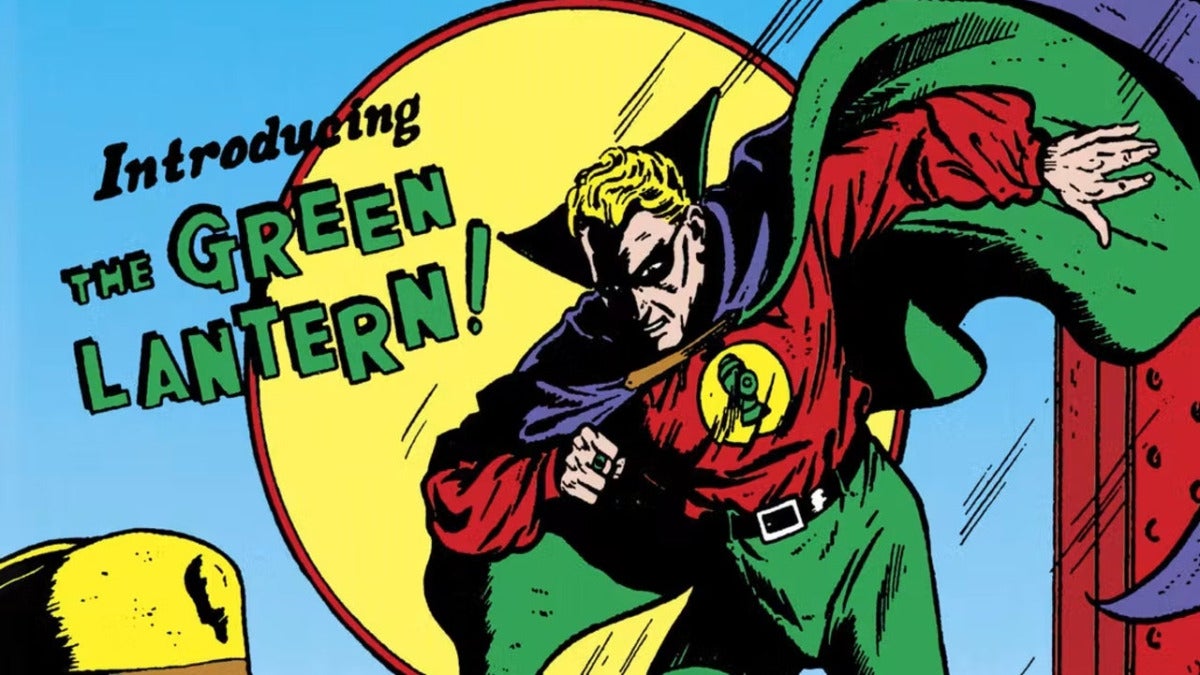
After Superman’s arrival in 1938, DC (well, National Allied Publications back then) changed its editorial direction completely: if people wanted superheroes, they’d get superheroes. Batman arrived in 1939, Flash followed shortly after, along with Hawkman and Hawkgirl, and little by little, with characters like Shazam, Catwoman or Lex Luthor, a pantheon of heroes worthy of being the new gods of Olympus was completed. And then, Green Lantern arrived.

In the darkest night…
In this comic-book stew where anything went if it was worth taking a chance on (and some truly aberrant things were done, by the way) the magazine All-American Comics was being published, where, indeed, anything could go: at first it was a children’s humor magazine, but little by little it became a bit more youthful thanks to characters like the one who debuted in issue 16 of the magazine: a certain Alan Scott, who possessed an immensely powerful ring, with powers from ancient China, that allowed him to fight evil as Green Lantern. No space base, no group of Lanterns, nothing: a man with a cape he made himself in red, green, purple, brown and yellow (yes, yellow, the color that traditionally weakens Green Lanterns). It was 1940, they didn’t know any better.
With the ring, Scott could do whatever he pleased, from flying to paralyzing his enemies, besides protecting him against metal objects (but not wood). He was a hit during the Second World War, and little by little, in the postwar period, he gave way to westerns. Alan Scott would live his last adventure in 1951, after twelve years, and no one remembered him again when Hal Jordan, in 1959, revived Green Lantern in a big way. His story contradicted Scott’s, his powers did too, and everyone acted, in the comics, as if no other Green Lantern had ever existed before. So they went with the easiest solution: yes, he existed, but on Earth-2, allowing him to make appearances here and there. Everybody happy?
DC became a mess of continuities, alternate earths, superheroes and powers, until they unified it all after Crisis on Infinite Earths. Now, Scott was in the same reality as Jordan, and he was still a veteran of the Second World War, except that his life had been magically extended. Ah! And he no longer used his ring, which gave him another codename: Sentinel. After that, editorial back-and-forth has taken him everywhere: he went back to Earth-2, became young again, went back to Earth-1’s reality… Anyway, a mess for which you have to read the comics and piece it together.
Over the years, Scott was married twice, had a son and a daughter… and in 2020, retroactively, we discovered that he’d been gay all along, thus making him, without a doubt, the first gay superhero in history. Marvel was doing the same with Bobby Drake, Iceman, and they had to catch up. That gave us something we probably won’t ever see in Lanterns: the story of a closeted man who got married, had children and struggled internally because he was gay… that we didn’t learn until 80 years later. That’s a long time to stay in the closet, even if you’ve got a lantern (green) to light your way.
