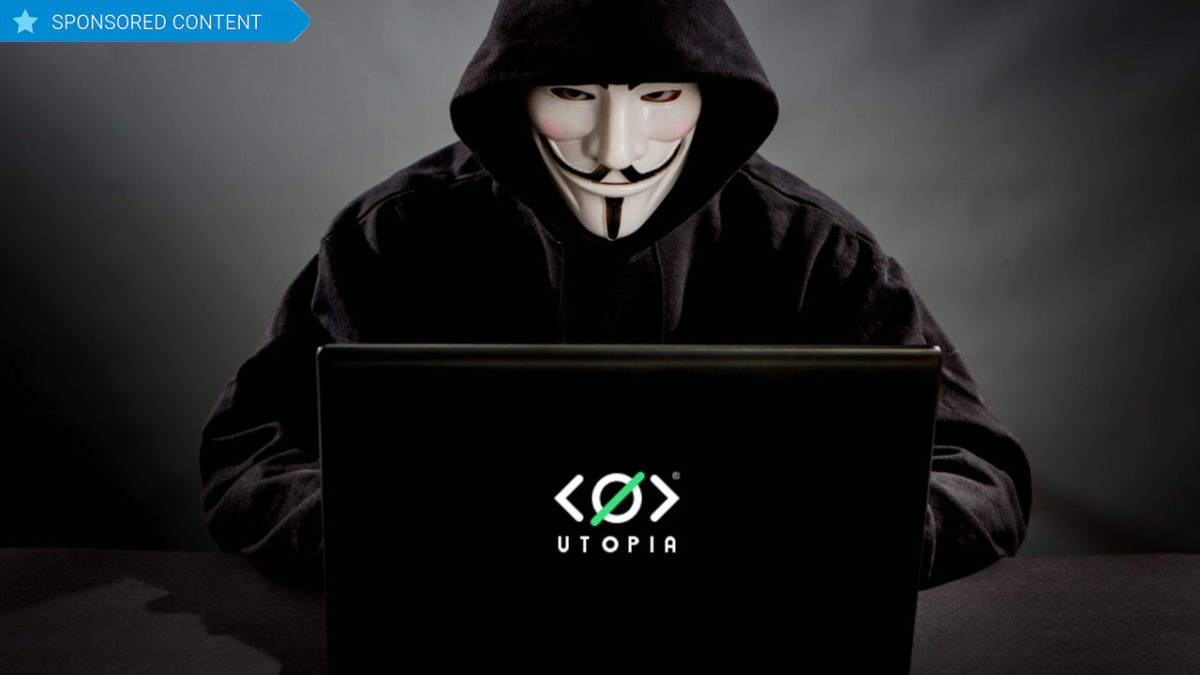
If the recent Netflix documentary “The Great Hack” proves anything, it’s that your online life is most definitely being tracked. Every purchase, every “like,” every ad you click on, and every survey you complete are all being compiled to create a profile of you that can at best be used to deliver relevant ads and content to you and at worst, can trick you into taking actions based on false information. As part of a growing movement to help you keep your online life safe from prying eyes, comes a new platform called Utopia.

Utopia: Chat with your peers with full privacy
Try it for freeDedicated to restoring a sense of privacy and anonymity to surfing and communicating online, Utopia offers an all-in-one encrypted decentralized platform, providing an anonymous browser called Idyll, a secure instant messenger, secure email called uMail, and even its own cryptocurrency known as Crypton (CRP).
Napster-era tech brought into the new millennium
The Utopia platform handles its operations through a peer-to-peer network (P2P), which means that the entire system is spread out amongst all of the users’ computers, in the same way that music-sharing program Napster once worked in the late ’90s. Login credentials are further stored on your own computer, rather than in a centralized system. This lack of a unified database makes surveillance practically impossible, as there is no main server to hack or monitor.
Tab-based simplicity
 After installing the software, all activities on the Utopia network are handled through a simple tab-based dashboard. The main screen opens to uMail, which operates as a fairly traditional web-based email client. All messages sent through uMail are automatically encrypted and are not stored on a central server so the possibility of having your email communications hacked or seized is virtually non-existent.
Chat rooms
 Another tab opens the channel manager, which allows you to join a series of pre-existing discussion groups like the chat rooms that used to dominate the internet in its early days, or you can start your own channel. Clicking on the name of a channel participant in the left column allows you to start a secure private chat. Images, voice messages, and other attachments in any format without size limits can be securely passed back and forth, forwarded via uMail or instant messaging, or downloaded to your computer.
 A new Tor
The Idyll browser will allow users to access sites created on the Utopia network. “Utopia Network includes a safe alternative to traditional Domain Name System (DNS) called Utopia Name System (UNS),” says the company. “This is a decentralized registry of names that are impossible to expropriate, freeze, intercept, or corrupt by any 3rd-party. Once registered it is your property for a lifetime.”
Utopia: Chat with your peers with full privacy
Try it for freeAll that and coin too
 Finally, Utopia plans to offer Crypton, its own cryptocurrency with a very smart approach to liquidity support and minimization of volatility. While the goal is that users will be able to further anonymize their online activities by making purchases using Crypton, the use of a reward system also keeps users online, which means the P2P network has maximum computing power. Users of the Utopia platform earn Crypton simply for using the software – and additional Crypton can be mined using bots which enlists users’ computers into the blockchain computational process.
 Summary
Utopia is setting out to provide a revolutionary approach in how people can securely communicate, access information, and make financial transactions that takes things much further than simple VPNs, private browsing tabs or regular cryptocurrencies. If you’re concerned about freedom of speech and the way in which your every movement is tracked online, it would certainly be worth taking it for a spin.
The Utopia platform will be in beta test until October 3 and is already available for Windows, MacOS and Linux.
Utopia: Chat with your peers with full privacy
Try it for free