How to trade cryptocurrencies on Binance Exchange

Become a master of cryptocurrency with Binance Exchange!

Our team is always looking for things we think our readers will value. If we make a content partnership like the one featured in this article, then we may receive compensation for publishing.
 

After a year-long downturn, cryptocurrencies are having a resurgent 2019, increasing in popularity, usability, and value.

As CoinDesk reported in early June, Bitcoin’s 2019 increases are predicated on actual transaction growth, and, collectively, cryptocurrencies surged nearly 150% this year as institutional and individual investors come together to push their prices higher.

In 2019, the crypto rally is outperforming many traditional investment vehicles, including stocks, bonds, gold, and oil.

In many ways, it’s representative of crypto’s first decade, offering both volatility and high rewards for willing investors.

The renewed interest in cryptocurrencies is bringing a surge of new users to prominent crypto exchanges like Binance, which boasts the biggest crypto exchange activity by volume, and it’s one that offers more than a hundred digital currencies on its platform.

Comprised of an incubation lab, research programs, charity projects, and its popular cryptocurrency exchange, Binance is helping lead the charge for higher levels of crypto adoption.

That’s becoming increasingly apparent this year.

In a May 22nd tweet, Binance CEO Changpeng Zhao, CZ, noted the exchange’s increased trading volumes, explaining, “We are seeing much higher order volumes (number of orders) than Dec 2017/Janu 2018 (the peak).”

We are seeing much higher order volumes (number of orders) than Dec 2017/Jan 2018 (the peak).

Trade (not order) volume in USD is 1/3 of the peak, but BTC price is 1/3 and ETH price is only 1/5 of the last peak, most other main alt prices are even lower. https://t.co/e9M20gqnm0

— CZ Binance (@cz_binance) May 22, 2019

Consequently, now is the time to take a look at Binance and to understand the functionality that makes it so popular.

Understanding Binance exchange

Initially founded by CZ in Hong Kong in 2017, Binance has quickly become one of the most lauded and well-recognized exchanges by crypto community members.

Binance is known for its competitive rates and expansive token offerings, and it’s often the go-to platform for both new and experienced crypto traders alike.

The exchange charges a flat fee of 0.1%, and users receive a discount when they use Binance’s native BNB token to make purchases on the exchange. Originally, the BNB token was an ERC-20 token hosted on Ethereum. However, with the launch of Binance Chain, the token is available and exchangeable directly with the platform.

Crypto traders can engage with several markets including BNB, BTC, ETH, and Stablecoins, which are presented in an aesthetically-appealing and easy-to-understand format.

In July, Binance introduced margin trading, a risky trading strategy that allows users to invest borrowed funds in crypto assets. Before users can engage in these trades, Binance provides a risk reminder, ensuring that investors are well-versed in this functionality before participating.

How to use Binance

Binance is defined by a combination of simplicity, and the startup process is incredibly simple and secure. It’s one reason that the amateur and experienced traders prioritize it over other exchanges.

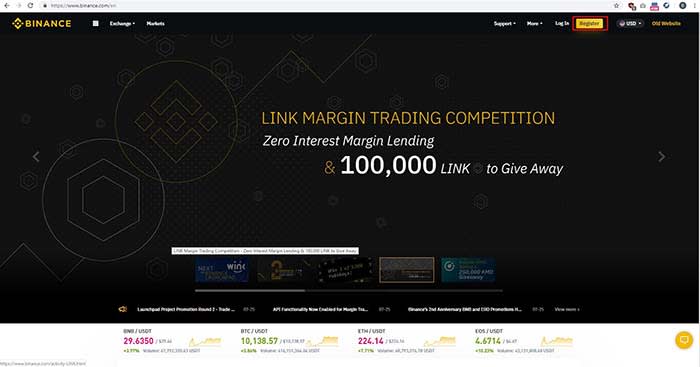
Step #1: Create an account

Binance requires users to create an account, and it offers different verification levels with corresponding features for each level.

For example, level 1 does not require account verification, but it limits withdraws to 2 BTC a day. For users looking for higher withdraw levels, they can complete a level 2 verification, which includes an uploaded photo ID that is approved by the platform. Level 2 users can withdraw as many as 100 BTC per day.

Users will need to schedule a verification meeting, so anyone looking for immediate level 2 access will need to plan ahead when creating an account.
Binance

With an emphasis on security, Binance encourages users to enable two-factor authentication to protect their digital assets.

Step #2: Deposit / Buy

After creating an account, users can transfer cryptocurrencies into their accounts.

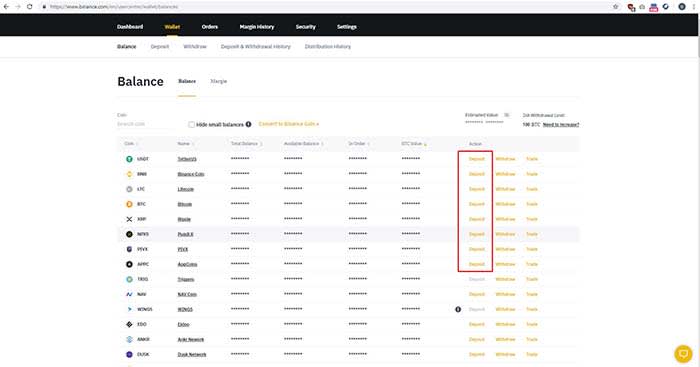
To fund an account, click “Funds” > “Deposits / Withdraws” > “Deposit.” After choosing “Deposit,” users are provided with a Binance wallet address where they send the tokens.

Once funds are deposited, users can begin trading on Binance, although some tokens take longer than others to settle.

For those looking to purchase crypto assets with a credit card, Binance announced a partnership with Simplex that allows users to do just that.
Binance

Step #3: Trade

Once an account is funded, Binance users can immediately begin trading. The platform offers a basic and advanced trading screen. First time traders will benefit from the ease-of-use of the basic format while more experienced investors will find value in the more meticulous metrics provided in the advanced screen.

Choose a trading pair by selecting digital tokens on the right side of the screen. Clicking on a digital token provides charts and metrics on the left side of the screen. When you’re ready to place an order, you can choose between timing the market with a “Limit” order, order buying immediately via a Market order. When you choose one of the options, click on the “Buy” or “Sell” buttons at the bottom of the screen to execute a trade.

Users can choose to buy a unique portion of a token, to spend a specific amount on a token, or they can allocate a percentage of their buying power to buy a token.
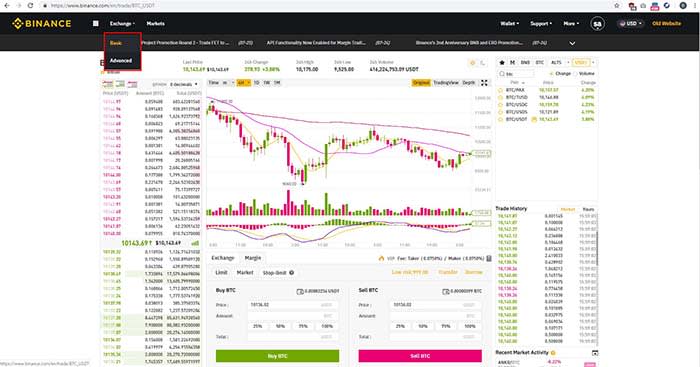
Binance

Conclusion

As cryptocurrencies continue to grow in popularity and value, new users are presented with a deluge of exchange options that can often be as complicated as the platforms themselves.

In contrast, Binance offers a simple value proposition as it combines powerful investing tools with a secure interface that can allow anyone to participate in this burgeoning ecosystem. By balancing this dichotomy, Binance stands out as a platform that isn’t just indelibly popular but as one that is undoubtedly capable of bringing crypto to the masses.
Utopia: Chat privately with your peers

Try out the beta version of Utopia, the latest P2P technology to chat with your peers with full privacy and much more. Download it now.

If the recent Netflix documentary “The Great Hack” proves anything, it’s that your online life is most definitely being tracked. Every purchase, every “like,” every ad you click on, and every survey you complete are all being compiled to create a profile of you that can at best be used to deliver relevant ads and content to you and at worst, can trick you into taking actions based on false information. As part of a growing movement to help you keep your online life safe from prying eyes, comes a new platform called Utopia.

Dedicated to restoring a sense of privacy and anonymity to surfing and communicating online, Utopia offers an all-in-one encrypted decentralized platform, providing an anonymous browser called Idyll, a secure instant messenger, secure email called uMail, and even its own cryptocurrency known as Crypton (CRP).

Napster-era tech brought into the new millennium

The Utopia platform handles its operations through a peer-to-peer network (P2P), which means that the entire system is spread out amongst all of the users’ computers, in the same way that music-sharing program Napster once worked in the late ’90s. Login credentials are further stored on your own computer, rather than in a centralized system. This lack of a unified database makes surveillance practically impossible, as there is no main server to hack or monitor.

Tab-based simplicity

Utopia platformAfter installing the software, all activities on the Utopia network are handled through a simple tab-based dashboard. The main screen opens to uMail, which operates as a fairly traditional web-based email client. All messages sent through uMail are automatically encrypted and are not stored on a central server so the possibility of having your email communications hacked or seized is virtually non-existent.

Chat rooms

Utopia platformAnother tab opens the channel manager, which allows you to join a series of pre-existing discussion groups like the chat rooms that used to dominate the internet in its early days, or you can start your own channel. Clicking on the name of a channel participant in the left column allows you to start a secure private chat. Images, voice messages, and other attachments in any format without size limits can be securely passed back and forth, forwarded via uMail or instant messaging, or downloaded to your computer.

Utopia platformA new Tor

The Idyll browser will allow users to access sites created on the Utopia network. “Utopia Network includes a safe alternative to traditional Domain Name System (DNS) called Utopia Name System (UNS),” says the company. “This is a decentralized registry of names that are impossible to expropriate, freeze, intercept, or corrupt by any 3rd-party. Once registered it is your property for a lifetime.”

All that and coin too

Utopia platformFinally, Utopia plans to offer Crypton, its own cryptocurrency with a very smart approach to liquidity support and minimization of volatility. While the goal is that users will be able to further anonymize their online activities by making purchases using Crypton, the use of a reward system also keeps users online, which means the P2P network has maximum computing power. Users of the Utopia platform earn Crypton simply for using the software – and additional Crypton can be mined using bots which enlists users’ computers into the blockchain computational process.

Utopia platformSummary

Utopia is setting out to provide a revolutionary approach in how people can securely communicate, access information, and make financial transactions that takes things much further than simple VPNs, private browsing tabs or regular cryptocurrencies. If you’re concerned about freedom of speech and the way in which your every movement is tracked online, it would certainly be worth taking it for a spin.

The Utopia platform will be in beta test until October 3 and is already available for Windows, MacOS and Linux.

How Firefox can help block cryptomining attacks

Is your computer constantly overheating? There might be a cryptominer hijacking your computing power.

Sometimes while you’re working on your computer, you wonder why the device is running so hot. It could be all that you’re doing is surfing Facebook, or getting something done for work, but your device feels like it could fry an egg, and the fan sounds like a helicopter propeller. This could be a sign that someone is hijacking your device to cryptomine.

Seriously, we’re not kidding.

About 2,000 power-stealing attacks happen every minute. Programs that steal your computing power are making attackers millions of dollars while your phone’s data usage bill climbs higher and higher. Basically, cryptominers are making money while you front the bill.
Luckily, Firefox has the tools for the job to help keep you safe from these attacks. If you’re not a Firefox user, this protection might just change your mind.

How Firefox can help block cryptomining

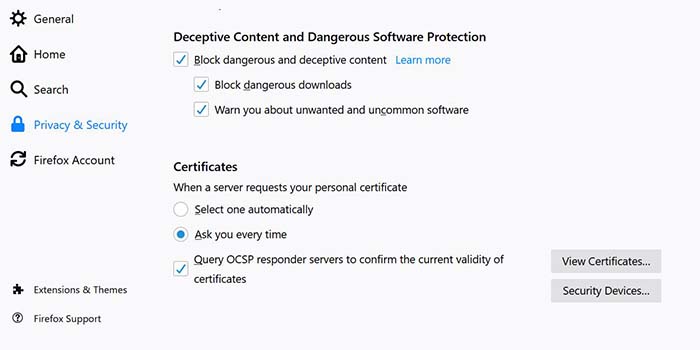
Firefox has partnered with the privacy company Disconnect. Together, they created a list of domains often used by cryptomining scripts. Firefox has given you the chance to block them. Simply select “Privacy and Security” from their menu. From there, scroll down and check the corresponding boxes.

Firefox block

Why you need to block cryptominers

Along with your ever increasing electricity and data bills, there are several reasons why you want to block cryptominers. By hijacking your device, they are rapidly draining your battery. Not only that, if it causes your device to overheat, it can do irreparable damage.

This activity could also pose a threat to the planet. Environmental researchers are concerned about the amount of resources being used up by cryptominers.

Protect yourself now

The bad guys are always working to take advantage of any gaps in your security. Downloading Firefox today can help prevent cryptominers from using your computer to make themselves rich.

Softonic is proud to partner with Mozilla. When you download from us, we may earn a commission.

How to tell if your PC is cryptojacked

What is cryptojacking and how do you know if you’re affected?

There are a lot of reasons a computer could be slow: Excessive programs running in the background; bloated temp files; a corrupted hard drive; or if you’re unlucky, it could be malware and viruses. One particularly sinister emerging threat is cryptojacking, which can increase overheating, slow down processing speed, and drain your batteries – all under the radar.

What is cryptojacking?

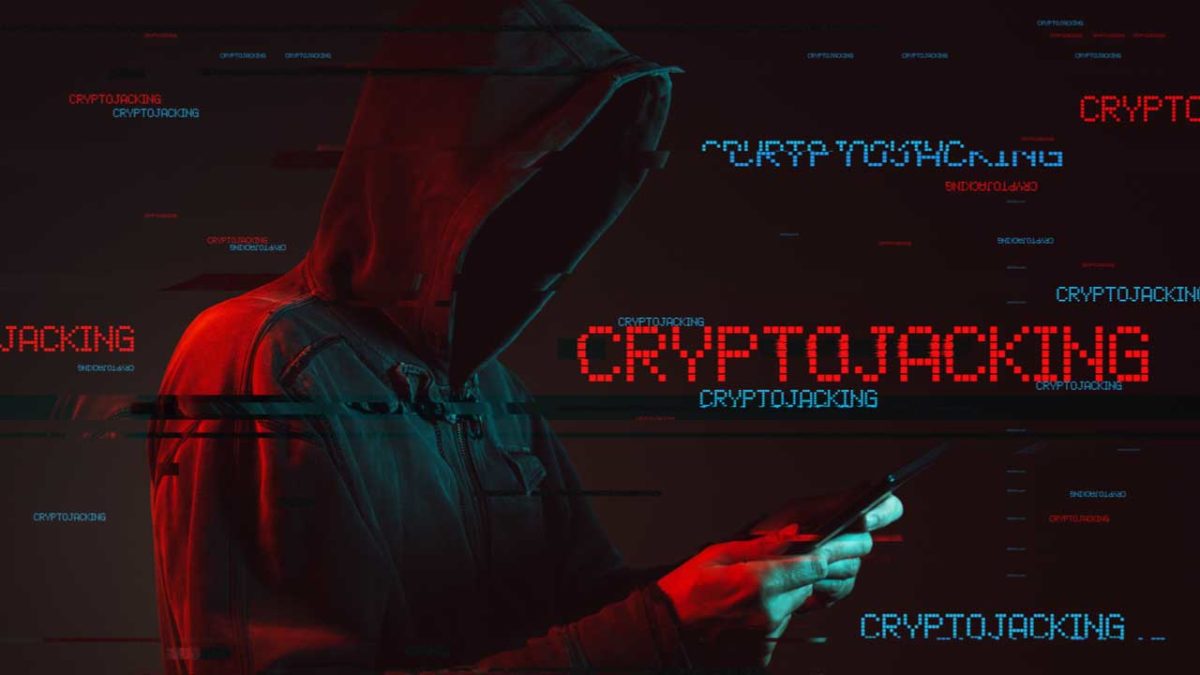
Cryptojacking is when someone takes hold of your computer to mine cryptocurrency. Often, hackers will ensnare you by infecting a website or online ad with an infected JavaScript code. The code auto-executes once loaded into your browser. Alternatively, a hacker might lure you into clicking a malicious link in an email. Once you click it, it uploads a cryptomining code to your computer and suddenly your processing power is getting leeched to an outside source.

Why would someone bother doing this?

Money.

Cryptojacking allows someone with malicious intent to steal computing resources from a victim’s device instead of having to build their own dedicated cryptomining computer. In this way, they can compete against sophisticated cryptomining operations without any of the costly overhead.

Stay protected

Even on a healthy computer, it’s tough to track the origin of a program that’s draining all your CPU. It’s harder still when you’re trying to do so on an infected computer that’s slow as dirt. Troubleshooting when your computer can barely chug along is a nightmare. As such, the best way to deal with cryptojacking threats is to not get infected in the first place.

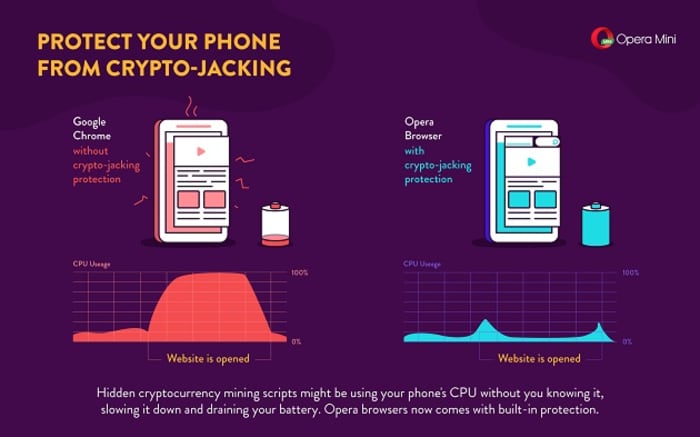
A smart, secure browser is your first line of defense – especially one that can block JavaScript. While this effectively closes any door on a cryptojacking attempt, the obvious drawback is that blocking JavaScript will also cull functions that you like and need. The best middle ground is Opera, a browser that’s been fighting the cryptojacking war since before we even knew about it. If you install Opera on your mobile device, it’ll actually block risky mining scripts when visiting a site. It’s analyzed over 100 mined websites, and noted how smartphones such as the Galaxy S8 or HTC One suffered reduced performance when exposed to cryptojacking.

Opera Mini cryptojacking

You can also download an extension like No Coin which blocks miners using your computer resources without consent. Opera even comes with the extension already installed on download.

Lastly, Opera even made this cool test to tell you whether you’ve been cryptojacked. If you’re a regular user of cryptocurrency, it might be a good idea to bookmark the page.

Using Opera in tandem with a strong anti-malware tool will help keep your PC protected from cryptojacking attempts, but it always helps to take extra precautions before clicking on that sketchy email, or opening a link that you don’t trust. Stay frosty, and stay tuned with Softonic for more tips and tricks to keep protect your computer protected.

Facebook’s Project Libra plans to introduce new cryptocurrency

Facebook makes another play for your wallet.

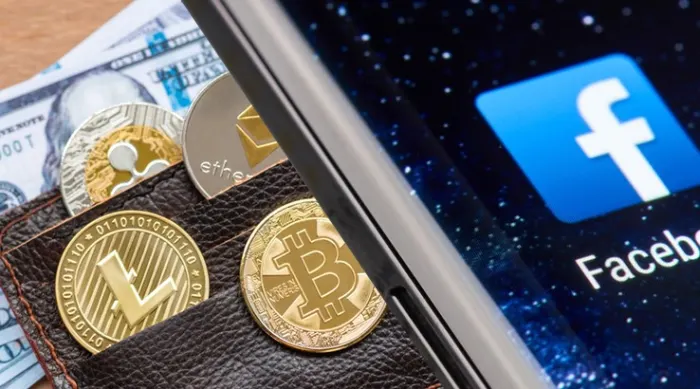
Ever since Bitcoin exploded into popularity, cryptocurrency has proven itself a mainstay of our internet 3.0 world. Back in December, Bloomberg News reported Facebook was working on a digital coin of their own via WhatsApp. How serious are they about the project? Enough that they’re seeking to raise as much as $1 billion dollars to see it through, reports the New York Times. Here’s everything we know so far:

Facebook Access Facebook
7

Project Libra

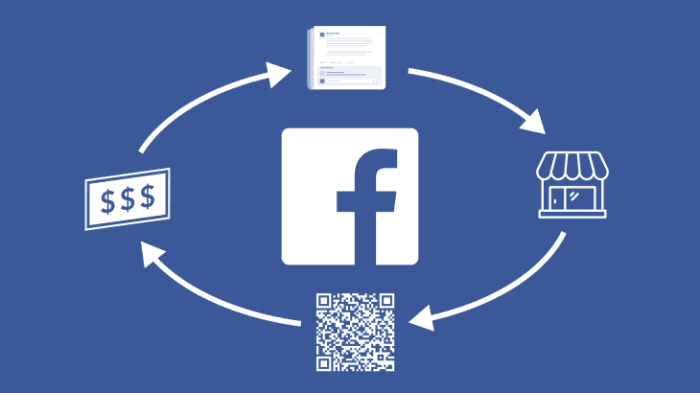
Facebook has had its eye on their own cryptocurrency for more than a year now, and is navigating through the footsteps of other tech giants like Amazon and Apple. Apple announced the new Apple Card back in March, also seeking to change and improve the digital transaction game. The goal of Facebook’s code-named Project Libra is to create a digital coin that Facebook users can use to make purchases on the social media site, as well as anywhere else across the internet.

The process is an arduous one, but would be a huge step for Facebook, utilizing investments from financial firms and online merchants. Additionally, there’s the project’s promising potential to reward users for their activity on the platform. “Like many other companies, Facebook is exploring ways to leverage the power of blockchain technology,” a Facebook spokesperson explained in an email.

Facebook cryptocurrency

User rewards

Rewarding users for viewing ads is a growing trend (the Brave browser’s Basic Attention Token seeks to do this as well), and it works similarly to accruing loyalty points at your chosen retailer – eventually those digital points can be put towards user rewards, such as improved ad targeting, or even access to premium content.

While inclusion of this facet is still speculation, it certainly meshes well with the user-publisher relationship that Facebook claims to encourage. It would be a welcome change from the flame wars, hate speech, political rants, and bot-created garbage that’s weighing more and more on the increasingly disgruntled Facebook community. It may even waive some of the condemnation that the organization has received of late for making money by invading user privacy.

Facebook Rewards
Facebook Rewards prove the company is familiar with this type of user transaction.

Progress and impact

As you might expect, Libra’s progress has been slow-going thus far. The cryptocurrency system that currently exists is beset by roadblocks both technological and political, with entrenched interests and stubborn affiliates refusing to budge. Despite its tumultuous 2018, Facebook is still trying to brave the waters of a new business outlet – one that, if successful, could threaten the card networks’ dominance over global payments, and arm 1.5 billion users with a new tool to use in online commerce.

Will Project Libra usher in a new mainstream application of cryptocurrency, and dethrone the traditional online payment system? A third of the world’s population logs on to Facebook monthly, and we all need to buy things. Is that enough? Let us know your thoughts in the comments below, and stay tuned for more details as they are made available.

Opera browser adds crypto-wallet

Opera releases Reborn 3 browser with support for cryptocurrencies and ad blocking.

The fight to be the most complete and fastest browser has raged for some time, and the battle just heated up with the arrival of Opera Reborn 3. Reborn 3 brings new options and a new design. It includes a dark theme for both mobile and desktop use. It also has complete customization to control privacy and security when surfing the web.

But this upgrade not only affects design and usability, but it also incorporates options such as a free VPN.

Opera Reborn 3 wants to be the browser of the future. It incorporates a security blockchain technology that is used to make payments. Fans of these electronic currencies are in luck since the new version of Opera allows us to operate with them with total security.

Reborn 3 also brings an ad blocker to the table. That’s not all, it also brings features like a currency converter, desktop-mobile compatibility, a screen grabber, and messages in the sidebar.

Of course, the interface has also been modified so you can customize the browser to your liking. Without question, Opera Reborn 3 is going to give the rest of the browsers on the market a run for their money.

China cracks down on Bitcoin mining

Will this radically change the industry or is this just a sign of things to come?

China BitcoinChina’s economic planning agency announced that they are looking to ban Bitcoin mining. They announced it in a report (written in Mandarin) that you can see here.  Click below if you need a translation app.

Google Translate Download now ►
8

According to an article from Reuters, China’s National Development and Reform Commission is seeking public opinions on a revised list of industries it wants to encourage, restrict or eliminate.

Of the new entries to that list, cryptocurrency mining was included. According to the NDRC, Bitcoin was hazardous to the country in several ways. It did not abide by regulations, was unsafe, wasted resources, and polluted the environment.

Bitcoin mining requires an incredible amount of electricity. As many of these mining operations are secret and unregulated, the electricity is often stolen.

The public has until May 7 to submit their opinion on whether or not Bitcoin will be eliminated. After that, Bitcoin’s fate is China will be decided.

China’s battle with Bitcoin farms

China is home to about 70% of the world’s Bitcoin mining operations, known as “farms.” To put in perspective how much China has dominated this market, the next closest is India who operates about 4% of the world’s farms.

Last year, Chinese police officers seized about 600 mining computers. To help combat issues with electricity consumption, the Chinese government also called for Bitcoin miners to exit the industry. As a result, more than half a million Bitcoin miners are out of business. 

What happens next?

Bitcoin taxBitcoin mining operations started off small when they began popping up in China in 2015. As a result, they flew under the government’s radar. However, as Bitcoin value rose so did the government’s attention toward Bitcoin. 

Most likely, China is not going to try to eliminate its Bitcoin industry altogether. As Bitcoin values haven’t suffered a major loss either, it seems like most everyone agrees.

The Chinese government likely realizes that their actions won’t stop some people from mining Bitcoin. However, that doesn’t mean that the country won’t do more to regulate the industry. By doing so, the country can tax it and the environment can be protected. 

Bitcoin has been around for about a decade, but people have only paid close attention in the last few years. In that time, the industry has exploded and has gone through rapid changes. 

‘Unhackable’ blockchains are getting hacked

Blockchains might not be as air-tight as we once thought.

Blockchaining

High-profile security breaches and issues with privacy are massive concerns for everyone.

Now, we’re seeing more of those security issues are emerging in crypto. That’s surprising since blockchain technology has been presented as the solution to our privacy woes.

Whether blockchain is slated to become the new “backbone” of the internet or the future home for our genetic data remains to be seen. However, we’ll need to remove the rose-colored crypto-glasses if we intend to move more sensitive info onto the blockchain.

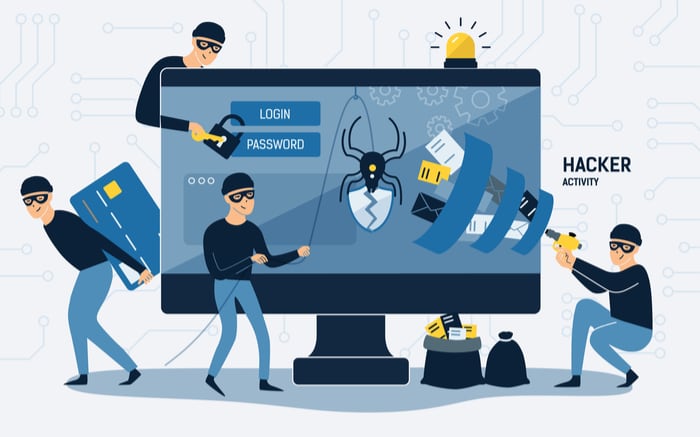
As reported in the MIT Technology Review, hackers have stolen nearly $2 billion worth of cryptocurrency since the beginning of 2017. Most of that money has been taken from the exchanges — not from lone-wolf hackers, but organized crime rings.

The belief that blockchaining is unhackable does seem odd. This is because blockchain hacks are one of the main reasons that the general public has even heard about this decentralized technology.

Here’s the thing: blockchains aren’t unhackable

Hackers

Blockchains are powerful platforms. But if we’ve learned anything from looking at high profile breaches, it’s that all technology has weak points.

For some reason, many people have gotten the idea that blockchains were an impenetrable force. Password protectors, VPNs, and even blockchains are not entirely hack-proof.

They’re leaps and bounds ahead of using the web unprotected — but you still need to be careful.

Are blockchain hacks actually on the rise?

There’s been a near-constant stream of attacks going back for at least five years. The most notable example is Mt. Gox, where nearly half a billion dollars in bitcoin was stolen from users and the company.

This year, there’s been the Cryptopia breach, a January attack that wiped out approximately 94% of the company’s holdings. The total amount is unknown, but data analysts estimate the stolen coins could be worth about $16 million total.

There’s also this attack that hit the Ethereum Classic blockchain where hackers made off with $1.1 million.

In the ERC case, Coinbase detected suspicious activity in the form of a 51% attack, a type of attack once thought to be hypothetical. This occurs when a group of miners with more than 50% control blocks new transactions to maintain the majority.

By controlling the computing power, the attacker(s) can monopolize the mining of new blocks. Then, they can prevent other miners from completing blocks while siphoning off their rewards.

Are blockchains safer than actual banks?

Online BankingForbes wrote critically about blockchain in January. The article says that people keep backing blockchain because there’s a case of industry anxiety.

It goes on to say there’s never been anything on this scale in the traditional banking world — a $2 million Bank of America robbery from 20 years ago is the biggest heist listed on Wikipedia. That number pales in comparison to the amounts stolen via hacking.

The point isn’t necessarily that the technology is bad news, but that people should be wary of keeping large sums in blockchain-powered accounts.

Lolli pays you Bitcoin for everyday online shopping

You’re already shopping online. Why not get free Bitcoin for it?

bitcoin

These days, everyone is after ways to earn Bitcoin — and everyone is shopping online. So why not link the two? That’s what startup Lolli is doing. The company launched a new platform that allows you to earn free Bitcoin while you shop.

Lolli brings Bitcoin to everyday online shopping

Getting everyone involved in Bitcoin

Bitcoin is the most well-known cryptocurrency, and it’s getting a lot of attention from those in the finance industry. Stock traders are interested in it, but what about everyday people? Bitcoin has opportunities to help everyone to achieve the same benefits, but the currency isn’t as readily available in the mainstream right now. Lolli can change that.

How does Lolli work?

In short, Lolli is a rewards-like platform similar to the many others out there. When you use the app, you earn Bitcoin when you make a purchase through a wide range of retailers. At this time, there are over 500 participating companies involved.

If you are interested, all you have to do is download the browser extension. The process is easy, and it takes only a minute to download from the company’s site. This is also the place to check out the list of retailers participating in the service. (Wal-mart, Seat Geek, VRBO, Barnes & Noble, Sam’s Club, and CVS are some of the heavy hitters.) The company currently offers the service just for Chrome and Safari users. However, Lolli plans to offer more browser support in the future.

Then what happens?

When you activate Lolli and shop, you can earn as much as 30 percent back in Bitcoin rewards. The tool automatically alerts users when they are shopping on one of the approved and partner websites. Once the transaction is complete, you earn your sweet, sweet Bitcoin.

For those who want a Bitcoin version of a cash-back app, Lolli is the way to go.