Today is one of the most important days in aerospace history. Today, April 1, 2026, NASA is going to send four astronauts to see the far side of the Moon.
Today will go down in the history books, right after other great milestones in aerospace (landing on the Moon is clearly still the greatest achievement to date, don’t worry, Neil Armstrong).
Everything we know about the Artemis II mission
The countdown has already begun at the Kennedy Space Center for the launch of Artemis II, which will take four astronauts to orbit the Moon and return on the first crewed lunar mission since 1972.
After a meeting of the mission management team held on Monday, NASA’s Deputy Administrator, Amit Kshatriya, stated that Artemis II is ready for launch this Wednesday.
The weather is now the only possible obstacle. The forecast indicates an 80% chance of favorable conditions, with the main concerns being cloud cover and the possibility of strong winds, NASA noted.
When will Artemis II be launched?
At 6:24 PM (10:24 PM GMT) on Wednesday, a two-hour window will open for the Artemis II mission to launch from the Kennedy Space Center in Florida.
The launch window will remain open until April 6 for two hours each day after sunset. The mission can only be launched when the Moon, orbital trajectories, weather, and the rotation of the Earth align safely.
Artemis II has suffered two significant delays that have pushed it away from its original launch window in early 2026.
In early February, the first attempt was suspended after a liquid hydrogen leak was detected during a test countdown.
A second launch attempt in early March was canceled when engineers discovered a helium flow issue in the upper stage of the rocket.
How to watch the launch
The NASA will broadcast the launch live via YouTube, where Artemis II has already been seen from its departure from the vehicle assembly building to launch pad 39.
What is NASA’s Artemis program?
The Artemis program is NASA’s multi-decade mission to bring humans back to the Moon for the first time since 1972, establish a long-term base there, and ultimately enable future crewed missions to Mars.
The program is currently divided into five missions: Artemis I, II, III, IV, and V.
Artemis I was the inaugural uncrewed test flight, which launched on November 16, 2022, and lasted 25 days. It successfully placed the Orion spacecraft into Earth orbit and provided crucial data for Artemis II.
What is Artemis II?
Artemis II is the first crewed mission of the Artemis program. While Artemis I was an uncrewed test mission that only carried mannequins and sensors, Artemis II will mark the first time since 1972 that astronauts will travel beyond low Earth orbit.
Will Artemis II land on the Moon?
No. The four-person crew will not land on the Moon, but will perform a lunar flyby, circling around the far side of the Moon before returning to Earth.
What is the goal of the Artemis program?
Essentially, Artemis II is a systems validation mission. NASA will use the flight to test life support systems, navigation, communication links, and the overall performance of the Orion spacecraft in deep space with a crew on board, conditions that cannot be fully replicated on Earth.
If successful, Artemis II will pave the way for Artemis III, a crewed mission in low Earth orbit; then Artemis IV, which aims to take astronauts to the Moon; and future missions that could establish a sustained human presence beyond Earth.
What is the difference between Artemis and Apollo?
In Greek mythology, Artemis is the twin sister of Apollo and the goddess of the Moon. The name symbolizes the program’s connection to the original lunar missions of Apollo, which took place between 1961 and 1972.
The most notable of the Apollo missions was Apollo 11, when, on July 20, 1969, Neil Armstrong and Buzz Aldrin became the first humans to set foot on the lunar surface.
The last mission was Apollo 17, when Eugene Cernan and Harrison Schmitt left the lunar surface on December 14, 1972, becoming the last people to walk on the Moon.
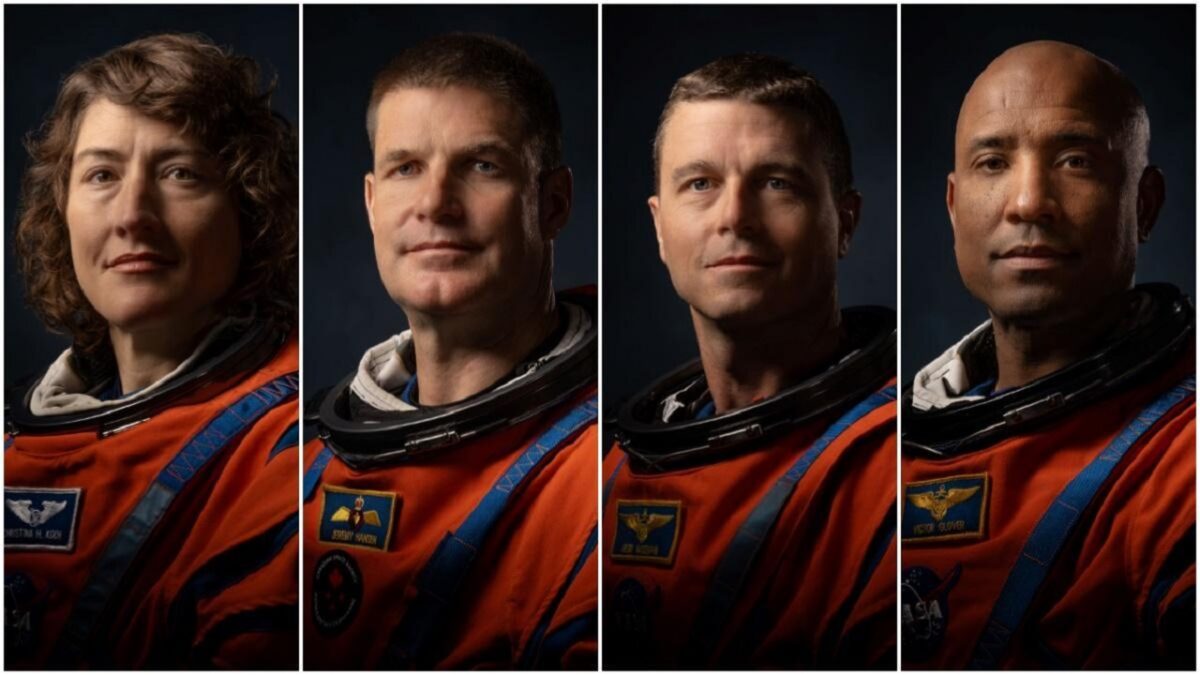
Who are the astronauts of Artemis II?
The mission will have four astronauts:
Reid Wiseman, 50 years old, commander: This NASA veteran and former commander of the International Space Station leads the Artemis II mission. A test pilot turned astronaut, he has leadership skills and extensive experience in spaceflight.
Victor Glover, 49 years old, pilot: This U.S. Navy aviator is the first black astronaut assigned to a lunar mission and flew on the SpaceX Crew-1.
Christina Koch, 47 years old, mission specialist: The holder of the record for the longest individual space flight by a woman, with 328 days, is a veteran of multiple spacewalks and has experience in scientific research and deep space missions.
Jeremy Hansen, 50 years old, mission specialist: The first Canadian to travel to the Moon is a former fighter pilot and represents international collaboration in deep space exploration.
Why is NASA returning to the Moon?
The mission reflects broader long-term goals. NASA plans to establish a sustained human presence on the Moon and its surroundings, especially near the lunar south pole, where it is believed that water exists in the form of ice.
This is considered a preliminary step towards future crewed missions to Mars. At the same time, Artemis is being developed in a broader geopolitical context, as the United States seeks to maintain leadership in space exploration amid growing competition, especially from China.
When will the next Artemis missions be?
Artemis III in 2027: NASA has recently reviewed the profile of the Artemis III mission. The mission, scheduled for next year, will no longer land on the Moon, but will send a crew to low Earth orbit, where integrated operations between the Orion spacecraft and one or both of SpaceX and Blue Origin’s commercial landing modules will be tested.
Artemis IV in early 2028: The mission will be the first crewed lunar landing since Apollo 17. NASA plans to send its crew to lunar orbit and two of its astronauts to the lunar south pole.
Artemis V at the end of 2028: With this mission, NASA plans a second crewed lunar landing and the beginning of a lunar base.
