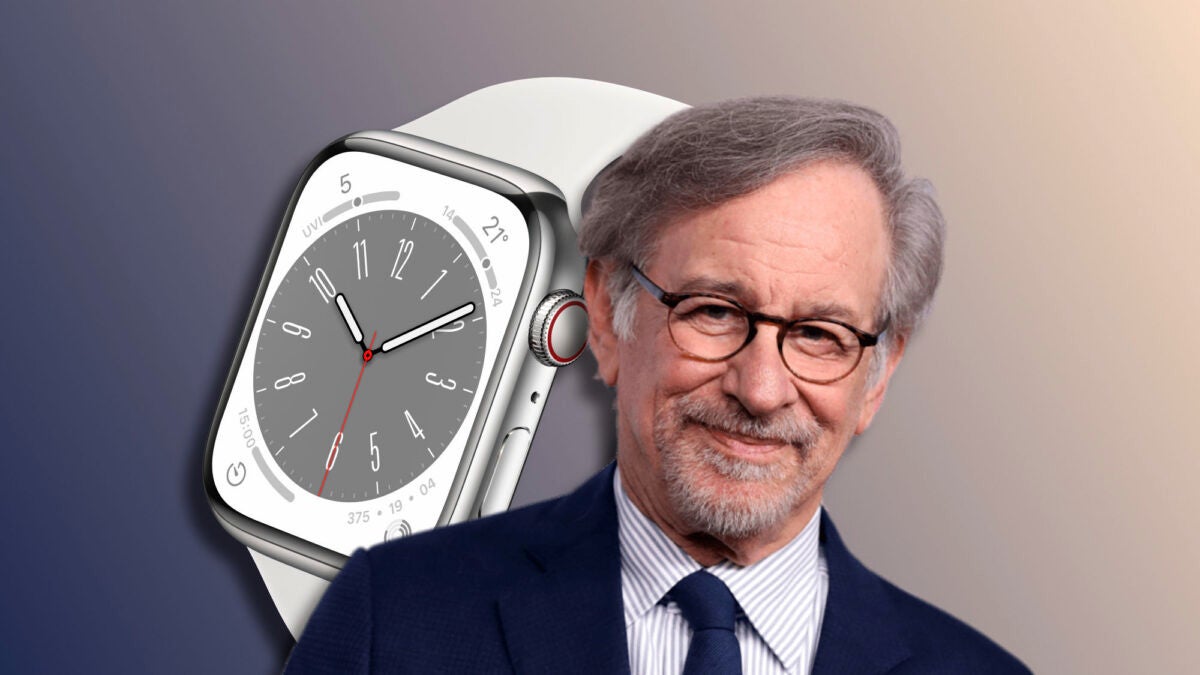
During the Tribeca Festival last weekend, Steven Spielberg, one of Hollywood’s most prestigious directors, had a rather peculiar moment with his Apple Watch. The acclaimed director threw his Apple Watch to the ground after the device mistakenly detected a fall.

Fall detection sometimes worries too much
The incident occurred, according to Variety, on Saturday, “while Spielberg was speaking at the festival in celebration of the 50th anniversary of his film “The Sugarland Express.” According to Variety, as the director shared anecdotes and experiences from his career, his Apple Watch interrupted with a message that said: “It looks like you’ve had a hard fall.” Spielberg, showing his sense of humor, commented: “I’m not going to press the SOS button” before throwing the watch to the ground. “I’ll pick it up later,” he added, only to retrieve it a few minutes later when the device started emitting a distress signal and preparing to call emergency services.
The irony of the situation is that by throwing the Apple Watch to the ground, Spielberg probably worsened the problem, as the additional impact could have intensified the emergency signal emitted by the watch. The Apple Watch, which we have already seen focuses on health and safety, has saved numerous lives on many occasions, detecting strong falls, for example, and through the SOS function that automatically calls emergency services when detecting them.
What to do in case of an accidental activation? There are some movements that can make our Apple Watch believe that it has detected a fall. It is worth mentioning that the type of strap we are using and how tight we wear the watch play a role here. A looser fit makes the watch move more with certain gestures, which is not recommended from the perspective of fall detection.
Conscious of this whole situation, the watch currently works as follows. Once it detects what appears to be a fall, the watch informs us. Here we have two options: tell it “I have fallen, but I’m fine”, in which case the Apple Watch does nothing else, or “I haven’t fallen.” This last option is key, as it trains the watch to know that a specific movement has not been a fall.
Ignoring the message is the last thing we should do, as the system is programmed to contact emergency services in case of no response. This is the function that has saved lives, such as in the case of a serious fall with the loss of consciousness, the response speed is crucial.
Often, we don’t get a notification like this when we’re speaking in front of hundreds or thousands of people. However, if that happens, a simple tap on the corresponding action is enough to keep this vital safety system looking out for us.
