Now, let’s be honest: making sure you know where North Korea is to avoid being embarrassed on a Jimmy Kimmel interview probably shouldn’t be your main reason to learn geography as an adult…
But hey, it’s a start, right?
Aside from that, there are many great benefits to knowing the world map: a higher understanding of world news stories taking place, a better developed worldview, a powerful mental map, helpful preparation for unexpected pop quizzes, and the simple joy of knowing where all Earth’s countries are (to name a few)!
If you’re ready to memorize the map, gaze at the globe, and admire the atlas, let’s talk about how to…
Learn geography for free with Sheppard Software!
Getting started
First things first: head to the website:
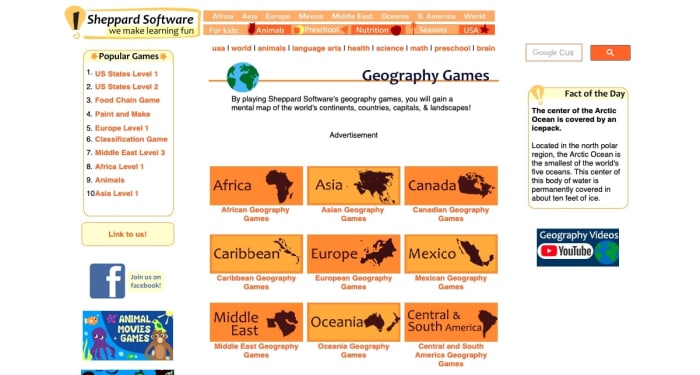 Welcome to Sheppard Software’s geography learning page!
Here, you can navigate your way through the world’s geographical regions one by one, and develop an understanding of the countries within. If you ever click away from this page, you should be able to find a “world” link that sends you back to the proper page:

Now, we should probably address the elephant in the room: don’t other sections of this website seem a little childish?
The simple answer is yes. But, while Shepperd Software has many games for kids – animals, Earth tips, Easter egg painting – the geography software is straightforward, robust, and challenging for people of all ages.
Don’t believe us? Let’s test it out, from the beginning: Africa!
Going deeper
Most geographical regions feature three options: Capitals, Countries, and Landscape (for topography buffs).
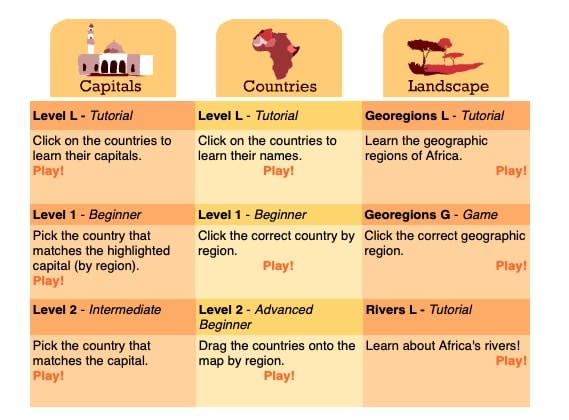 Now, if you’re wondering why Capitals are first, we’re right there with you. The sections were likely meant to be in alphabetical order, but you would think one should probably learn the countries locations before the capitals, right?
Anyway, we digress.
From this screen, you can begin at any level you like! We’ll feature the main three (there are even more below the picture shown):
Level L
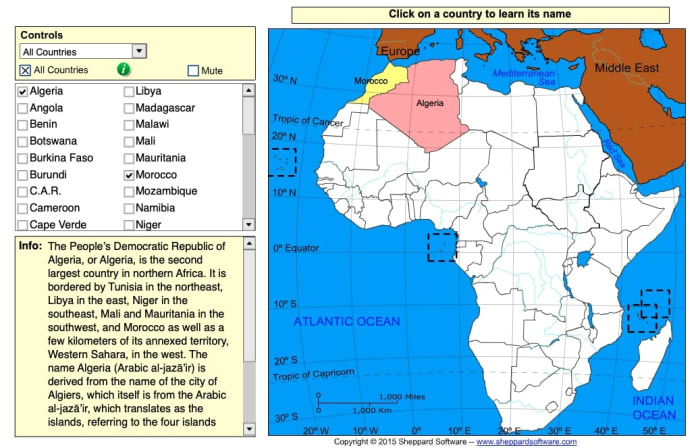
Ostensibly, this stands for “Level: Learning.” Here, you click on each country and the program provides the name, with information on the left.
If you have your device’s volume, you can hear it as well! Don’t let that detail slide: we think it’s pretty impressive that Sheppard’s games help you engage on multiple levels.

5 mobile apps that can actually teach you something
Read Now ►Level 1
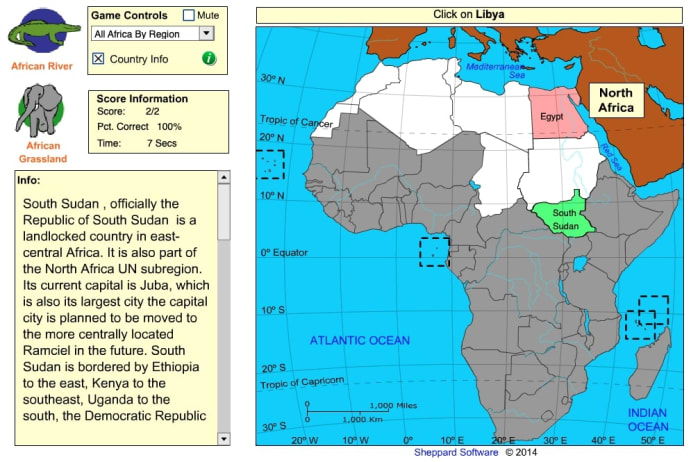
Here, you encounter your first challenge!
Within a certain area, you must click on the upcoming country. Simple as that! After the third attempt, you’re provided with the answer. We encourage you to begin here first and see whether or not you’re good enough to skip to a higher level!
Level 2
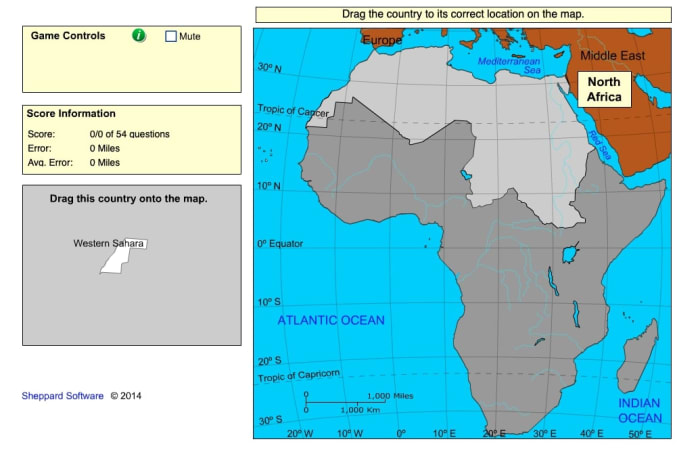 The challenge continues, with a twist: inside the same pre-defined areas, you must drag and drop the countries in place. It might sound simple, but this changes a few things!
Most importantly, we often imagine testing our geography as clicking pre-defined outlines on a map. This challenge asks you: can you mentally remember where the country lands on the map, with no guides? It may be harder than expected, even for people who can name each location…
From there
The next challenges (Levels 4-9) are variations on the two originals. At first, you lose the pre-defined areas so the entire map is up for grabs from the start. Later, you’ll be asked to rotate countries to the proper orientation and size them properly. The final challenge adds everything together for the “Cartographer” quiz!
Final suggestions
So, how far do you go?
Frankly, you may not care to have intricately detailed knowledge of an unmarked map. We simply want to reliably know the location of a place when it’s mentioned: whether that’s the Czech Republic, Tunisia, or the Virgin Islands. It all depends on what’s good enough for you; if you want to go all the way and know every location along with its capital and major bodies of water nearby, go for it!
The point is… learn as much as you want and don’t pressure yourself to go further. Just remember that Sheppard Software is there to help you reach the level of your choosing!
Conclusion
We want a better understanding of our world, which begins with a solid grasp of where countries are located. Hopefully, you share that desire and can use this program to learn geography more easily!