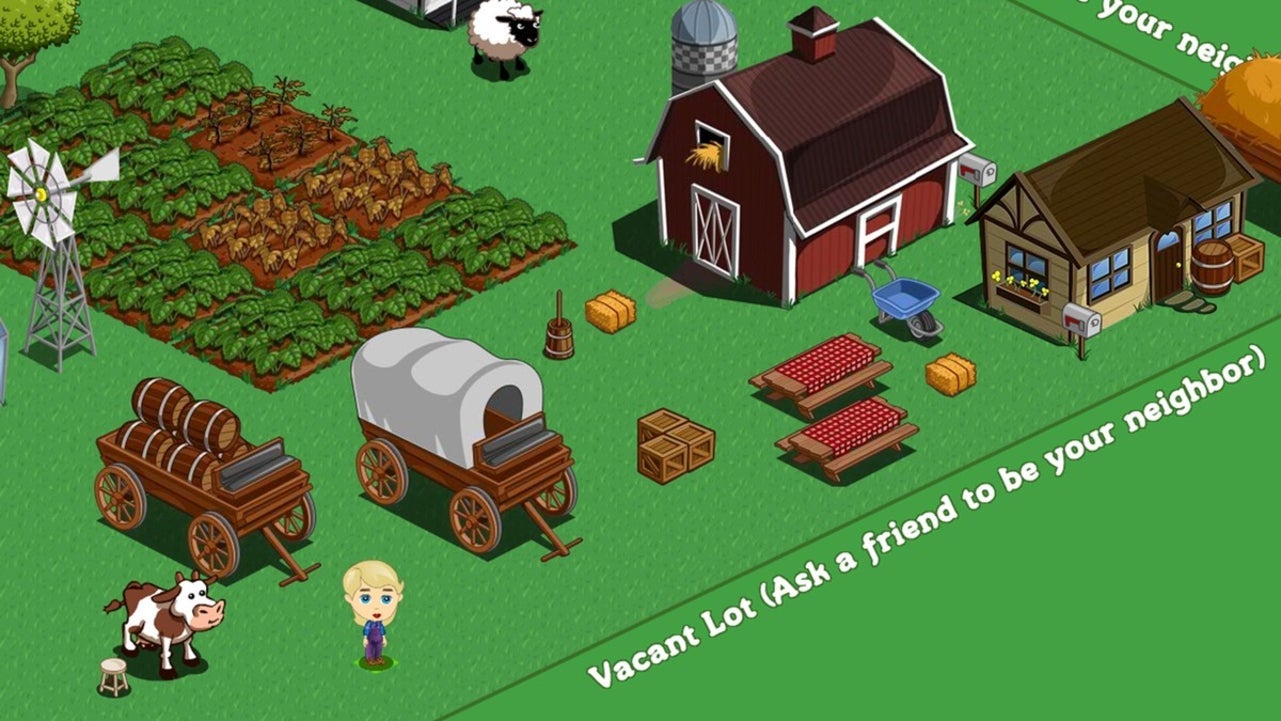
Facebook reached the peak of its popularity in 2009 and 2010, before the rest of the social networks came and swept everything away, condemning it to a refuge for people who did not adapt to modern Internet. Back then, it was not uncommon to log in and have several messages and comments on your photos, yes, but above all, messages from games. From many, many games. Whether it was Scrabble, Pet Society, or Mafia Wars, everyone was asking you to help them, lend them something, or simply connect there as well. It was the Steam for people who didn’t have consoles, the ultimate pastime, the trap that later evolved into freemium games and “pay to win.” But among all of them, there was one that stood out more than any other: FarmVille.
On the Facebook farm, ia, ia, oh
In fact, Zynga didn’t invent anything: FarmVille was the evolution (or rather the plagiarism) of Happy Farm, a game launched by the company 5 Minutes on the Tencent QQ instant messaging app. And it was already a success: in fact, at its peak, 23 million people were playing daily in Asia. Zynga saw that planting vegetables and starting your own garden had appeal and created a version for the rest of the world that spread like wildfire.
It may seem silly to us, but in its day, FarmVille surpassed any game from Sony, Nintendo, and Microsoft with a staggering nearly 84 million active users worldwide, of which more than 34 million logged in every day. A huge success for a game whose first version took just over a month to develop by four students from the University of Illinois, who maintained the social component and added something very important that was practically unheard of at the time: micropayments.
Now they are part of everyday life, but back then the name sounded somewhat distant (even World Of Warcraft came later!). With Farm Cash -not to be confused with Farm Coins, which were earned by completing objectives within the game- we could buy all kinds of upgrades, such as making your trees grow immediately or resurrecting those that had died along the way. And how was Farm Cash obtained? Well, although you could also help Aunt Manoli and Cousin Juan fix their farm, usually it involved spending money.
In addition, in FarmVille you could send gifts to your friends, something that, I assure you, happened constantly and at all hours to the point that it was almost frightening. In the end, of course, people got tired, and even teaming up with different brands did not help its survival: on December 31, 2020, the game disappeared from Facebook without anyone missing it much. To replace it, Zynga had already laid the groundwork in 2012 and 2021, respectively, with the launches of FarmVille 2 and FarmVille 3, the latter fully intended to be a mobile app. The times a’changing.
Over time, we could see FarmVille for what it was: a machine destined for the absurd, a program that forced us to log in every day, insist on our friends, perform the same meaningless tasks over and over again, and if we got frustrated, spend money to keep going. In fact, when it won an award at the GDC in 2010, the audience did not hesitate to boo Zynga, although that doesn’t seem to matter much today: it was bought for $12.7 billion by Take Two. It may seem outrageous, but it should be noted that, according to estimates, about 10% of the world’s population plays something created by Zynga daily, whether it’s Words With Friends or their slot-style games. If someone here isn’t getting rich, it’s because they don’t want to (or have too much ethics).