A recent study published in the journal Psychology of Aesthetics, Creativity, and the Arts has revealed that watching experimental animated short films can significantly increase creativity levels compared to consuming viral videos on platforms like YouTube. This work, led by scientists Jonathan Schooler and Madeleine Gross, was conducted with 500 people, divided into two groups: one exposed to experimental short films and the other to viral content. What, something created by a human is better than something that is not? How? The results of the study show that those who watched experimental short films achieved a remarkable improvement in […]
A recent study published in the journal Psychology of Aesthetics, Creativity, and the Arts has revealed that watching experimental animated short films can significantly increase creativity levels compared to consuming viral videos on platforms like YouTube. This work, led by scientists Jonathan Schooler and Madeleine Gross, was conducted with 500 people, divided into two groups: one exposed to experimental short films and the other to viral content.
Is something created by a human better than something that is not? How?
The results of the study show that those who watched experimental short films achieved a notable improvement in their creativity, evidenced by writing short stories in which they had to identify connections between different concepts. In contrast, participants who watched viral videos showed no significant change in their creative ability. Although viral videos were perceived as more entertaining, their cognitive impact was practically nil, compared to the stimulation provided by the short films.
The research suggests that exposure to ambiguity and the originality of short films challenges the brain to seek alternatives and break established thought patterns. Schooler emphasizes that even small doses of this type of content can be beneficial, much like light exercise that improves physical health. “This indicates that, although we enjoy lighter content, we need to include in our mental routine those that truly contribute to our cognitive development“, says Gross.
Thus, experts recommend integrating experimental animated short films into our audiovisual consumption as a way to exercise the mind, suggesting that this type of content can provide cognitive enrichment similar to that of a healthy diet. Therefore, if you feel that your creativity is stagnant, consider exploring the fascinating world of experimental animation to reactivate your imagination.
Last week, the long-awaited transfer of TikTok’s operations to American owners took place, a change that generated excitement in the digital community. However, shortly after this transition, TikTok users in the U.S. began to experience serious problems with the app. Many were unable to view new videos or upload content, and in some cases, the algorithm of their accounts seemed to reset. At the worst moment, in light of the growing discontent among users, the new American ownership of TikTok, known as the TikTok USDS Joint Venture, offered an official explanation through […]
Last week, the long-awaited transfer of TikTok’s operations to American owners took place, a change that generated excitement in the digital community. However, shortly after this transition, TikTok users in the U.S. began to experience serious issues with the app. Many were unable to view new videos or upload content, and in some cases, the algorithm of their accounts seemed to reset.
At the worst moment
In response to the growing discontent of users, the new U.S. ownership of TikTok, known as the TikTok USDS Joint Venture, offered an official explanation through its X account. The company reported that the service interruption was due to a power outage at a data center located in the U.S., which affected not only TikTok but also other applications operating under its umbrella. Since yesterday we have been working to restore our services following a power outage that impacted TikTok,” they stated in their announcement.
This situation is especially unfortunate, as it occurred right after the transfer of ownership, a moment that should have marked a new beginning for the platform in the U.S.
The problems have raised growing concerns about the stability of TikTok’s services under its new management. The company has expressed its commitment to work alongside its data center partners to quickly stabilize the service. Users hope that this incident will prompt the ‘TikTok USDS Joint Venture’ to take preventive measures to avoid future disruptions.
A recent study conducted by Integral Ad Science and YouGov has revealed that 84% of digital professionals in the United States consider social media to be their highest priority, significantly surpassing influencer marketing, which ranks second at 61%. This 23 percentage point difference highlights the growing importance that companies are placing on social platforms in their marketing strategies. If you’re not on social media, you’re not there. The survey, conducted in October 2025, included 290 digital media professionals in the U.S. who use programmatic advertising, covering […]
A recent study conducted by Integral Ad Science and YouGov has revealed that 84% of digital professionals in the United States consider social media to be their highest priority, significantly surpassing influencer marketing, which ranks second at 61%. This 23 percentage point difference highlights the growing importance that companies are placing on social platforms in their marketing strategies.
If you’re not on social media, you’re not
The survey, conducted in October 2025, included 290 digital media professionals in the U.S. who use programmatic advertising, covering a spectrum that includes advertisers, agencies, publishers, platforms, and ad tech professionals. This group has expressed the need to align with industry priorities, highlighting the relevance of social media compared to other traditional channels such as search or even video games.
The resulting chart from the study is presented as a key tool for leaders of their respective organizations, as it can serve to justify budget allocations to social media. Additionally, it allows marketing teams to compare their channel mix with industry trends, which helps to identify if they are underrepresented in crucial areas such as social media.
From a market perspective, this trend suggests that brands are recognizing the influence and reach that social media has on the current audience. Digital professionals seem to agree that a solid social media strategy is essential to remain competitive in an ever-evolving media environment.
As we continue transitioning to a more digitized approach in marketing, it can be anticipated that investment in social media will continue to rise, solidifying itself as a key component in the advertising mix of companies in the coming years.
LinkedIn has launched a new feature that allows users to make queries in natural language, such as “marketing leaders with experience in AI,” to find matches in profiles, as reported by TechRadar. This improvement, which is available exclusively to Premium subscribers in the United States, transforms the search experience on the platform, making LinkedIn more context-aware and strengthening its role as a precise targeting engine at a time when its advertising business continues to grow. LinkedIA This new tool is a significant advancement in semantic search, as it allows for identifying matches in profiles […]
LinkedIn has launched a new feature that allows users to make natural language queries, such as “marketing leaders with experience in AI”, to find matches in profiles, as reported by TechRadar. This improvement, which is available exclusively to Premium subscribers in the United States, transforms the search experience on the platform, making LinkedIn more context-aware and strengthening its role as a precise targeting engine at a time when its advertising business continues to grow.
LinkedIA
This new tool is a significant advancement in semantic search, as it allows for the identification of matches in user profiles without the need for exact words to appear in them. The innovation lies in the process it uses, designed to scale the search through generative artificial intelligence among the 1.3 billion members that LinkedIn has, representing a change in the way searches are handled on the platform.
As the LinkedIn advertising market in the United States is estimated to grow from 4.86 billion dollars in 2023 to 5.67 billion in 2027, although growth is slowing down, the introduction of smarter search is crucial to maintain advertisers’ interest. By improving relevance and engagement, this functionality tightens the connection between the user’s identity, their knowledge, and their interaction on the platform.
Marketing specialists on LinkedIn will see a considerable impact, as this tool allows them to reach their target audience more effectively. With the ability to conduct more precise searches, the effectiveness of advertising campaigns is expected to increase, providing advertisers with a competitive advantage in an increasingly saturated environment.
Facebook reached the peak of its popularity in 2009 and 2010, before the rest of the social networks came to sweep everything away and condemn it to a refuge of people who did not adapt to modern Internet. Back then, it was not uncommon to log in and have several messages and comments on your photos, yes, but above all, messages from games. From many, many games. Whether it was Scrabble, Pet Society, or Mafia Wars, everyone was asking you to help them, lend them something, or simply connect there as well. It was the Steam for people who did not […]
Facebook reached the peak of its popularity in 2009 and 2010, before the rest of the social networks came and swept everything away, condemning it to a refuge for people who did not adapt to modern Internet. Back then, it was not uncommon to log in and have several messages and comments on your photos, yes, but above all, messages from games. From many, many games. Whether it was Scrabble, Pet Society, or Mafia Wars, everyone was asking you to help them, lend them something, or simply connect there as well. It was the Steam for people who didn’t have consoles, the ultimate pastime, the trap that later evolved into freemium games and “pay to win.” But among all of them, there was one that stood out more than any other: FarmVille.
On the Facebook farm, ia, ia, oh
In fact, Zynga didn’t invent anything: FarmVille was the evolution (or rather the plagiarism) of Happy Farm, a game launched by the company 5 Minutes on the Tencent QQ instant messaging app. And it was already a success: in fact, at its peak, 23 million people were playing daily in Asia. Zynga saw that planting vegetables and starting your own garden had appeal and created a version for the rest of the world that spread like wildfire.
It may seem silly to us, but in its day, FarmVille surpassed any game from Sony, Nintendo, and Microsoft with a staggering nearly 84 million active users worldwide, of which more than 34 million logged in every day. A huge success for a game whose first version took just over a month to develop by four students from the University of Illinois, who maintained the social component and added something very important that was practically unheard of at the time: micropayments.
Now they are part of everyday life, but back then the name sounded somewhat distant (even World Of Warcraft came later!). With Farm Cash -not to be confused with Farm Coins, which were earned by completing objectives within the game- we could buy all kinds of upgrades, such as making your trees grow immediately or resurrecting those that had died along the way. And how was Farm Cash obtained? Well, although you could also help Aunt Manoli and Cousin Juan fix their farm, usually it involved spending money.
In addition, in FarmVille you could send gifts to your friends, something that, I assure you, happened constantly and at all hours to the point that it was almost frightening. In the end, of course, people got tired, and even teaming up with different brands did not help its survival: on December 31, 2020, the game disappeared from Facebook without anyone missing it much. To replace it, Zynga had already laid the groundwork in 2012 and 2021, respectively, with the launches of FarmVille 2 and FarmVille 3, the latter fully intended to be a mobile app. The times a’changing.
Over time, we could see FarmVille for what it was: a machine destined for the absurd, a program that forced us to log in every day, insist on our friends, perform the same meaningless tasks over and over again, and if we got frustrated, spend money to keep going. In fact, when it won an award at the GDC in 2010, the audience did not hesitate to boo Zynga, although that doesn’t seem to matter much today: it was bought for $12.7 billion by Take Two. It may seem outrageous, but it should be noted that, according to estimates, about 10% of the world’s population plays something created by Zynga daily, whether it’s Words With Friends or their slot-style games. If someone here isn’t getting rich, it’s because they don’t want to (or have too much ethics).
A new report titled The Gen Z Audio Report, prepared by Edison Research and SiriusXM Media, has revealed insightful information about the advertising attention habits of Generation Z in the United States. According to the research, nearly half (49%) of young people in this generation are more attracted to ads that make them laugh or that use music they find familiar. This finding underscores the importance of incorporating humor and relevant music into advertising campaigns to capture the attention of this demographic. Music and laughter, their two pillars Advertisers should focus on […]
A new report titled The Gen Z Audio Report, produced by Edison Research and SiriusXM Media, has revealed insightful information about the advertising attention habits of Generation Z in the United States. According to the research, nearly half (49%) of young people in this generation are more attracted to ads that make them laugh or that use music they find familiar. This finding underscores the importance of incorporating humor and relevant music into advertising campaigns to capture the attention of this demographic group.
Music and Laughter, Its Two Pillars
Advertisers should focus on creating content that is not only fun but also reflects the values and authenticity that Generation Z seeks. As noted in the report, the content must be snackable and scroll-stopping, meaning it should be easily consumable, like a snack, and capture their attention. In this context, the strategic use of influencers emerges as a useful tool, but it should not be the only strategy; the content must first establish a genuine connection with the audience.
The research was based on a survey of 2,010 young people aged 13 to 24, conducted online during the fourth quarter of 2024. The diversity of the sample, which included 851 respondents aged 13 to 17 and 1,159 aged 18 to 24, allows for a more accurate representation of current trends within this age group. With this type of data, advertisers have the opportunity to adjust their messages and strategies to resonate more effectively with youth.
With the constant change in the interests and preferences of Generation Z, advertising professionals must quickly adapt to these emerging trends to remain relevant in a competitive market.
It doesn’t prevent rumors (fueled by a simple tweet from Phil Spencer) from causing sadness and frustration among the fandom.
Doom! Sadness! Apocalypse! There may not be many die-hard fans of Xbox, but those who are, continue to fuel the “console war” even now, when it should have long been over. No, we are not in a time where being a Sega or Nintendo fan defined you as a gamer, and exclusives are not as important as to make a big fuss and fight over them. However, that doesn’t stop the rumors (fueled by a simple tweet from Phil Spencer) from causing sadness and frustration among the fandom.
It’s normal, mind you: when you base your entire personality on a very specific thing (in this case, Microsoft consoles, but it could be Nintendo or Sony consoles, or any other niche), if you feel like it’s about to break, getting nervous is logical. On February 3rd, the rumor came out that ‘Starfield’, ‘Gears of War’, ‘Indiana Jones’ and other Microsoft exclusives could be released (and continue) on Sony consoles. And, far from thinking “We will all be able to play the same thing”, Xbox fans have thought that a piece of their soul was being taken away from them.
Por otro lado, Spencer ha intentado calmar el fuego usando gasolina, declarando en Twitter “Estamos escuchando y te oímos. Hemos planeado un evento para la próxima semana donde esperamos compartir más detalles contigo sobre nuestra visión para el futuro de Xbox. Mantente atento”. Para muchos, fue un llamado a la calma. Para otros, el símbolo del Armagedón. Lo que está claro es que algo está sucediendo, sea lo que sea, y no a todos les va a gustar.
Microsoft ha hecho una apuesta fuerte comprando exclusivas, pero el retorno no ha sido inmediato ni grande: claramente Xbox Series X/S se está vendiendo menos que PS5 y Switch, y estas son decisiones lógicas para salvar el negocio, pero hay fans en Twitter que afirman cosas como “Me equivoqué todo este tiempo. Xbox no se preocupa por nosotros, hemos estado luchando esta guerra en vano”. Esta guerra. Estos términos. Tremendos.
There are even Youtubers who have cried in front of the cameras and influencers who have claimed not to be able to sleep after finding out that exclusives may not be such if the rumors are confirmed. It is certainly a hill to die on. And all this without having received any explanation yet. Possibly nothing they are thinking is so serious as to cry or worry beyond a “Well, let’s see what happens”, but we live in the age of exaggerated reactions to mundane problems. And the Xbox Apocalypse was not going to be any different, of course.
Mark Zuckerberg, the CEO of Meta, has stated in a hearing held in the United States Congress and has once again rejected the idea that social media companies should be responsible for managing parental control systems for the use of apps like Facebook and Instagram by minors. Trying to shift the blame, the executive suggested that the problem should be solved by app store providers, such as Apple and Google.
This is not the first time that Meta raises this idea. As TechCrunch reports, the company presented a proposal last November in which it argued that Apple and Google should do more to strengthen the safety of minors, requiring parental approval when users between the ages of 13 and 15 download certain applications.
At that time, Meta’s global head of safety, Antigone Davis, said that this would be the “best way” to support both parents and children, and that the solution should be applied “across the board”, where “all apps are governed by the same consistent standard”.
In the hearing that took place this week, Zuckerberg suggested that Meta‘s own investigation indicated that parents wanted more control over apps through mobile devices and app stores that families use.
“I don’t think parents should have to upload an identification document to prove that they are the parents of a child in each of the applications their children use,” said the CEO, presenting a proposal that would eliminate the need to upload legal documents, which would be an improvement in user privacy.
“As far as I understand, Apple and Google already require, or at least Apple already requires, parental consent when a child makes a purchase within an app,” Zuckerberg said, referring to Apple’s requirement for apps on its platform to use their own payment methods. “So it should be fairly straightforward to pass a law that requires them to ensure parents have control every time a child downloads an app and gives consent for it.”
After its launch in over 100 countries, Meta’s competitor to Twitter has reached the EU and its 448 million citizens.
Threads was launched unexpectedly this summer, as you may recall, but it encountered an insurmountable wall in the Old Continent, this wall was called the European Union and its Commission. Because in Europe we may be old, but no one takes care of our rights like we do.
After its launch in over 100 countries – including the US and the UK – in mid-2023, Meta’s Twitter competitor has arrived in the EU and its 448 million citizens.
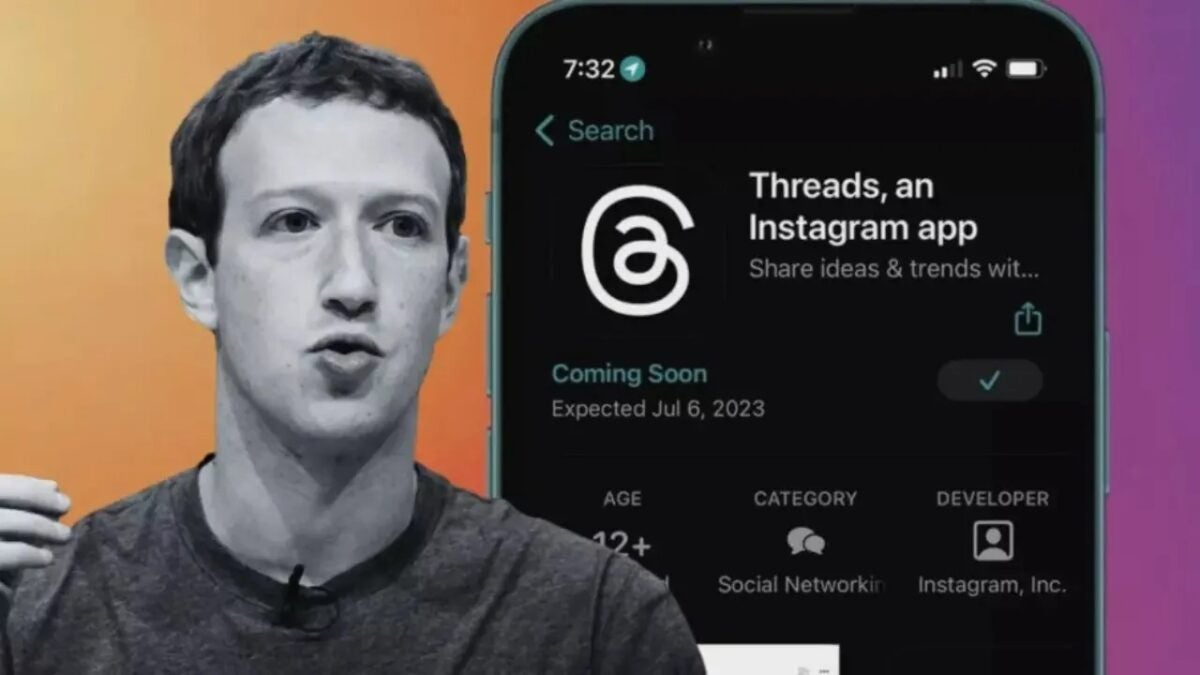
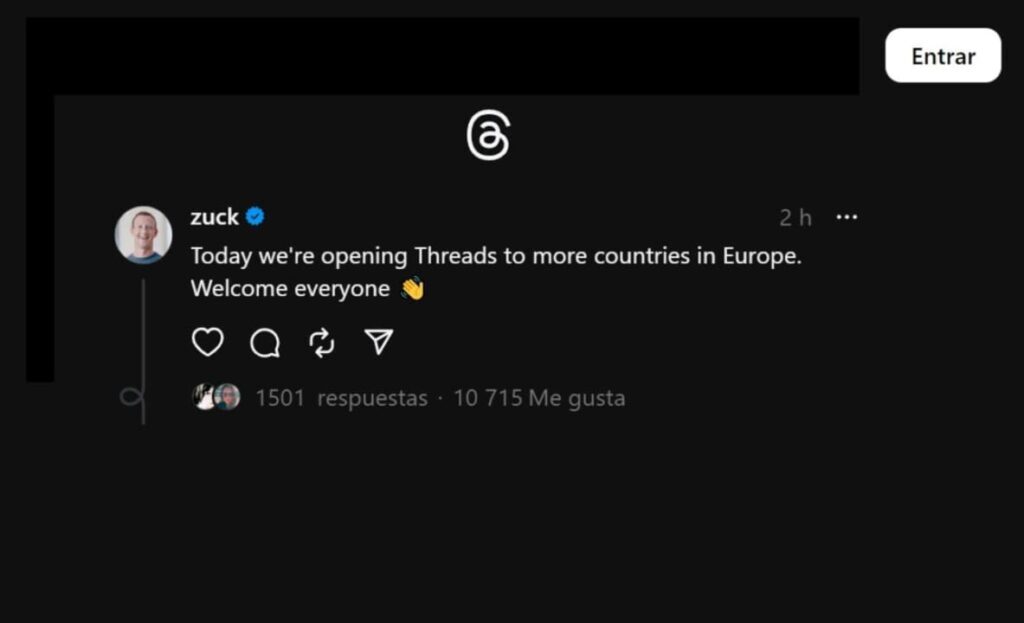
The Twitter competitor of Meta, Threads, is now available in the European Union, according to its CEO, Mark Zuckerberg. “Today we are opening Threads to more European countries,” Zuckerberg wrote in a post about Threads.
A very difficult path because of the regulators
The launch comes after the service debuted in the United States and in over 100 countries worldwide, including the United Kingdom, in July 2023.
But until now, Threads was not available to the 448 million people living in the EU, and the company has even blocked access to the service to EU users through VPN.
? Twitter rival Threads launches in Europe as the bloc’s Big Tech rules come into play.
First launched in the US, the UK and 100 other countries in July, the delay in its arrival in the EU is reportedly blamed on the bloc’s Digital Markets Act. ⤵️https://t.co/jJypKeIS43
To coincide with today’s launch, Meta offers European users the ability to browse Threads without needing a profile. However, to post or interact with content, an Instagram account will still be required.
The company’s delay in launching the service in EU countries has been largely attributed to the recent introduction in the block of the Digital Markets Law, a comprehensive legislative text designed to curb abuses by large technology companies and level the playing field.
Although Meta has not directly mentioned the regulation, Adam Mosseri, head of Instagram, has attributed the delay to “the complexity of complying with some of the laws that will come into effect next year”.
Now it’s the turn of the most unexpected: Twitch. What’s the point of an app designed to do live shows for several hours launching Stories? Go find out.
It’s part of your daily routine on social media: take a look at Twitter, watch a couple of TikTok videos, and, of course, see what your friends are up to on Instagram Stories. The social network, which borrowed the concept from Snapchat (and, in the process, left it in the dust), popularized the format in such a way that everyone wanted to jump on the bandwagon. The latest one, the most unexpected.
Twitter launched (and quickly removed) Fleets, YouTube is still trying with Shorts, Facebook has also named its version “Stories,” and even WhatsApp allows you to show everyone in your contact list what you’re up to. They are all exactly the same: short videos or photos, preferably taken in the moment, to keep creating content on whichever social network you’re using. Hey, BeReal built its entire existence on this.
Now it’s the turn of the most unexpected one: Twitch. What does an app designed for streaming hours-long live broadcasts have to do with launching Stories? Who knows. Trial and error. And it’s… well, exactly what you’re thinking. Users can share short videos on their channel that will be deleted after 48 hours. They must have really stretched their imagination to figure out how to make Stories work. Yes, they’re called that. Imagination at its finest.
For now, only partners and affiliates who have streamed once in the last month will have access to this absolutely new tool. What’s the point? Well, it will allow creators to update their lives to their followers while they are away from home or announce that they are going live hours before it happens, as they currently do on other social networks.
The problem is that where we used to find differentiation between different platforms, it’s now a mishmash of… the same thing. All the time. Without stopping. The same post repeated seven times, the same TikTok video commented on by Ibai on Twitch, re-uploaded to YouTube, retweeted on Twitter, ignored on Facebook… Is this all there is? Is there nothing more after this? BlueSky, you are our last hope.