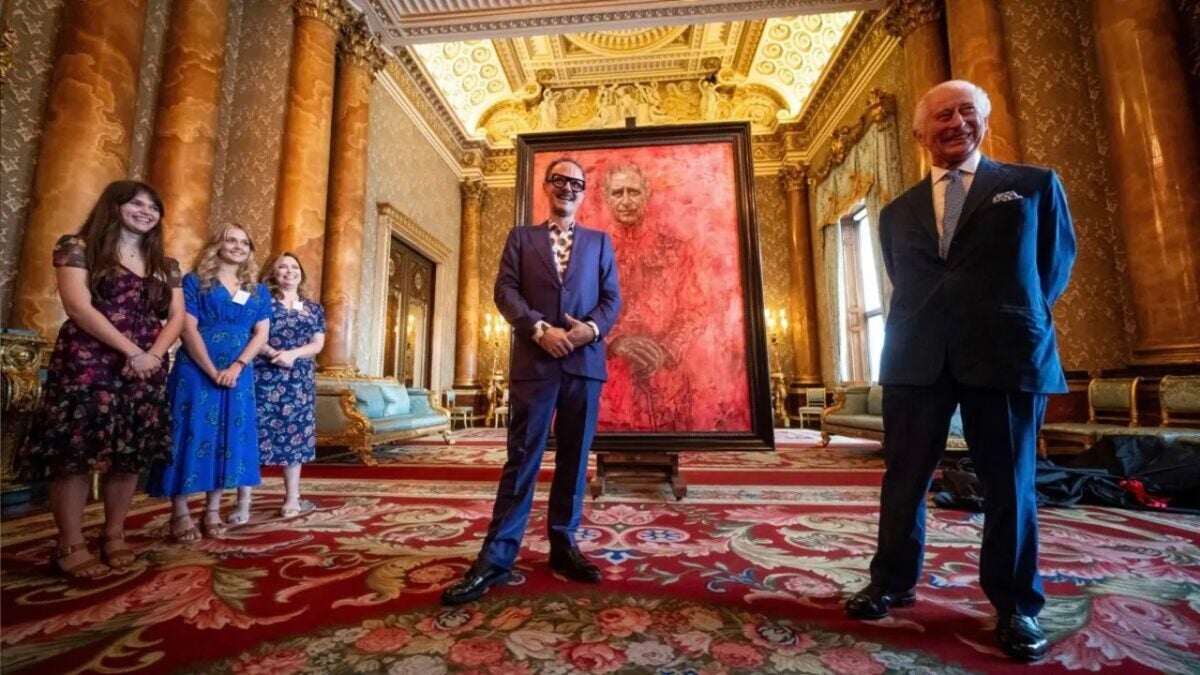
There are many traditions that, even though they are archaic, still make sense. For example, creating an official portrait of a new incoming king. In the past, it served to immortalize the rulers and give them a sense of importance, something that may not be necessary today with photography, but still holds some meaning. It is a demonstration of status. Of power. Even if it doesn’t turn out as well as the represented individuals would like.
On May 14th, King Charles III of England presented the first official royal portrait alongside Queen Camilla and artist Jonathon Yeo. The painting depicts the king wearing a scarlet uniform of the Welsh Guard, with a background of red, pink, and scarlet brushstrokes. This gives the whole ensemble an ominous and unique appearance, far from what we expect from a royal portrait. Something that, along with the inclusion of a butterfly, the painter has defined as “a symbol of metamorphosis and rebirth”. In addition to “a visual contrast with the military rigidity of the uniform and sword”.
The problem is that this painting, besides having a quite questionable adaptation to the context, does not fit at all with the image that a real portrait wants to convey. This has led people on the Internet to compare it to something that we don’t believe would please the English king: the final bosses of From Software games.
Comparisons with Dark Souls and Elden Ring have not been delayed, but they should not surprise us either. The use of colors and the contrast between the real and the military situates it well in a dark fantasy context. Even more striking is how well it fits into other contexts, such as the steampunk fantasy of Dishonored, the game from the recently closed Arkane Austin, or even in the walls of Doom, a game with which it shares a certain taste for color-based textures.
Anyone who was connected to social media trends or how memes work could have seen what was going to happen. Of course, the artistic community that can make a real portrait and the world of nobility are not exactly characterized by having a great awareness of the present. That’s why we’re not surprised that this work of art, in more than one sense, is killing Internet with laughter. Not without good reasons, if you ask us.