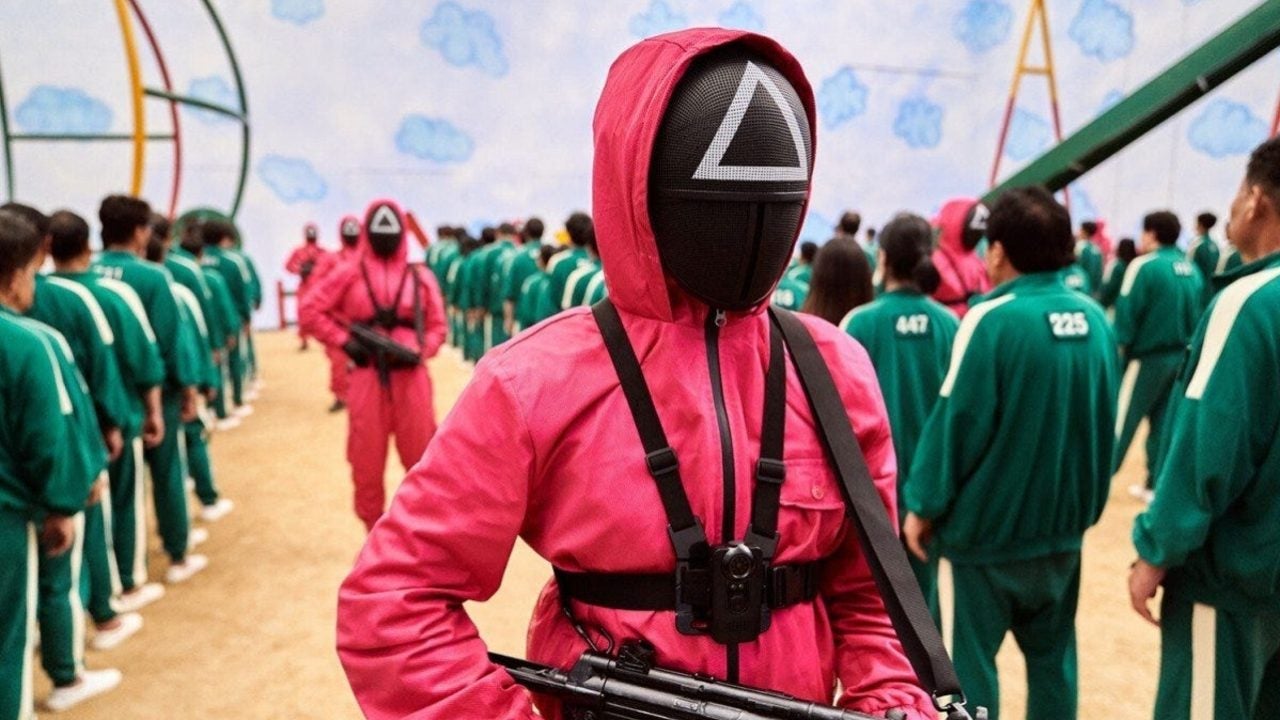
I remember perfectly the first time I heard about Squid Game: I was on vacation in Marrakech when suddenly, all of Twitter started talking non-stop about a new Korean series. A phenomenon that hadn’t been seen on Netflix since Stranger Things and Money Heist, a craziness like few others… That, in addition, had something very much in its favor: it was a good series. Hwang Dong-hyuk, its creator, became one of the most important faces in audiovisual media in the country while his series accumulated viewing hours. Currently, in fact, its season 1 still holds the record for non-English language series with 265 million views, and its subsequent seasons are following closely behind. But… what if it had been called something else? Would it have meant the same brutal success?
Give it another title. Worse, please
Originally, Dong-hyuk had thought of Squid Game as a movie that was born from his own misery: his whole family was constantly paying debts and continuously mortgaging themselves, and in fact, he lived in a Korean café where manga could be read. There he discovered survival-style comics and thought it could be his own life, after all: a fable of the most disgusting and overwhelming oppressive capitalism. What’s the problem? No one, absolutely no one, wanted to buy it because they found it grotesque and incomprehensible, so he left it at the bottom of the drawer until, suddenly, Netflix knocked on his door.
But of course, Netflix didn’t come empty-handed, and instead of respecting his original idea, they asked him to change it and turn it into a television series. And of course, what would you have done? Dong-hyuk added plots and characters, modified the structure, and finally had a perfect script to present to a Netflix that, despite everything, was not convinced about the idea of Squid Game: it was such a Korean title that probably no one would understand it in the rest of the world. Instead, they suggested calling it Round 6. Would it have had the same success?
Fortunately, the director insisted that his original title was its essence (and, after all, it should be seen as something total and not keep people waiting for the hypothetical sixth round) and, so that Netflix wouldn’t interfere, he proposed the entire visual campaign, showing how it helped to create curiosity among viewers. It took a while, though: when the series was originally announced on Netflix’s blog, it was done under the title Round Six.
For Minyoung Kim, a Korean executive at Netflix, stated that at that time they tended to underestimate the audience’s curiosity. “Trying to make it easy, we could have made a big mistake. I’m glad that director Hwang made us return to Squid Game, it sparks curiosity and captures the story very well.” Interestingly, the title proposed by Netflix survived… But only in Brazil! And the reason is quite curious.
It turns out that “squid” in Portuguese is “lula”, so the series would be called Jogo da Lula, which could sound like a clear reference to the president (then former president) Lula da Silva, who was going to run for election the following year. To avoid problems, they preferred that it simply be called Round 6. Even if it was apart from the rest of the world, it was also an unprecedented success, proving that perhaps what mattered was never the title, but what it was about.