
In reality, and although it is hard for us to believe now, Where’s Wally? started as a simple plagiarism of another book series, Busy Places, by Philippe Dupasquier, a collection of images filled with people where something is always happening, but which did not have a playful component: they were large murals to admire. However, Martin Handford, in 1986, had a different idea: to introduce, within these images, a recognizable character that had to be found by the readers. The following year, the first book of the series was published, and it was such a success that from that moment on he dedicated his life to the character, in a way, obviously, very lucrative. Will he find Wally now among his bills?
Where is the pixel?
Success, especially in the late 80s and early 90s, inevitably leads to its conversion into a franchise. Where’s Wally? ended up having seven main books (the last one in 2009), several activity and educational books, a magazine, a comic strip, two animated series – in the first one, from 1991, the screen would pause for a minute in each episode so that the viewer could find the character – cereal boxes, and even a mini-game on Google Maps. A proper Wally-mania.
But a whole generation remembers Wally for his first video game, which appeared in 1991 for NES and whose gameplay was, well, just like that of the book: an image, in this case overwhelmingly pixelated, in which you have to find the time traveler in question across 8 levels. The smoothness of Handford’s stroke became pure pixel here and finding him became a task as arduous as it was boring, almost like doing homework. Moreover, the book was cheaper than the cartridge, so… what was the reason to buy this?
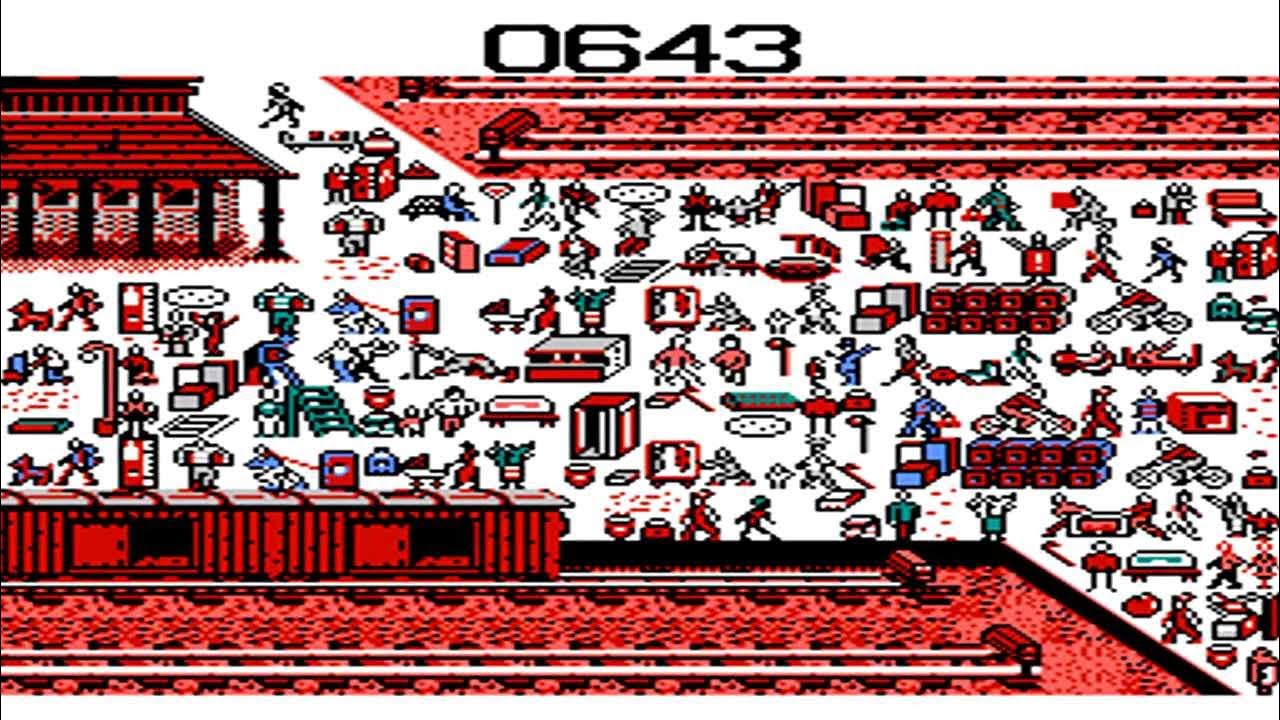
In the 8 levels, you control a magnifying glass that must be placed right above Wally to consider that you have found him and move on to the next level. There isn’t much more to it, except that in the higher difficulty levels Wally changes his outfit color to make it even harder to find him. Additionally, there were a couple of minor minigames. As you can see, it wasn’t much, but the curious thing is that behind this triviality was none other than Bethesda. Specifically, its programmers were Paul Coletta and Randy Linden, key figures in the history of video games who started their days rendering a pixelated image.
Where is the quality?
The critics ruthlessly tore apart Where’s Wally?, for obvious reasons. Beyond the fact that, indeed, Wally always appeared in a different place, thus providing variety and allowing the game to remain fresh, the graphics were dreadful, the gameplay nonexistent, and many wondered what the need was to adapt something so, at first glance, unadaptable. However, the game cost very little, made much more, and, logically, they began to plan its inevitable sequel.
In 1992, a year later, and already far from Bethesda, Where’s Wally? The Fantastic Journey was released, based on the third book of the saga, in which the player had to search for Wally, his dog, and various objects throughout the image across just five levels. In addition to NES, the game was released for Super Nintendo and Genesis, which significantly improved the clarity of the image. The idea was still a mess, but somehow, in 2009, a remake was made taking advantage of the capabilities of Wii, DS, and mobile phones.
Curiously, after this, Where’s Wally? has not returned to consoles in Europe (although it has in Japan), and on PC and mobile, it has only had a few titles that are either educational or simplistic. For now, the only thing that is clear is that Martin Handford, at 68 years old, doesn’t have to work another day in his life after selling his brand 15 years ago for two and a half million pounds. With that money in his pocket, anyone would start looking for Wally again!