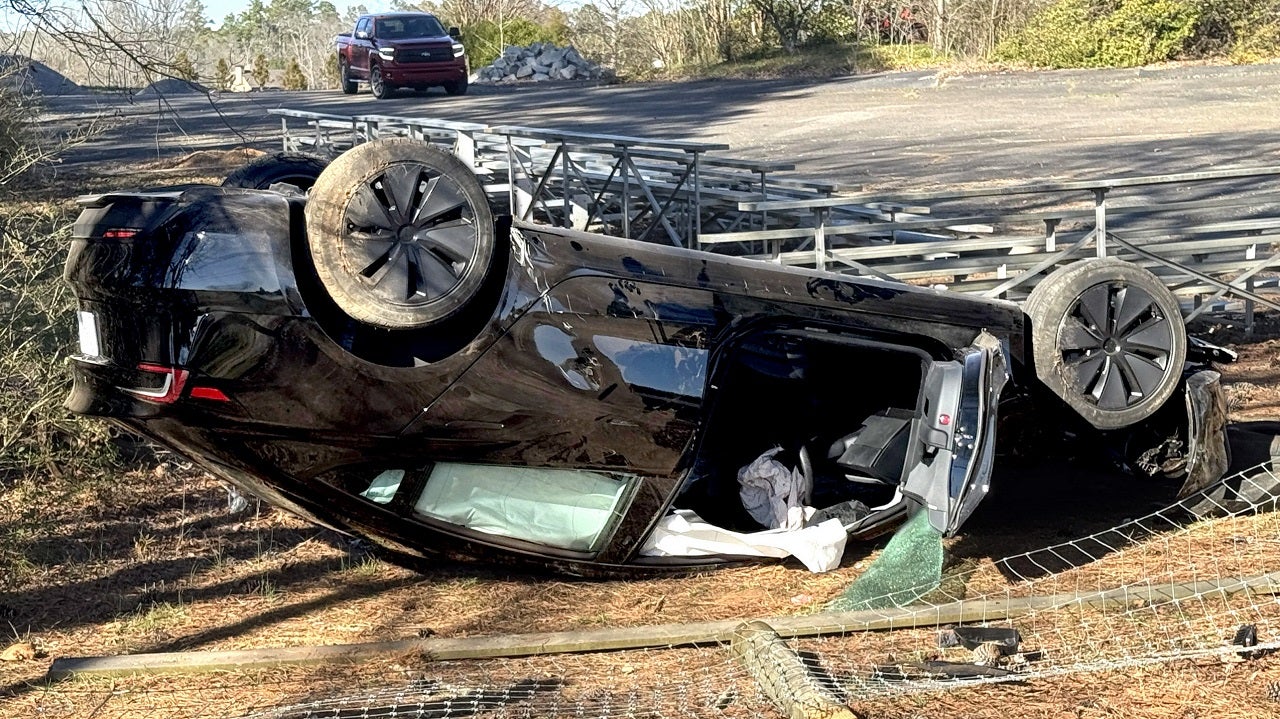
A Tesla Model 3 became embroiled in a precarious situation after it got stuck on a train track in Sinking Spring, Pennsylvania, and was subsequently struck by a train.
According to reports, the driver claimed that the vehicle was in “self-driving mode” when it approached the tracks, ignoring a barrier near South Hull Street and Columbia Avenue.
The incident prompted immediate concern from local authorities, with the fire commissioner ordering a halt to all train traffic while emergency services worked to recover the stranded vehicle using a crane.
Incident Raises Questions About Tesla’s Autonomous Driving Capabilities
The impact of the train lightly damaged the Model 3, reportedly snapping off its side mirror, but fortunately, the driver was able to exit the vehicle unharmed.
This event raises significant questions about the capabilities and limitations of Tesla’s autonomous driving systems. Tesla asserts that all vehicles manufactured since 2016 are equipped for unsupervised self-driving through future software updates, a claim that has yet to be fully realized.
Currently, Tesla sells a “Full Self-Driving” package, which costs up to $15,000 but requires constant driver supervision, keeping the responsibility on the driver at all times.
There have been multiple instances of Tesla drivers exhibiting reckless behavior, sometimes attributing their actions to the functionalities of the self-driving features. While it’s unclear if this was the case in Sinking Spring, it’s plausible to suggest that similar issues could arise during complex situations, such as navigating around construction barriers or railway crossings.
The incident underscores the pressing need for more comprehensive information about Tesla’s autonomous systems, particularly in emergency scenarios. As self-driving technology evolves, both the industry and consumers must navigate the fine line between innovation and safety, ensuring that drivers understand their responsibilities while leveraging these advanced features.
