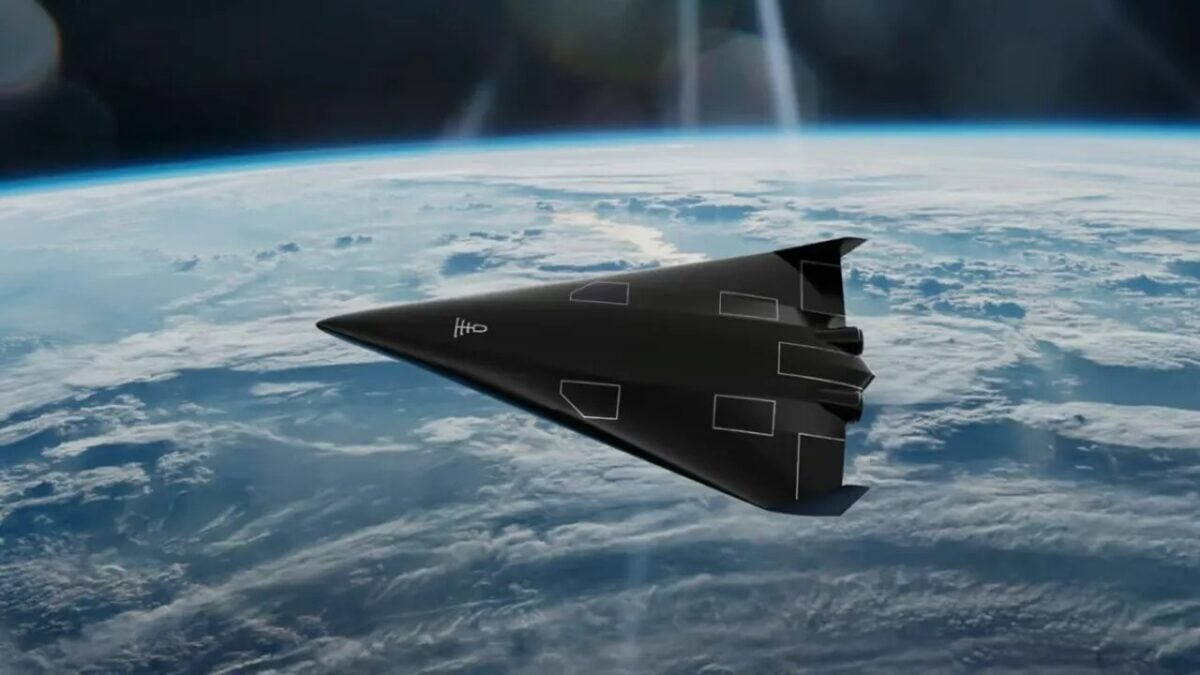
It was going to be the first test flight of an aerospike rocket engine, but the prototype MIRA I crashed on takeoff before the most innovative part of its propulsion system could be fired. Luckily for science, Polaris is building two more prototypes.

The MIRA I, from the German aerospace company Polaris Raumflugzeuge, was traveling at approximately 169 km/h during takeoff when a “landing gear reaction” and crosswind caused a “forced landing” that left the spacecraft inoperable and irreparably damaged its fiberglass fuselage.
However, instead of trying to repair the prototype spacecraft, Polaris has decided to dismantle the MIRA I, which measures 4.25 meters long, to move forward with the design of the MIRA II and III, which measure 5 meters long and are identical in shape. Basically, larger copies of the MIRA I.
An engine that has never been able to be tested in the real world
This unfortunate test was going to be the first opportunity for the MIRA I to fire its AS-1 LOX (liquid oxygen)/kerosene linear aerospike engine in a real flight, and in fact, the first time an aerospike engine was successfully tested in flight on a real aircraft.
Yes, an aerospike rocket engine, developed internally by Polaris. If it sounds like science fiction, it almost is. They were invented in the 1950s by Rocketdyne, but have never been used outside of a laboratory.

The easiest way to imagine an aerospike engine is to take a conventional rocket engine nozzle in the shape of a bell, and more or less turn it around, making the inner cross-sectional area half of the bell shape and leaving the outer part open to the atmosphere.
Why? Traditional bell rockets can only operate at maximum efficiency at a specific altitude, defined by the shape and size of the bell. As the rocket’s altitude increases, atmospheric pressure decreases and efficiency decreases, so different rocket stages are required, using different shapes and sizes of bells for different phases of a launch.
Although I didn’t have the opportunity to test this technology in flight, the new MIRA II and III will have the same propulsion arrangement: four kerosene jet turbines and the only aerospike rocket engine AS-1 that was equipped in the MIRA I. The main difference is the size of the fuselages.
Another factor that sets the MIRA project apart is its delta wing fuselage, designed to be completely reusable for transportation to and from orbit. If everything goes as planned, it will be able to transport payloads or passengers like a fully functional, reusable, single-stage-to-orbit (SSTO) spacecraft.
