
For many of us, the Hubble Space Telescope is one of the most iconic elements of space exploration. We can’t envision capturing stars without its signature at the bottom of the image. Without the Hubble, the James Webb wouldn’t exist.

The Hubble Space Telescope should have been retired for about 13 years by now, as it has been functioning in space for over 30 years, and NASA itself confirmed that it has been experiencing issues since 2010. And it’s not its fault; it wasn’t designed to work for such a long period.
However, the veteran telescope soldiers on. Recently, it has captured images of a massive galaxy cluster that could hold secrets about both dark and ordinary matter.
A bright galaxy full of secrets
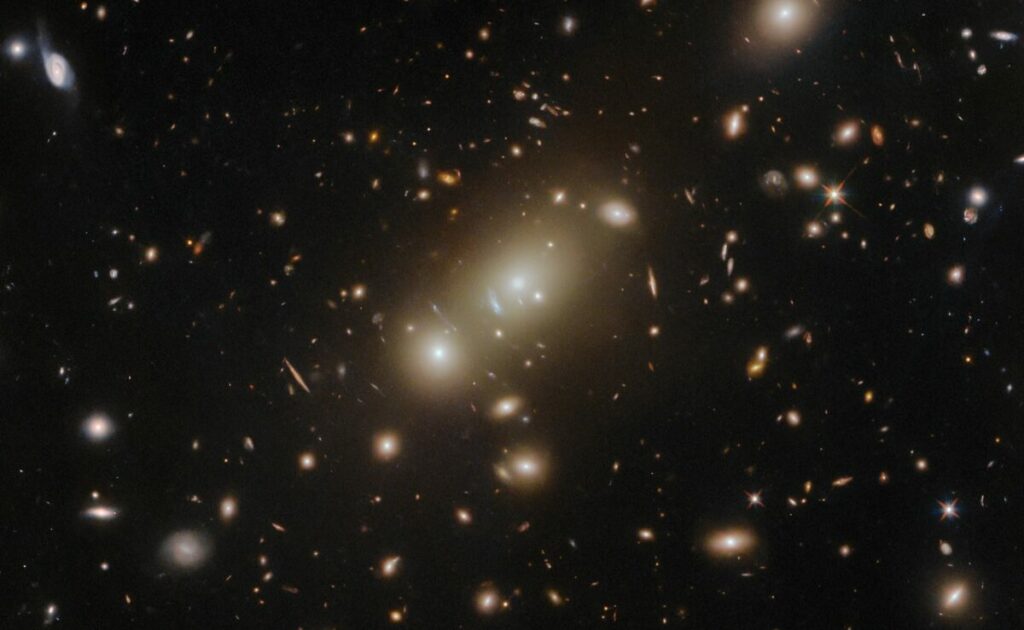
At the heart of the recent image captured by the Hubble of Abell 3322 lies 2MASX J05101744-4519179, an exceptionally bright galaxy. The image was taken by Hubble’s Wide Field Camera 3 and its Advanced Camera for Surveys, third-generation instruments that capture images in near-infrared and visible light wavelengths.
Three galaxies in the image shine brighter than the rest (two at the center and one in the upper-right corner). The alignment of these galaxies indicates to scientists that the galaxy cluster appears to be actively forming, according to a statement from the European Space Agency.
Dark matter isn’t literally ‘dark’; it’s only dark to us. In simpler terms, we don’t know what it is. It could be various things or a challenging-to-detect particle. Dark matter barely interacts with ordinary matter, making its understanding difficult, and it has never been observed directly.
However, scientists are aware of its existence due to its gravitational effects. Halos of dark matter manifest around some galaxies and galaxy clusters, and regions with gravitational lensing serve as fertile hunting grounds for dark matter candidates.
In the recent image, some galaxies appear distorted or flattened; these are gravitational lenses, which means their light is bent and refocused by the gravitational field between them and the Hubble.
The two primary candidates for dark matter are Weakly Interacting Massive Particles (WIMPs) and axions, a theoretical particle named after a laundry detergent.
At the beginning of this year, a team of astronomers found indications of dark matter resembling axions in Einstein rings, particularly in images of HS 0810+2554, a distant quasar. Einstein rings are striking circles or near-circles of light in space caused by intense gravitational lenses.
A greater number of observations of regions in space where dark matter appears to be at work will assist researchers in understanding how the matter that composes it interacts with the observable world.
Combined with laboratory investigations of dark matter candidates, we are edging closer to shedding light on some of the most concealed physics of space… and one step closer to comprehending the universe.
Dark matter is something we have considered real for the past 100 years, but its study is exceedingly challenging and elusive. The ability to obtain clear images that aid in the study of this matter could be pivotal for the future of physics and astronomy. If we aim to reach for the stars, there’s no other way.
Some of the links added in the article are part of affiliate campaigns and may represent benefits for Softonic.
