
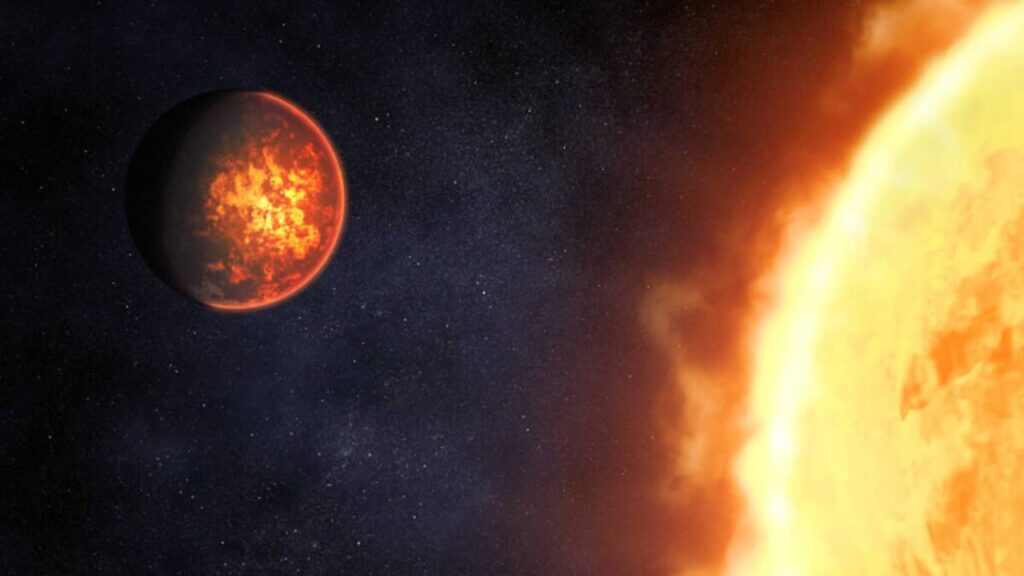
A newly discovered volcanic exoplanet has left astronomers speechless as it has a surface hotter than some stars. TOI-6713.01, as the exoplanet has been named, is located 66 light-years away from Earth and is surrounded by a magma ocean that makes it look like something out of a science fiction world.
Described as “Io on steroids” by Stephen Kane from the University of California, Riverside, this exoplanet surpasses Jupiter’s volcanic moon in terms of volcanic activity, which is considered the most volcanic body in our solar system.

With a size 30% larger than Earth, TOI-6713.01 orbits the star HD 104067 every 2.2 days, at a distance of 4.57 million kilometers. This planetary system also hosts two equally impressive worlds: one rocky and one gaseous, in orbits comparatively close to their host star. The elliptical orbit of TOI-6713.01 brings it almost into contact with its star, experiencing gravitational tides that trigger a “tidal storm” as it approaches, stretching and twisting its molten interior.
The energy generated by these tidal forces causes a constant volcanic activity on the surface of the exoplanet, raising its temperature to an incredible 2,600 kelvin (2,327 degrees Celsius), which exceeds that reached in some low-mass stars. Stephen Kane emphasizes that, although stars contribute to the heat of a planet, most of the energy in TOI-6713.01 is tidal.
The HD 104067 planetary system was initially discovered in 2011 by the High Accuracy Radial velocity Planet Searcher (HARPS), a planet-searching instrument at the La Silla Observatory in Chile. Subsequently, the third planet, TOI-6713.01, was identified in several observations from the Transiting Exoplanet Survey Satellite (TESS), a telescope of NASA.
The discovery of the exoplanet TOI-6713.01 provides a fascinating insight into the limits that terrestrial planets can reach under extreme conditions, as well as the importance of considering tidal energy in understanding the habitability of other worlds.
