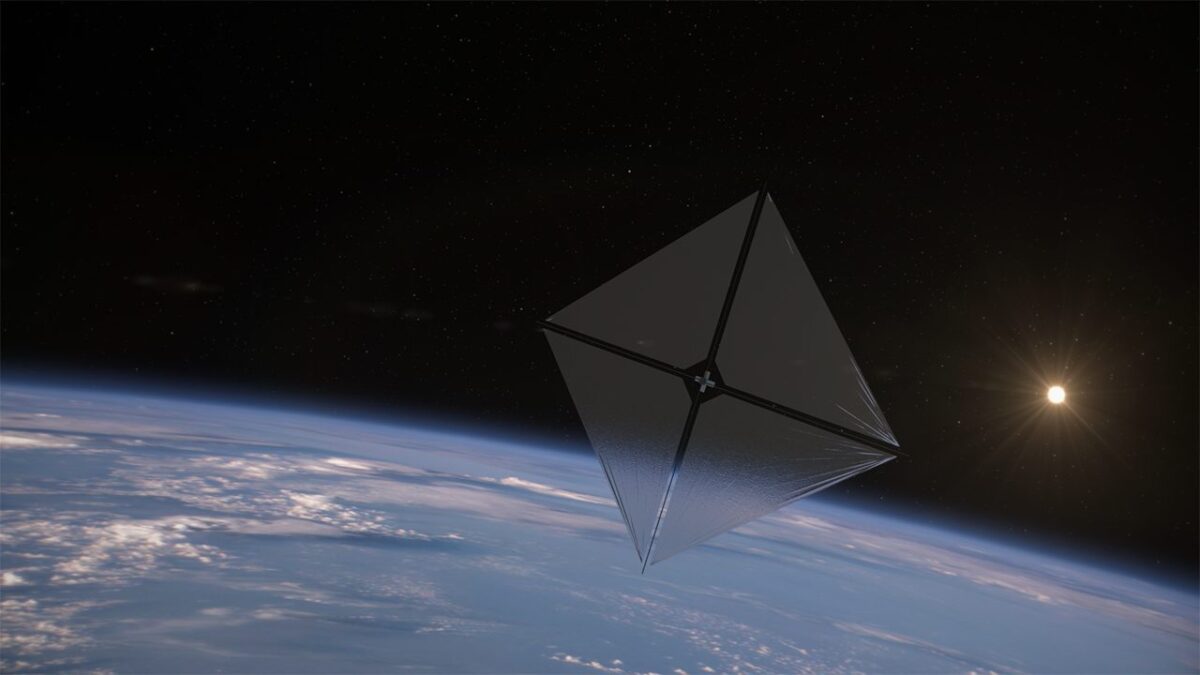
The NASA has successfully deployed its innovative solar sail, known as the Advanced Composite Solar Sail System (ACS3). This sail, launched into space aboard the Rocket Lab’s Electron rocket, was successfully deployed along with the supporting arms, marking a key milestone in the mission to demonstrate the functionality of this technology in low Earth orbit.

Last Thursday at 7:33 CEST, the ACS3 team officially confirmed the deployment of the sail, a crucial event that will allow the spacecraft to use only photons from the sun for propulsion. Conceptually, NASA’s solar sail evokes ancient ships that sailed the seas powered by the wind, although in this case, the spacecraft moves thanks to the pressure exerted by sunlight on the reflective sail. This propulsion method, unlike traditional systems that depend on fuel, is only limited by the durability of the materials and the efficiency of the control systems.
The ACS3 is a twelve-unit CubeSat (12U) built by NanoAvionics, with a size comparable to that of a microwave, which deploys its approximately 80 square meter sail using flexible polymer and carbon fiber booms. These new booms, more durable and less prone to deformation, represent a significant improvement over previous designs, being more compact and offering the necessary rigidity to support the sail.
Alan Rhodes, chief systems engineer for the mission at NASA’s Ames Research Center, highlighted the innovative capability of these arms, stating that “seven meters of deployable bars can be rolled up to fit in the hand”.
The spacecraft, which will orbit the Earth at an altitude of approximately 1,000 kilometers, will be visible from our planet on clear nights thanks to the high reflectivity of its sail. The data collected during the ACS3 tests will be used to develop future solar sail systems that will be used in early warning missions for space weather, surveillance, and solar observation.
