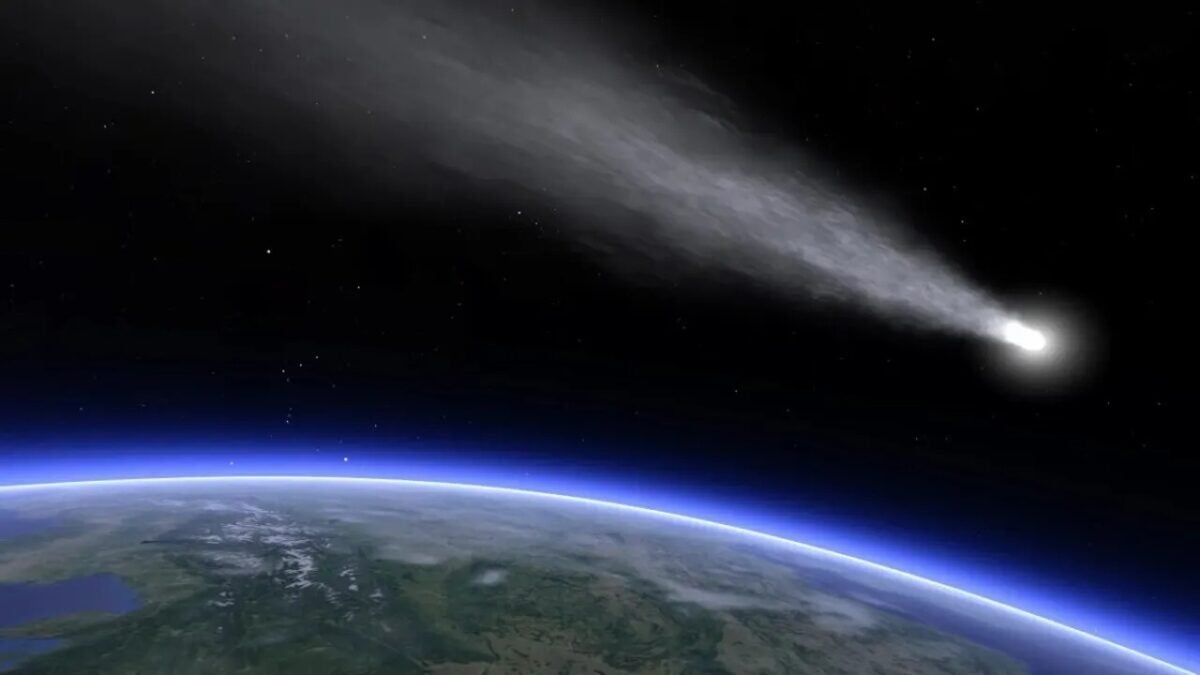
For many, Halley’s comet is like that older aunt who comes to visit us once in a lifetime. You have affection for her, despite not seeing her in decades. For humanity, Halley’s comet is a magical phenomenon that has accompanied us since we populated the Earth.

One of the most famous comets is heading back to Earth. On December 9, 2023, Halley’s comet reached its aphelion – its farthest point from the Sun – and turned towards our planet for its next appearance in the 2060s.
And if you’re worried that the comet will crash into us, there’s nothing to worry about, there are no options. It’s not even close to colliding with Earth.
History and Fun Facts about Halley’s Comet
Like all the comets we know, it is made of dusty ice, part of which burns to create a majestic tail as the body approaches the Sun.
Currently, the comet is located further than Neptune, at just over 5.000 billion kilometers from the Sun, so far away that it is out of sight even from our largest telescopes, and it has been like this since 2003. Halley’s comet will pass by our planet again on July 29, 2061, coinciding with its 76-year cycle.
So, why is there so much talk about this space rock, among the millions that exist in the solar system, and why has it fascinated humans so intensely throughout history?
In reality, people have been observing it for generations, with sightings recorded since 240 BC. For most of human history, we didn’t know what to call this mysterious visitor from outer space.
As expected, something so unknown and unpredictable (at that time) was greatly feared and considered a bad omen or the omen of a disruptive change. The comet supposedly announced the defeat of Attila the Hun in 451 and the widespread conquest of the Ottoman Empire in 1456.
Genghis Khan even took the comet as a sign to lead his armies in 1222, dramatically expanding his territory and fathering many children along the way, so many, in fact, that 1 in every 200 men may be his descendant.
Around 1705, the British scientist Edmond Halley observed three comets with surprisingly similar orbits, seen in 1531, 1607, and 1682. He came to the conclusion that they were actually the same comet, which passed by every 76 years, and predicted that it would appear in 1758.
Although he did not live to see it, his prediction came true, changing our perspective of the cosmos. Despite the identification and explanation of the comet as a regular part of the cosmos, the appearance of Halley in 1910 caused widespread panic.
An astronomer pointed out that the Earth would encounter the gaseous tail of the comet, filled with toxic cyanogen gas.
In the 2060s, there probably won’t be panic about this comet. For most of us, it will undoubtedly be a cosmic event that happens once in a lifetime (or twice, if you’re lucky) and is worth appreciating.
