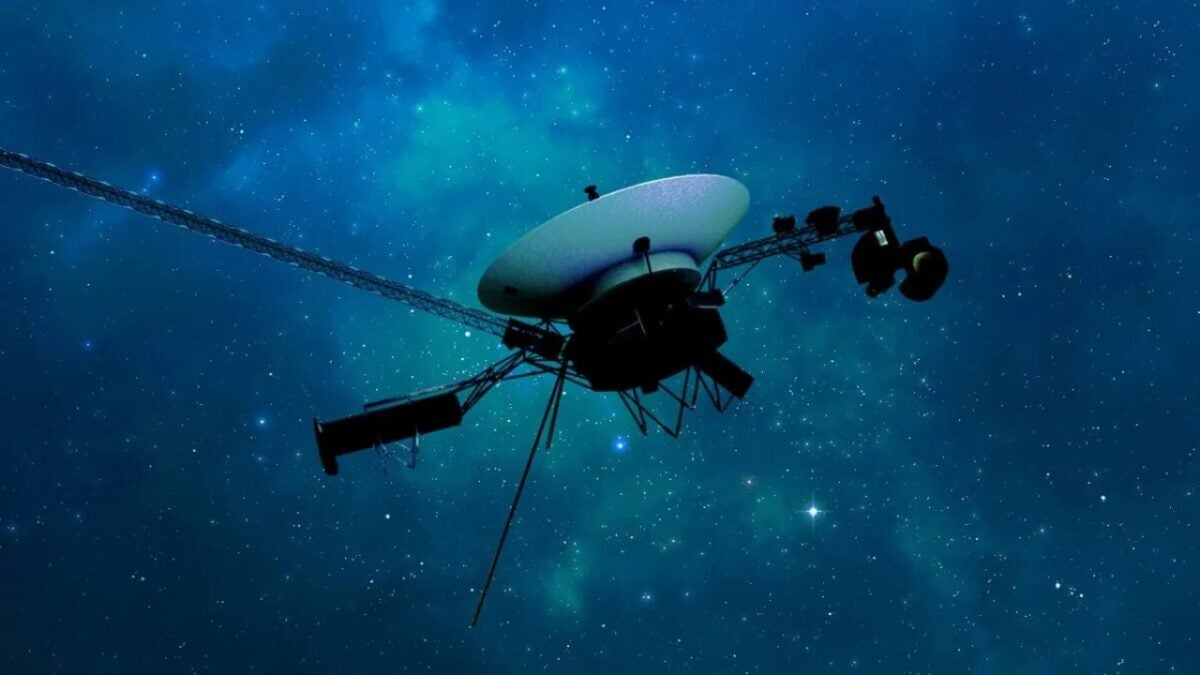
The NASA has managed to get the Voyager 1 probe, which has been traveling through space for 47 years, to send engineering data for the first time since November 14th.Until now, the only thing the spacecraft could send was a jumble of words.

We are so used to seeing how technology quickly fades into obsolescence that it is easy to consider it fundamentally ephemeral. Even the best smartphones usually don’t last more than 6 years of use.
Therefore, it is somewhat surprising to find not one, but two pieces of complex technology that have been functioning on their own for almost half a century while being 24 billion kilometers away from Earth.
Five years of life expectancy and we are on our way to fifty active years
When Voyager 1 and 2 were launched in 1977, it was only expected that they would operate for five years and be retired shortly after their visits to Jupiter, Saturn, Uranus, and Neptune. However, their lifespan has been multiplied by 10 despite having crossed Jupiter’s deadly radiation belts and having been exposed for decades to cosmic rays and extreme cold as they moved away from the solar system.
This is an impressive figure for a spacecraft that uses microchips developed before the first desktop computers hit the market. It is even more impressive when you consider that the team that launched the Voyager missions has long since retired or passed away, and the manuals they left behind have yellowed with time.
The only comparables are the intercontinental ballistic missiles Minuteman from the United States, which still operate with eight-inch floppy disks, just like the United States air traffic control system.
Over the years, Mission Control has been responsible for taking care of the Voyagers to extend their lifespan. Systems that are not in use are turned off and those that are turned off are recovered to replace the ones that fail. It is also important to consider the delicate handling of energy, as engineers closely monitor the nuclear power systems, which inevitably deplete their plutonium fuel.
However, all of this would be useless without the onboard computers, which not only collect and transmit scientific data to Earth, but also provide vital engineering telemetry about the systems of each spacecraft.
Last November, Voyager 1 experienced a alarming malfunction when it sent what can only be described as a series of nonsensical words. The probe was still receiving commands, but the engineers had no idea what was happening.
Since then, attempts have been made to correct the problem, but it is a long and tedious exercise, as each radio signal sent takes 45 hours to receive a response due to the enormous interplanetary distances.
Fortunately, a signal sent in March caused Voyager 1 to send a copy of its entire memory. This allowed engineers to narrow down the problem to a single microchip that either had worn out or had been hit by a cosmic ray particle.
According to NASA, Mission Control has found a way to solve the problem of the damaged chip, although primitive computers, with their small memories, make it a bit difficult.
The method consists of dividing the affected code into sections and moving them to different parts of the Flight Data Subsystem (FDS). The difficult part is labeling the different sections and making them work together again as a whole.
If this repair is successful, NASA hopes to have Voyager 1 send back its scientific data with a similar repair.
