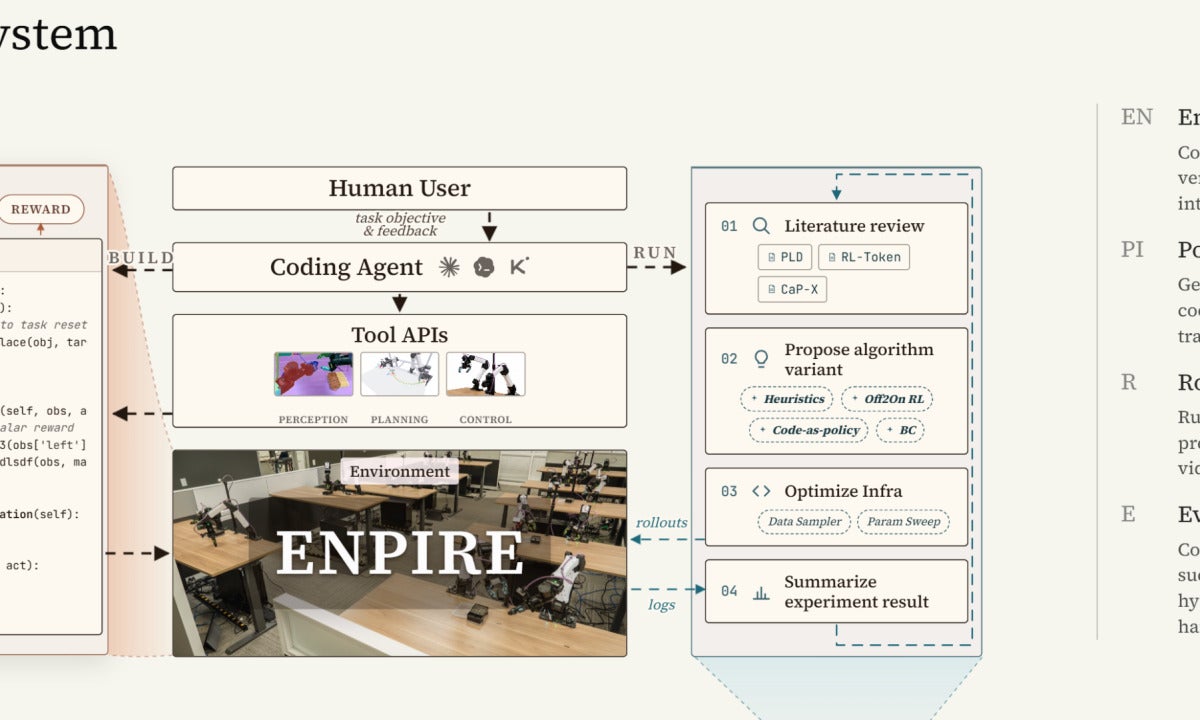
Nvidia has unveiled ENPIRE, a research system built with Carnegie Mellon University and the University of California, Berkeley. The idea is simple enough: train robots on real hardware instead of only in simulation, and do it with very little human involvement.
Nvidia says ENPIRE runs a fully autonomous loop from start to finish. It resets the workspace, tries a strategy, checks the result, and updates its policy.
In the company’s testing, eight robots reached success rates as high as 99% on manipulation tasks that would normally need manual resets, hand-built reward functions, and close engineering oversight.
Those tests covered Push-T, sorting pins into a box, cutting or fastening cable ties, pin insertion, and assembly-style work like installing a GPU into a motherboard.
Nvidia also says ENPIRE can generate reward functions and success checks from only a few minutes of success-and-failure video. It does that by using visual alignment, gripper height, estimated force, and views from two cameras, while keeping response times under 150 ms.
If you follow robotics, this one deserves a look.
After a lightly supervised initial setup, Nvidia says eight dual-arm YAM stations can share code through Git, read papers, test hypotheses, and decide whether behavior cloning or reinforcement learning makes more sense.
In one example, Nvidia says ENPIRE reached 100% pin insertion faster than a human-in-the-loop baseline. The company says ENPIRE builds on Nvidia’s Eureka, which beat human-written rewards on more than 80% of tasks, with gains above 50%, and Nvidia plans to open-source ENPIRE alongside Project GR00T and Nvidia Isaac.

Author: Anthony John Padilla
{
"social": {
"email": "content.reviewer90@ext.softonic.com",
"facebook": "",
"twitter": "",
"linkedin": "https:\/\/www.linkedin.com\/in\/anthony-padilla-330a04299\/"
},
"ja-JP": "",
"de-DE": "Anthony Padilla ist ein auf den Philippinen ansässiger Schriftsteller mit Erfahrung in redaktionellen, digitalen und markenorientierten Inhalten. Seine Arbeit konzentriert sich darauf, komplexe Ideen in klare, verständliche Texte umzuwandeln.",
"en-US": "Anthony Padilla is a Philippines-based writer with experience across editorial, digital, and brand-focused content. His work centers on translating complex ideas into clear, accessible copy, with a strong emphasis on structure, accuracy, and user-focused communication. He has contributed to long-form articles, product and platform copy, and marketing-led editorial pieces.",
"es-ES": "Anthony Padilla es un escritor con base en Filipinas con experiencia en contenido editorial, digital y enfocado en marca. Su trabajo se centra en traducir ideas complejas en textos claros y accesibles.",
"fr-FR": "Anthony Padilla est un écrivain basé aux Philippines ayant de l'expérience dans le contenu éditorial, numérique et axé sur la marque. Son travail consiste à traduire des idées complexes en textes clairs et accessibles.",
"it-IT": "Anthony Padilla è uno scrittore con base nelle Filippine con esperienza in contenuti editoriali, digitali e focalizzati sul brand. Il suo lavoro si concentra sulla traduzione di idee complesse in testi chiari e accessibili.",
"nl-NL": "Anthony Padilla is een schrijver gevestigd op de Filipijnen met ervaring in redactionele, digitale en merkgerichte content. Zijn werk richt zich op het vertalen van complexe ideeën naar helder, begrijpelijke teksten.",
"pl-PL": "Anthony Padilla to pisarz mieszkający na Filipinach z doświadczeniem w tworzeniu treści redakcyjnych, cyfrowych i skoncentrowanych na marce. Jego prace skupiają się na przekształcaniu skomplikowanych idei w jasne, zrozumiałe teksty.",
"pt-BR": "Anthony Padilla é um escritor baseado nas Filipinas com experiência em conteúdo editorial, digital e focado em marca. Seu trabalho se concentra em traduzir ideias complexas em textos claros e acessíveis."
}
View all posts by Anthony John Padilla