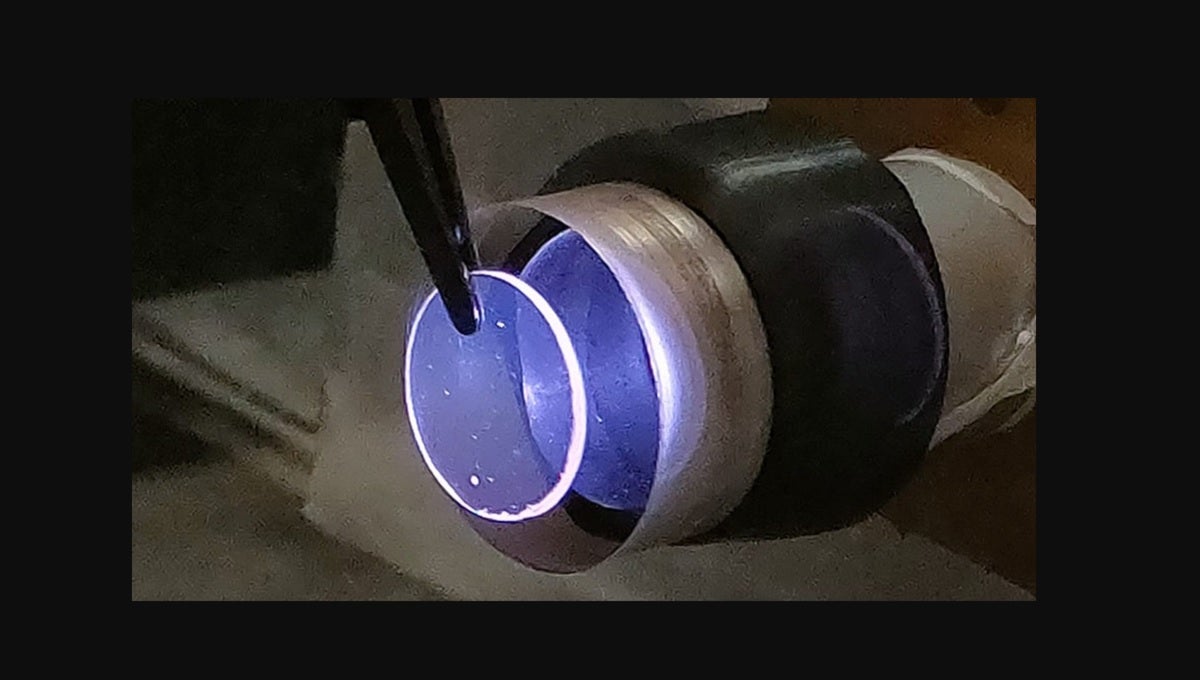
Researchers at the University of Chicago have made a significant breakthrough in data storage capacity using an innovative technique that utilizes atomic-sized crystal defects.

This technique allows for the storage of terabytes of information in a cube just one millimeter in size, a development that could transform the way we conceive and use digital memory.
Tian Zhong, assistant professor at the Pritzker School of Molecular Engineering, highlighted that inside this millimeter cube there are at least one billion classical memories based on atoms.
The future of information is crystals
This approach combines principles of solid-state physics applied to radiation dosimetry with advances in quantum storage, significantly improving traditional non-volatile memories.
The research suggests that this new methodology could be comparable, and even superior, to the so-called “5D memory crystals,” which promise to store 360 terabytes in an area of 5 square inches.
Evaluating the figures, a cubic millimeter could offer between 2 and 3 terabytes, which implies that, based on equivalent measurements, these memory crystals present a comparable potential.
Leonardo França, postdoctoral researcher and lead author of the study, explained that his work is based on the intersection between quantum systems and optical data storage.
By integrating radiation dosimetry methods and quantum storage, researchers have found a place where traditional and emerging technologies can coexist and complement each other.
As the demand for quantum systems and the need to improve storage capacity continue to grow, this type of research is at the center of a field that promises to revolutionize not only the technology sector but also applications in medicine and beyond.