Google cancels a contract with a major AI data company

Google has terminated a contract it had with Appen, an Australian data company that participates in training the language models used in Bard, search, and other Google products. This happens at a time when competition in the world of artificial intelligence is becoming increasingly fierce, and more and more companies are creating their own generative AI.
Bard ACCESS

“Our decision to terminate the contract was made as part of our ongoing effort to evaluate and adjust many of our partnerships with suppliers across Alphabet to ensure that our supplier operations are as efficient as possible,” said Google spokesperson Courtenay Mencini to The Verge.

On the other hand, Appen notified the Australian Stock Exchange in a statement, stating that “it had no prior knowledge of Google’s decision to terminate the contract”. As The Verge comments in its article, workers from companies like Appen are usually responsible for many of the most unpleasant parts of AI training and are generally the lowest paid and often overlooked backbone of the entire industry.
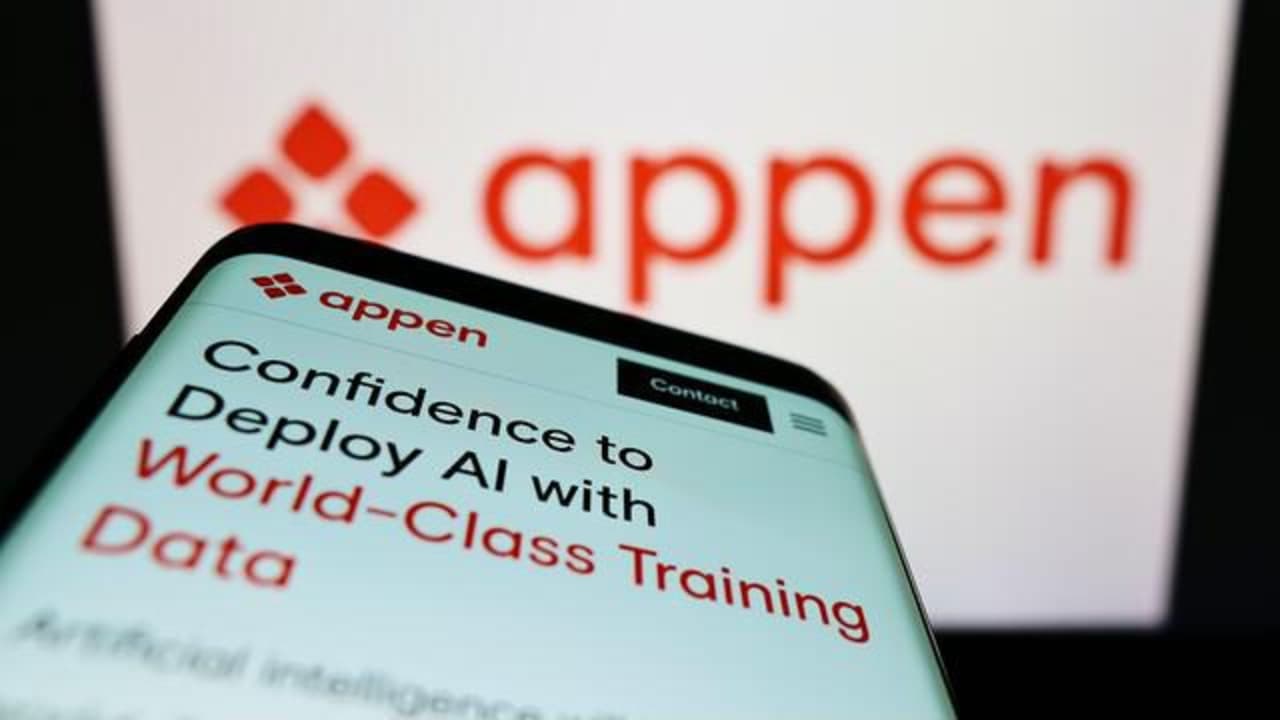
Appen employees are responsible for evaluating the quality of data and responses from AI models. As reported by Fast Company last year, some Appen employees who are members of the Alphabet Workers Union asked Appen to increase wages from $10 to $15 per hour. Although the union achieved several wage increases, the desired amount was not ultimately reached, and many of these workers were fired due to “business conditions”, according to Appen.

Bard ACCESS

Appen has also helped train AI models for Microsoft, Meta, and Amazon, according to CNBC. The company stated in a presentation that its work with Google had a significant impact on its revenue, which amounted to $82.8 million in 2023 alone. Mencini added that Google is working closely with Appen to make the transition “as smooth as possible”.
Will Google Bard have a paid version?

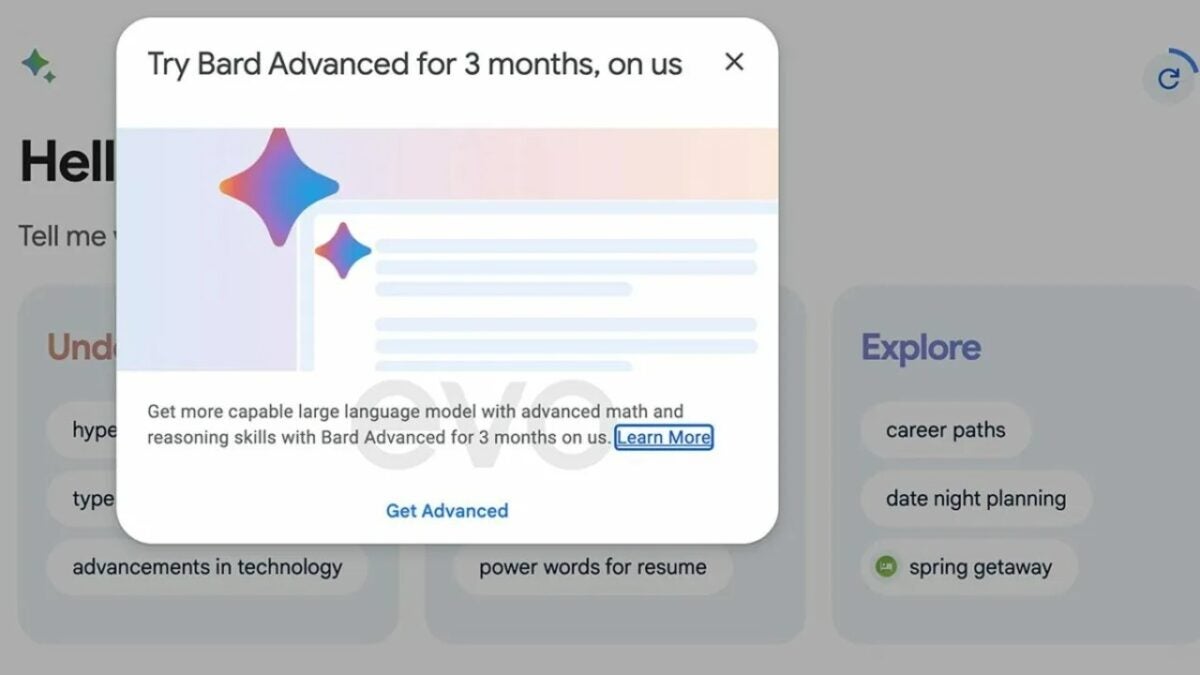
Google would be developing an improved version of its AI chatbot Bard, called “Bard Advanced”, which will be available through a paid subscription to Google One, as shared by developer Dylan Roussel on Twitter.

Bard ACCESS

Roussel states in his publication that Bard Advanced would work with Gemini Ultra, the top level of the recently announced large language model by Google. This is an improvement over the current version of Bard, which uses Gemini Pro, the middle level.

One of the screenshots shared by Roussel describes Bard Advanced as a “larger language model with advanced mathematical and reasoning abilities”. The developer Bedros Pamboukian also discovered a code string that suggests Google is working on an “advanced” level.

In addition, Roussel found more updates than the ones he shared screenshots of, including a feature codenamed “Motoko” that could allow users to create custom bots. However, there is no indication whether users will be able to share these bots or if they will have to pay to access this feature. Last year, OpenAI announced that it will allow GPT Plus subscribers to create and share custom bots.

Google could also introduce a new “powering up” feature that uses AI to enhance and improve the instructions you give to Bard. According to Roussel, there is also mention of a “Gallery” section that, as speculated, will allow you to “explore different topics to see what you can do with Bard”.

Bard ACCESS

Other small adjustments revealed by the screenshots include a new “tasks” tab that users could use to keep track of longer jobs they are working on Bard, such as image generation, and a way to add a custom background for Bard’s prompts shared by users.

This is Google’s AI that could answer questions about you that you don’t even know

Google is developing an artificial intelligence assistant that will analyze personal photos, files and search results with the aim of counting…

Artificial intelligence is something that humans have been searching for since the 16th century, when the first automatons began to be created. What we didn’t know is that, at the end of the journey, this AI could be our replacement… for better or for worse.

Bard ACCESS

And now, in the midst of 2023, Google is working on an AI assistant that could answer ‘impossible’ questions about you.

Google is developing an artificial intelligence assistant that will analyze personal photos, files, and search results with the aim of telling “the story of your life.” A story that you yourself might not even know how to tell.

Welcome to the Ellman Project

The American media outlet CNBC has seen documents revealing that the tech giant recently held an “internal summit” where company executives and employees presented Project Ellman.

According to the article, the AI will offer a “bird’s-eye view” of a person’s life, extracting files from their Google account and using written biographies and adjacent content to understand the context.

This process involves sifting through information files to highlight significant moments. Google employees claim that Project Ellman can deduce a user’s date of birth, who their parents are, and if they have siblings.

And it doesn’t stop there because apparently, it can highlight chapters of your life, like the years spent in college or living in a specific city. Ellman can even learn about your eating habits.

For instance, if you upload a lot of photos of pizza and pasta, the AI might deduce that you’re a big fan of Italian food. The technology isn’t limited to just one person either, as it can identify friends and family, as well as social events you’ve attended.

Bard ACCESS

Your most useful chatbot, your other super-intelligent self

CNBC states that the presentation continued with the demonstration of Ellman Chat, described as ChatGPT but with the ability to “answer previously impossible questions.”

Judging by the examples given, the questions aren’t necessarily impossible; just challenging, especially if you’re forgetful. For instance, you can ask the chatbot when was the last time your brother visited or for suggestions on a place to move based on the photos you upload.

So, we come to what might be one of the secret purposes of Project Ellman. Analyzing the screenshots users upload, the technology can make all sorts of predictions, from products you might buy to interests you might have, even including future travel plans. Project Ellman might know you better than you know yourself.

Gemini, Google’s new large language model (LLM), appears to be the model that will power Project Ellman because it’s multimodal, meaning it can accept multiple forms of input besides text.

Of course, there are no guarantees that Ellman will come to fruition. A Google spokesperson told CNBC that this is an “early internal exploration.” If there are plans for a launch, developers will take their time to ensure it’s helpful for people while keeping user privacy at the forefront.

We will have to wait quite a bit longer to see Google’s new AI

Google has delayed the release of its Gemini, its next-generation AI chatbot, and will keep it under wraps until next year. The company announced its new language model at I/O 2023, stating that it would be the foundation for the next generation. Its debut was set for next week; however, Gemini won’t see the light until January 2024.

Bard ACCESS

According to The Information, this multimodal chatbot, which would be the most powerful conversational AI created to date by Google, was set to make waves around the world next week at a series of events, starting in California, New York, and Washington, where the presence of American politicians and lawmakers was expected.

However, after some internal investigations, Google’s CEO, Sundar Pichai, reportedly decided to once again postpone the launch of Gemini upon discovering that the AI didn’t handle certain queries that weren’t in English very well.

The compatibility with languages from around the world is a crucial factor for Google to ensure that Gemini surpasses GPT-4, OpenAI’s AI. This is of significant importance to Google, which has opted to delay one of its most anticipated releases to guarantee an adequate level of quality.

It’s also been said that Gemini might have significantly outperformed GPT-4 in private tests, thanks to the utilization of greater computational power compared to the latter. Pichai stated in November that “the company is focused on releasing Gemini 1.0 as soon as possible, ensuring it’s a competitive and cutting-edge product, and from there, we’ll continue building.”

Sissie Hsiao, vice president and director of Bard and Google Assistant, explained Gemini’s feats with an example: “I’ve seen incredible things. For instance, if I’m trying to make a pie, I just have to sketch out 3 steps to make a three-layer pie, and Gemini will create those images. They are entirely new images, not just images from the internet.”

Bard ACCESS

A deep dive into the Bard YouTube Extension experience

The Bard YouTube extension by Google is a chatbot designed to simplify your video engagement. However, this new enhancement might not be good for all of the parts. But first, let’s understand what is capable of it.

It dissects videos using prompt-driven interactions, allowing users to skip through content and quickly access specific details.

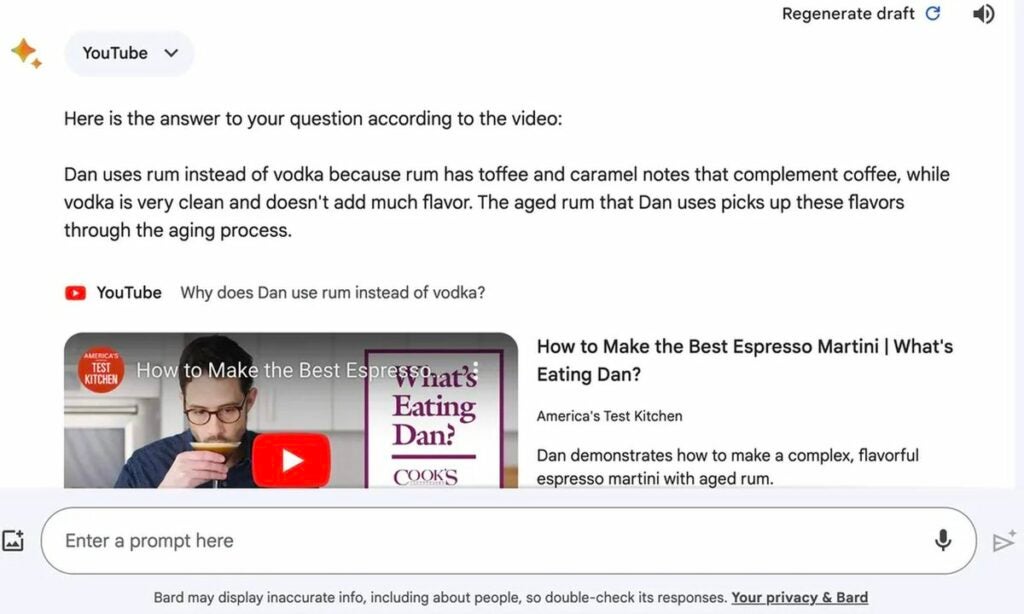
The accuracy of the YouTube Bard extension is evident in practical examples, including a test conducted on a video from America’s Test Kitchen by Verge, known for its recipe content. In this specific instance, the user queried Bard about the recipe for an Espresso Martini, and Bard successfully extracted accurate information, providing details on ingredients and step-by-step instructions. This showcases Bard’s proficiency in comprehending and summarizing content effectively, enhancing user experience.

(Credit)

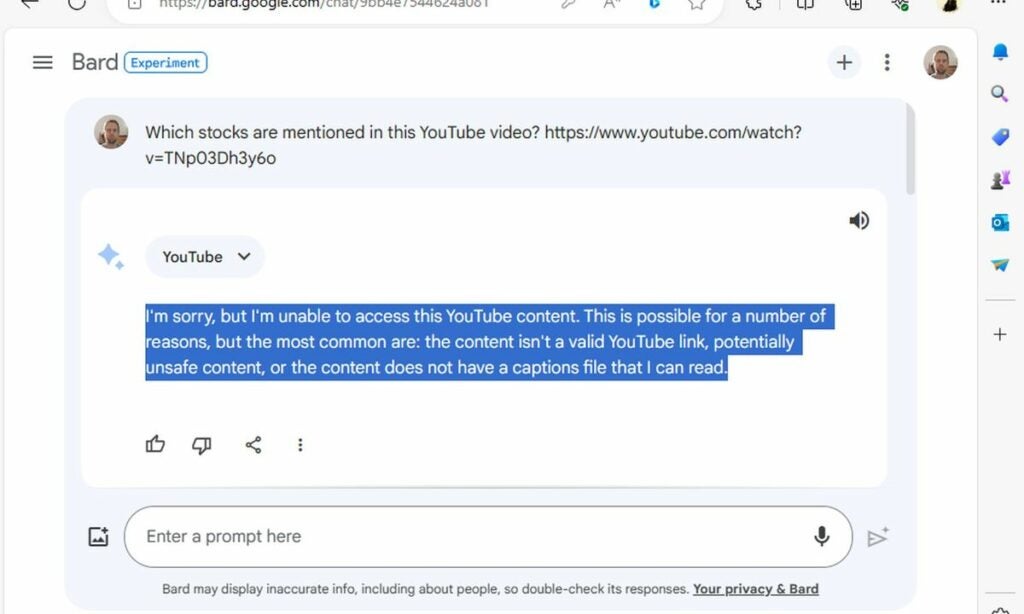
However, it’s essential to acknowledge potential limitations. According to a Ghacks report, Bard may encounter difficulties in retrieving data from a video if it lacks closed captions. In such cases, Bard responds with an explanation, stating, “I’m sorry, but I’m unable to access this YouTube content. This is possible for a number of reasons, but the most common are: the content isn’t a valid YouTube link, potentially unsafe content, or the content does not have a captions file that I can read.”

Bard YouTube Extension
(Credit)

Here are the key features of Bard YouTube Extension:

  • Advanced query handling: Bard can now handle complex queries related to specific video content. Whether it’s dissecting recipe quantities or summarizing instructional steps, Bard has your queries covered.
  • Content summarization: The standout feature of Bard’s YouTube extension is its ability to summarize key points from videos. From extracting ingredient details to providing measurements, Bard ensures you get a quick overview without having to watch the entire video.
  • User-friendly interaction: Bard has made the interaction process incredibly user-friendly. Through simple prompts, users can access specific details by typing a few queries, making it an intuitive and efficient experience.
  • Opt-in Labs experience: The YouTube integration is an opt-in Labs experience. Users have the choice to explore and utilize this feature, although it might require some experimentation and strategic prompts to get the desired information.

How to use Bard YouTube Extension easily

Using the Bard YouTube extension is a straightforward process that enhances your video-watching experience. Here’s a step-by-step guide on how to use the Bard YouTube extension:

  • Open your browser and access the Bard chatbot.
  • Look for the extension button situated in the top right corner of the Bard chatbot interface.
  • Click on the extension button and activate the YouTube extension.
  • Begin testing the feature with specific queries, especially those related to the details you seek in videos. Whether it’s a recipe or instructional content, prompt Bard to extract the information you need.
Bard YouTube Extension
(Credit)

Is Bard YouTube Extension not showing?

If you’re experiencing issues with Bard YouTube extensions not showing, here are some troubleshooting steps to address the problem:

  • Ensure that extensions are available for personal Google accounts. Google Workspace accounts for schools, businesses, or organizations might not have access to extensions.
  • Check if extensions are turned on. Visit bard.google.com and click on the puzzle piece icon in the top right corner. If extensions are turned off, you will see a toggle to enable them.
  • If the above steps don’t work, try using a different browser or device. Clear your browser’s cache and cookies to eliminate potential issues.
  • Note that Bard extensions may not be available for certain Google Workspace apps, such as Docs, Sheets, and Slides. Extensions are currently limited to specific Google Workspace apps.
  • Check if Bard extensions are rolled out in your area. If the extension icon is not visible at all, it might not be available in your location yet.

If none of the above solutions work, consider reaching out to Google support for further assistance.

A broader perspective

Google’s Bard YouTube extension introduces an innovative way to engage with video content, but it raises concerns for content creators. A significant worry is the potential impact on monetization, as Bard allows users to extract detailed information without engaging with ads or the full video, posing a threat to a YouTuber’s ad revenue. There’s also the concern of a reduction in overall watch time, a critical factor in YouTube’s recommendation algorithm. If users turn to Bard for quick answers, creators may experience decreased visibility.

Bard YouTube Extension

Content creators who use paywalls for exclusive content face challenges, as Bard’s ability to extract information behind paywalls could diminish the perceived value of premium content. Moreover, the tool’s influence on YouTube’s recommendation algorithm may alter user behavior patterns, affecting how videos are suggested and potentially limiting a creator’s reach.

While Bard is currently part of an opt-in Labs experience, its broader implications and long-term effects on content creation and consumption remain to be fully addressed by the industry. Striking a delicate balance between user convenience and the challenges faced by content creators is crucial for maintaining a sustainable and thriving YouTube community.

You can now ask Google Bard any questions you want about any YouTube video

Do you often use Bard? Google’s artificial intelligence is one of the great rivals of the popular ChatGPT, as well as Microsoft Copilot, and allows users to have conversations about practically anything and generate all kinds of texts just by specifying what you want. But, if it was already a very versatile AI, now it will be even more so.

Bard ACCESS

Google has updated Bard so you can have deeper and more meaningful conversations with the chatbot when asking about YouTube videos. In their latest experimental update log, the company announced an expansion of Bard’s YouTube extension capabilities, enabling the generative AI to “understand some video content.”

For instance, Google mentioned that you’ll be able to ask Bard how many eggs were used in a video for an olive oil cake recipe. As Android Authority suggested, you might also inquire about specific tools’ names in DIY videos. Regarding food reviews, Bard might inform you about the locations of mentioned restaurants in the videos or the origin of a specific cuisine.

Bard first gained the ability to extract data from YouTube in September through an update that integrated it with other Google products, including Gmail, Docs, Drive, Maps, and Lens. However, it couldn’t analyze the content of a video or respond to detailed questions about it. Google stated that they released this update because “they heard that you want deeper engagement with YouTube videos.”

They also mentioned that they’ve just taken the “first steps in Bard’s ability to understand YouTube videos,” indicating that the technology might better analyze videos on the platform in the future. To chat with Bard about YouTube videos, you’ll need to activate the YouTube extension in the chatbot’s web portal.

Bard ACCESS

Are they asking you for money to install Google Bard? Don’t stop reading

Google says it has filed about 300 takedowns related to this group trying to scam and deceive Google users around the world.

If you want to know how Google Bard is used and what artificial intelligence entails, don’t hesitate to visit this article we released a few weeks ago with so much care. It’s the definitive guide (or so we believe).

Bard ACCESS

Google has filed lawsuits against two separate groups of scammers in an attempt to protect its users from malware using its chatbot Bard AI as bait and to set a legal precedent to assist others in combating scammers on the internet.

In a blog post, the company states it is pursuing those posing as Bard, as well as those abusing the Digital Millennium Copyright Act (DMCA).

According to the report, the first group created Bard “applications” containing malware. Subsequently, the group would advertise these applications, using the malware to compromise victims’ social media accounts.

Google says it has filed around 300 takedown requests

“We are seeking an order that prevents scammers from creating domains like these and allows us to disable them with U.S. domain registrars,” Google states. “If successful, this will serve as a deterrent and provide a clear mechanism to prevent similar scams in the future.”

The second group created dozens of Google accounts and used them to file thousands of false copyright claims against their competitors, essentially abusing the DMCA.

As a result, over 100,000 websites owned by various companies were taken down, costing the victimized businesses millions of dollars and thousands of hours in lost employee time, Google explains.

“We hope that our lawsuit not only puts an end to this activity but also deters others and raises awareness of the damage that fraudulent takedowns can have on small businesses across the country,” it concludes.

Artificial intelligence holds enormous potential for good… but also for harm. There’s still a long way to go and a lot of work to be done.

Bard ACCESS

How to stop Google from training its AI with your web data

Google uses all the websites it indexes to train its artificial intelligence, but a tool launched this week allows you to prevent it.

The capabilities of artificial intelligences are increasing with each passing day. From “simply” being able to converse with them on trivial topics, AIs are now also able to see, hear and recognize us.

bard ACCESS

But, as we have explained on other occasions, for this to happen, companies must train their language models with huge amounts of data. Data that, on many occasions, comes from people, companies and websites that have not given their express consent.

Just today we were talking about how Meta has made use of its Facebook and Instagram users’ posts to train Meta AI, its new chatbot, and Google is another big technology company that does the same, but using all the websites it indexes. Of course, as of this week there is already a way for Google not to use your website to train Bard or other language models.

In a blog post, Google announced the launch of Google-Extended, a new control that publishers can use to allow or disallow data from their sites to be used to train Bard and Vertex AI, as well as “future generations of models that power these products.”

In other words, those who want to prevent Google from using their web information to train its artificial intelligence need only disable “User-Agent: Google-Extended” in the robots.txt file, a document that tells automated web crawlers what content they can access.

bard ACCESS

Google does not mention the word “train” at any time in its press release, but talks about “helping to improve generative APIs”. A euphemism that clearly tries to dilute the bad image that both this and other companies are earning for not asking for the express collaboration of people to train their AIs. “Train our AIs”? No, no: “help us improve our tools”.

Have you recently spoken to an AI? Your conversations could be on the Internet

One of the most used artificial intelligences in the world has suffered a failure that has leaked users’ private conversations on the Internet.

Who would have thought years ago that today we would spend hours and hours talking to a machine? Well, probably some science fiction fans could imagine it, but with more… catastrophic consequences.

Chatbots are already a part of the daily lives of thousands and thousands of people, who talk to artificial intelligences to ask them all kinds of questions or simply to tell them about their lives.

Bard ACCESS

However, the majority of people who chat with a chatbot don’t even ask themselves the question, “Are my conversations private?” It’s a somewhat complex issue that could be summarized as “yes, with some exceptions,” since conversations are used to further train AI, although companies claim that they remain private.

And that’s how it has been (in theory) until the all-powerful Google, one of the largest companies on the planet, messed up big time. According to How-To Geek, Google’s search engine is indexing users’ conversations with Bard, its AI chatbot. In other words, everything users talked about with the artificial intelligence would appear as a search result.

Apparently, the glitch is related to Bard’s feature to share conversations with other people, such as family and friends. Although this feature should not allow shared conversations to be indexed, some Twitter users have shared screenshots showing conversations of certain individuals in Google search results.

Bard ACCESS

However, from what is known, very few shared conversations end up appearing in search results. Google is already aware of this Bard error and has announced that they are working to fix it and prevent indexed conversations from continuing to appear in search results.

The Battle for Supremacy: ChatGPT Faces Competition from Emerging Extensions

Bard, Google’s AI, could gain ground on ChatGPT thanks to extensions, a very useful feature for users.

Bard, Google‘s artificial intelligence, is not planning to give any quarter to ChatGPT. OpenAI‘s AI enjoys great popularity, and part of its success is attributed to its ability to integrate into numerous third-party applications and programs through its plugins.

Bard ACCESS

While Bard lacked this type of functionality, at Google I/O 2023, Google announced that they were working on “Extensions” for the AI, which would allow its functions to be integrated into various services of the company, such as Drive, Gmail, Maps, among others, as well as third-party tools.

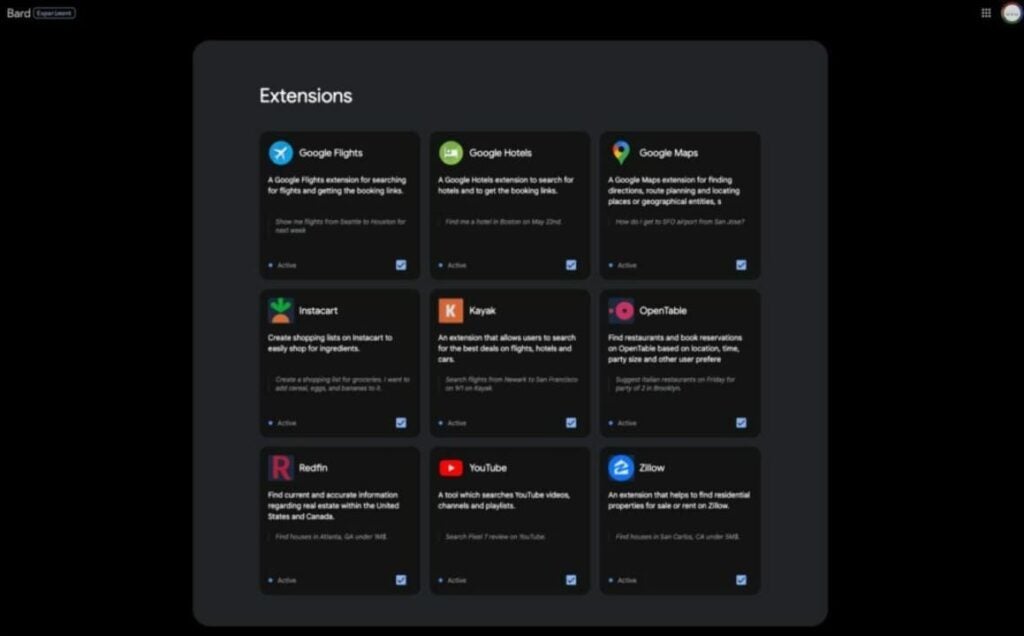
Now, 9to5Google has gained access to a beta version of Google’s upcoming extensions, which will have their own interface on the Bard website. Although the extensions themselves were not available for testing, the publication was able to preview the design of the user interface for this new feature, as well as the extensions that will be available.

At launch, Bard will have a minimum of 9 extensions, both for Google services and third-party services. These include Google Flights, Google Hotels, Google Maps, Instacart, Kayak, OpenTable, Redfin, YouTube, and Zillow. All of these extensions can be enabled or disabled from the new extensions menu.

To access the new extensions menu, users will need to click on a puzzle piece-shaped icon. Once accessed, they will be able to view all available extensions and see what each extension brings to the respective service. For example, with the Bard extension for YouTube, users will be able to search for videos, channels, and playlists on the platform by simply requesting it from the AI.

Bard ACCESS

While the current list of extensions is relatively limited, it is highly likely that it will expand in the future. When released, these extensions could pave the way for Bard and close the gap with ChatGPT, which continues to lead the world of AI.

Some of the links added in the article are part of affiliate campaigns and may represent benefits for Softonic.