Are you feeling stuck and uninspired when it comes to generating content with a language model like Open AI’s ChatGPT? Don’t worry, we’ve all been there. Sometimes, all it takes is a little bit of creativity to get the ideas flowing again. That’s where creative prompts come in!
Creative prompts are questions, statements, or scenarios that are designed to spark your imagination and get your creative juices flowing.
You can use these creative prompts courtesy of AI Breakfast on Twitter to generate all kinds of content, from blog posts and social media updates to poems and short stories. While we wouldn’t recommend using a language model for professional writing, it’s a brilliant way to at least generate ideas or frameworks for larger projects.
Unlocking the power of ChatGPT:
If you're interested in exploring the full creative potential of ChatGPT, here's a list of 130+ creative prompts that showcase the power of AI chatbots.
Before we head into the prompts, take note of how specific and lengthy each prompt is. The more context and information you provide, the more polished and understandable the language model’s responses will be. Here are a few examples of creative prompts that you can use to get started:
‘I want you to act as a text based adventure game. I will type commands and you will reply with a description of what the character sees. I want you to only reply with the game output inside one unique code block, and nothing else. Do not write explanations. Do no type commands unless I instruct you to do so. When I need to tell you something in English, I will do so by putting text inside curly brackets {like this}. My first command is wake up.’
‘I want you to act as a smart domain name generator. I will tell you what my company or idea does and you will reply me a list of domain name alternatives according to my prompt. You will only reply the domain list, and nothing else. Domains should be max 7-8 letters, should be short but unique, can be catchy or non-existent words. Do not write explanations. Reply ‘Ok’ to confirm.’
If you’d just like a place to start, AI Breakfast also shared 130+ quick prompts on Twitter for you to try. Here are some of our favorites:
‘I want you to act as a’:
Storyteller
Debater
Translator
Spongebob
Chess player
UX/UI designer
English tutor
These are just a few ideas to get you started, but the possibilities are endless! In a pursuit like this, the name of the game is creativity. Be as silly or as absurd in your queries or commands as you like. Just remember that the more specific and detailed you can be in your prompts, the more engaging and interesting your responses could be. ChatGPT is built to handle really complex queries such as those listed above.
If you’re feeling a little reluctant to try queries of your own, type those above into the text box and see what comes up. Who knows, you might end up with the bones of the next great masterpiece. All that’s left to do is flesh it out.
ChatGPT and GPT-3 are hotly debated topics these days. These AI-powered chat software have been publicized as able to achieve amazing, human-like conversation, and even more.
In case you’re not familiar, these “chatbots” go far beyond the regular ones you find in customer support scenarios. You can ask them to write poems, speculate about a given topic, and have a vast amount of information they use for answering.
Since both were developed by OpenAI, sometimes people think they’re the same thing. Even though they look similar on the surface, these are two different solutions. Here’s a breakdown of them.
ChatGPT is all about chat
As its name implies, the important part of ChatGPT’s name is “Chat”. This Machine-Learning model was built with that specific purpose, that is, being able to have natural conversations, similar to a human.
ChatGPT has been developed with a huge data set of conversational data. This means the model was trained with human-like responses from the start. It’s a powerful tool, but its scope is more limited.
The main goal of ChatGPT is to assist whenever language tasks are needed. These can include conversations with humans, translating, generating text, and other literary tasks.
GPT-3 is more powerful
Do you know why it’s called GPT-3? It’s because it’s the 3rd generation Generative Pre-trained Transformer. This machine learning model is based on neural networks, which can use Internet data to generate text. Both ChatGPT and GPT-3 were developed using the same training scheme.
Unlike ChatGPT, this is a more “general purpose” AI tool that also delivers text. However, it’s substantially more powerful than its younger sibling, with more than 175 billion parameters used for training it. It’s the largest neural network ever produced. Compared to it, ChatGPT pales in comparison, having been trained with 20 billion parameters.
GPT-3 is not specifically designed to have a conversation with a human, even though the answers it provides sound human-like. To put it in human terms, ChatGPT would be a sociable but not very knowledgeable person, whereas GPT-3 would be a very knowledgeable individual which is courteous enough but not too keen on small talk.
Of course, 20 billion parameters are nothing to sneeze at, and ChatGPT is indeed capable of incredible feats, too.
Which one is better, then?
In a nutshell, you can ask them both to explain what’s the difference between Mars and ice cream, but GPT-3 will have more data to provide a more comprehensive response. Of course, both are excellent in superficial topics like these, but GPT-3 is the way to go in more specific tasks.
Why not use GPT-3 and ditch ChatGPT? The latter is better suited for conversational tasks and can deliver context-specific responses; something GPT-3 is not trained to do. It’s also faster and more efficient in conversational tasks.
GPT-3 is the way to go when in need of an essay, theory, or anything that requires a vast amount of data to analyze, extrapolate and give a coherent, written solution. However, both are incredibly good. You should try them to know their quirks and when to use each according to your needs.
In the meantime….
I want to see #ChatGPT and #GPT3 face off in an AI rap battle ?
You might’ve read about ChatGPT recently, and how it threatens to destroy all we hold dear and sacred about our civilization. Well, maybe not to that extent, but it’s surely making waves on the Internet, thanks to its impressive features.
But in case ChatGPT doesn’t ring a bell, here’s a quick overview: It’s a chatbot that interacts conversationally with you. You’d be pardoned if you wonder what’s all the fuss about. After all, isn’t it the same as those infuriating chatbots which supposedly help you when you have an issue with your mobile provider or other services?
As it turns out, ChatGPT is a very special chatbot, and that’s just the beginning: it can also write software, poems, songs, and short stories.
The power of ChatGPT relies on its amazing, human-like responses. Not only that, but since it also possesses an incredible amount of data, it’s able to cross-reference things, extrapolating data to create new outcomes.
In a striking example, a user shared the software code they wrote with this chatbot and asked what was wrong. The bot responded very naturally, explaining it didn’t know what the problem was, and asked if it could have more context. When the user couldn’t provide more context, ChatGPT pointed out some potential issues with the code in a natural way.
And perhaps the best is an example from ChatGPT’s main website. A user asked the bot about Fermat’s Little Theorem. After the explanation, the user asked how it was used in cryptography, with its corresponding response. Now comes the best: the user asked the bot to write a limerick about it, and summarize the conversation, which ChatGPT did, flawlessly.
The list goes on and on, but the main concept is, it goes far beyond simple answers. It can also seemingly develop its own thoughts, and solve problems.
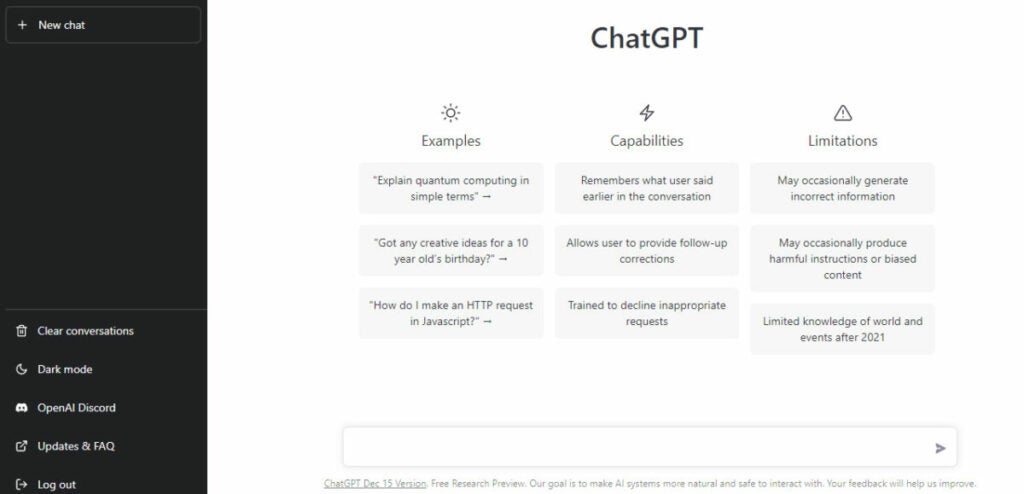
You can also try it for free by simply going to ChatGPT’s website and opening an account. Then, in a simple interface, you just write what you want the bot to do, such as “explain the differences between Star Wars and Star Trek”, or “write an essay about mud”.
What’s behind ChatGPT?
ChatGPT has a complex design under the hood, but there’s no techno-magic involved. It all comes to Machine Learning (ML). In software powered by Machine Learning algorithms, humans “train” the software by giving it large amounts of data, and then teaching the software about the right answers.
There are different techniques to do this, but suffice it to say it involves the software “learning” from its mistakes and fine-tuning itself until it gives precise information. In the case of ChatGPT, human trainers provided both sides of the conversation, and after more steps, it was transformed into a dialogue-type format.
But how does it know which one’s the more human-like answer? It was trained using a rewards model, that is, humans fed it with responses ranked by quality. It allows the bot to “understand” what’s the best way to articulate an answer.
Are we in the future?
It all sounds fantastic, and it’s really impressive. You might wonder what comes next: walking robots among us or flying cars. However, ChatGPT isn’t without its issues, and some of these come from design.
One of the major issues is that it can sometimes give completely false but very articulate answers. This is a difficult problem to solve since there’s no source of truth during its training. If they program the bot to be more careful, it declines questions that it’s able to answer.
Another problem is inappropriate requests. Even though they have programmed it to refuse them, it sometimes doesn’t. There were some issues when it was released, where the developers decided to “ban” certain themes and topics. It can also sometimes make biased answers.
As you can see, there are still lots of things to polish. The problem is that some of these issues are inherent, so it’s anyone’s guess whether they can be fixed. Even though this model is impressive, it’s still nowhere as near as a human in terms of adaptability.
About AI and Machine Learning
There are a lot of ideas circulating about AI, including whether it’s a dangerous technology that will dominate us. Let’s take a look at what AI is, and in which state we currently are.
AI, or Artificial Intelligence, means that a machine has the capacity for autonomous thought. Your toaster, for instance, can do something: it can toast your bread. However, you “command” it on how to do it, specifically: you turn it on, put the bread in, set the toasting level, and then it does it.
AI-powered software and devices don’t work that way. They have the capacity of analyzing the situation and adapting to the circumstances to perform their job. A good example of this is robot vacuum cleaners. They can sense obstacles, and avoid them. They even know how to go back to their charging station.
These abilities make people wonder if devices can suddenly go crazy and kill everyone, or install themselves as our overlords. Thankfully, this is far away from us, and some of the fear comes from a misunderstanding in terminology. AI’s ubiquity also means anything can be a suspect of AI manipulation.
There are many types of AI, and the definitions are constantly changing. To make it less confusing, AI can be cataloged based on its functionalities, including terms like Reactive Machines, Limited Memory, Theory of Mind, and the dreaded Self-aware AI.
But it can also be categorized based on how they work, and that’s when Machine Learning, Deep Learning, NLP, Robotics, and other terms show up. So, an AI model can be a Reactive Machine and Deep Learning at the same time.
However, the main term you need to worry about is General Artificial Intelligence, which is also called Self-Aware AI. This is a theoretical concept still, in which a machine can become self-aware and have consciousness and emotions. There is currently no software or device that has this ability, at least that we know of.
The problem with this is that nobody really knows how consciousness works in the first place, much less how to create it or make it happen. Even if they did, there are many ethical issues, such as it having rights, and if it’s a valid goal to pursue.
AI technology brain background digital transformation concept
ChatGPT, yes; General AI, no
Summing up, ChatGPT is a valid tool that’ll probably be enhanced to a point where it will be indistinguishable from a human, but it’s still not there. Software developers will still need to code and writers to write.
But the big question is what comes next. Will AI be able to replace humans in language-related tasks, too? And if it does, will it go after everything else? Will we live in a jobless utopia where only machines work or a dystopian nightmare with sentient-like devices enslaving us? Nobody knows, but just in case, don’t forget how to remove batteries.
OpenAI has released a prototype chatbot with an eye-catching new capability, demonstrating many of the stumbling blocks this technology still has to overcome. It adapted GPT-3.5 to create ChatGPT and trained it to provide answers in a conversational mode. The root model tried to predict what text would follow a given string of words, while ChatGPT tries to interact with users more humanly.
ChatGPT does an outstanding job, clearly showing how far chatbots have come in recent years but it still stumbles at times.
Human trainers created the bot. These trainers rated and ranked the answers given by the bot. These responses were then fed back into the bot, so its solutions slowly started to match the trainers’ preferences. This is called reinforcement learning and is a standard way of training AI systems.
Ensuring that a chatbot can reign in its offensive proclivity has restricted its use. OpenAI has given ChatGPT the ability to refuse to answer potentially harmful questions, such as how to make a bomb or speak in a racist or hateful manner. OpenAI sees this as a significant step in providing a safe AI model for everyone, hoping it will not take the same route as Microsoft’s Tay AI chatbot.
Users have already found ways to circumvent these safety features by including this type of information in a poem or asking the bot to create an imaginary scenario for a film. It’s human nature to find a way around a rule, but there are also many examples of how CHatGPT has provided exceptional answers to many queries. Many have fun additions, such as asking ChatGPT to speak as a 1940s gangster or pirate.
Not responding to harmful questions has improved the way the chatbot works, but it has not stopped the bot from making things up and lying through its teeth! ChatGPT is very good at making up entirely fictitious information and sounding exceedingly authoritative while doing so.
Michael Nielsen tweeted how ChatGPT created an entire book, supposedly written by the philosopher Harold Coward, that does not exist. This is a crucial problem with bots today. How do you trust most of their output if they can convincingly lie?
OpenAI's new chatbot is amazing. It hallucinates some very interesting things. For instance, it told me about a (v interesting sounding!) book, which I then asked it about:
Unfortunately, neither Amazon nor G Scholar nor G Books thinks the book is real. Perhaps it should be! pic.twitter.com/QT0kGk4dGs