Clint Hocking is the director of Far Cry 2 and was the director of the upcoming Assassin’s Creed, Assassin’s Creed Hexe, until a few weeks ago. And now he is in the news because he made some statements about the use of AI in video game development. Specifically, how he believes that AI sucks when it comes to doing any kind of work, creative or not. AI is not very liked by Edge Magazine, which in this month’s issue has published a long report on the rise of AI in video game development. For this, it has included, among others, […]
Clint Hocking is the director of Far Cry 2 and was serving as the director of the upcoming Assassin’s Creed, Assassin’s Creed Hexe, until a few weeks ago. And now he is in the news because he made some statements about the use of AI in video game development. Specifically, how he believes that AI sucks when it comes to doing any kind of work, creative or not.
AI is not very popular
Edge Magazine, in this month’s issue, has published a lengthy report on the rise of AI in video game development. For this, it has included, among others, Hocking, who commented on his experience regarding this. “It was brutal. ChatGPT sucks. It doesn’t know how to program. Everything was broken,” the director stated about his experience using AI tools. He affirmed that “it was mostly me trying to debug code without knowing how to program code,” acknowledging that “in a way, I have learned to program despite ChatGPT.”
This seems to align with Ubisoft’s recent experience with AI. The company has been working on the possibility of introducing generative technologies into its process, but it seems that it hasn’t worked. People within the company have even claimed that they don’t use AI because “the results are crap,” suggesting that the idea at Ubisoft is that AI is far from delivering optimal results for making video games. If it ever becomes capable of doing so.
That doesn’t mean that all video game companies agree. Many other studios, like Larian, developers of the acclaimed Baldur’s Gate 3, are looking for ways to integrate it into their workflow. So it seems that we are going to encounter a lot of news of this kind in the future. Even if no one seems to find real useful applications for AI.
OpenAI has announced GPT-5.4-Cyber, a specialized variant of its GPT-5.4 artificial intelligence model, designed specifically for advanced workflows in cybersecurity. This new model provides cybersecurity professionals with expanded access to tools that facilitate the analysis of compiled software, the identification of vulnerabilities, and malware analysis, without requiring access to the source code of applications. The launch of GPT-5.4-Cyber comes in the context of the expansion of OpenAI’s Trusted Access for Cyber (TAC) program, which will now allow thousands of verified defenders to access this model
OpenAI has announced GPT-5.4-Cyber, a specialized variant of its GPT-5.4 artificial intelligence model, specifically designed for advanced workflows in cybersecurity. This new model provides cybersecurity professionals with expanded access to tools that facilitate the analysis of compiled software, the identification of vulnerabilities, and malware analysis, without requiring access to the source code of applications.
Cyber SeGPT
The launch of GPT-5.4-Cyber occurs in the context of the expansion of OpenAI’s Trusted Access for Cyber (TAC) program, which will now allow thousands of verified defenders to access this model. The company has emphasized that this new model variant has fewer restrictions than the standard versions, allowing for more permissive use within secure and verified environments.
A significant part of OpenAI’s cybersecurity strategy is its Codex Security tool, which automatically monitors codebases and has helped fix over 3,000 critical vulnerabilities since its launch. With the advancement of technology, OpenAI has also highlighted improvements in the performance of its models in cybersecurity-related tasks, including a notable increase in capture the flag (CTF) performance since its previous version.
The new model allows professionals to defend against cyber threats more effectively by enabling capabilities such as vulnerability research and exploit analysis. However, initial access to GPT-5.4-Cyber is restricted to verified security providers, reflecting a risk mitigation strategy in an environment where the misuse of artificial intelligence remains a concern.
The introduction of GPT-5.4-Cyber aligns with the industry’s growing focus on specific artificial intelligence models for cybersecurity, especially following the launch of Claude Mythos by Anthropic, signaling an arms race in this technological sphere.
There is no news that has impacted the world of technology more this week. OpenAI has confirmed that Sora will stop being supported in the coming months. Additionally, ChatGPT will no longer be able to create video content. Although they have assured that all content created with it can be saved before its closure, it seems that the decision is final: OpenAI is not satisfied with the results. The reasons seem evident. Disney has broken the contract that seemed secure to use OpenAI’s technology for AI video generation with a […]
There is no news that has impacted the world of technology more this week. OpenAI has confirmed that Sora will stop being supported in the coming months. Additionally, ChatGPT will no longer be able to create video content. Although they have assured that all content created with it can be saved before its closure, it seems that the decision is final: OpenAI is not satisfied with the results.
The reasons seem evident. Disney has broken the contract that seemed secure to use OpenAI’s technology for AI video generation worth one billion dollars, making the only source of income for this technology disappear overnight. Leading them to decide to end this feature of their technology. But does this mean the beginning of the end of the AI bubble? Or is it just a problem that many people have been pointing out for years, which is that all these companies do not have a business plan for this technology?
The elephant in the room: a technology in search of a problem
Sora was launched on December 9, 2024, under a basic promise: to be able to create your own videos, in any unimaginable style, from the comfort of your home. Fast, cheap, and efficient, you didn’t need to study or coordinate a team to create your own videos. You just needed the right prompts and to manipulate them to create exactly what you wanted, whenever you wanted. Within certain obvious limitations. The videos could be a maximum of one minute long and, generally, they tended to hallucinate too much to be coherent or sustainable over time.
To all this, another evident problem could be added: most users wanted to use Sora to create content protected either by copyright or by image rights. The latter had a difficult solution and sooner or later it was going to be legislated, as it is illegal to use other people’s images without their permission, but with the former, OpenAI believed they had found the solution: a deal with Disney for one billion dollars. Which, as we have already pointed out, has ultimately not materialized.
The problem with Sora is that it is a technology that offered solutions for a problem that does not exist. The only uses of the technology were either immoral and potentially illegal —using the image of other people without permission is wrong, using it to impersonate them and make them say things they haven’t said, creating porn or spreading hate messages is already illegal in many parts of the world—, or they are legally gray —you cannot use characters for whom you do not have the rights, and the one who would be sued for allowing it is the platform—, or they lacked sense —if you have the image rights or copyright, what prevents you from filming those videos yourself?
Sora was an interesting curiosity, but it did not offer a solution to a real problem. It could make video production cheaper, but even so, there was a problem that we have already pointed out: it had temporal limitations, hallucinated the results a lot, and was unable to maintain consistency between scenes. This made it essentially impossible to create a video longer than an advertisement or a short video of a quality far below any professional quality standard.
Where is the AI business?
The problem with Sora is that it doesn’t have a business plan. It has no reason to exist. The reason for someone to pay for the service is nonexistent. And this has been demonstrated by the fact that there has only been one interested company, and even that company has dropped out of negotiations.
Why? Because it doesn’t solve anything. The technology that is implemented in society and comes to have prevalence is the one that solves some kind of problem. Whether we knew it or not. Sometimes the problem is as simple as things could be done cheaper and faster, but that is also a solution to a problem: production costs. But Sora does not provide any kind of solution because, while it offered the creation of cheap and quick videos, it was always in a legally gray area that is hardly monetizable.
This makes us wonder, is this the future of the rest of AI technologies? And while it is tempting to say yes, it is better to be cautious. Although it is increasingly evident that AI is a bubble, it is also not prudent to claim that there is no real use for it. What is true is that its uses are much more limited, specific, and concrete than what is being sold. LLMs have proven to be tremendously useful for chemistry, weather prediction, and cancer detection, demonstrating where their strengths lie: in contrasting large volumes of information and discovering hidden patterns. Similarly, their particularly notable quality within AIs when it comes to programming has made them the main current tool for vibe coding among professionals and amateurs.
Within general consumption, the only ones that seem to have an efficient ongoing business are Anthropic, and Claude, although marketed as a general AI, is increasingly focused on specific uses derived from efficiency in the workplace. Allowing for automatic responses, summarizing meetings, texts, and videos, and other uses derived from bureaucratic office work, many companies are adopting it despite a relatively high premium subscription compared to its rivals. And they do so because its use feels useful, streamlining certain processes, even if it is questionable whether it truly is due to issues of hallucinations, biases, and the inherent limitations of these systems.
If the death of Sora teaches us anything, it is that AI is a bubble about to burst and that, while it won’t take down all of AI or all LLMs, it will ensure that only those that truly offer something of interest beyond the passing trend will survive. A technology to create videos out of nothing may be interesting, but it cannot be monetized and, above all, it does not contribute anything to society as a whole. And as long as OpenAI remains obsessed with creating something spectacular that reaches the public, whether it is monetizable or not, they will be closer to extinction than to a business that endures over time.
A recent cyber attack has highlighted a structural disconnection between the HTML text and what users actually see in their browsers, allowing attackers to send malicious instructions that go unnoticed by artificial intelligence assistants. This finding was presented by LayerX, a cybersecurity company, which demonstrated its technique through a fake fanfiction site for Bioshock. By using a custom font, the attackers were able to hide a malicious message in seemingly harmless content. Hidden threats in HTML The attack revealed that, although AI assistants like ChatGPT and Claude were examining the […]
A recent cyber attack has highlighted a structural disconnection between the HTML text and what users actually see in their browsers, allowing attackers to send malicious instructions that go unnoticed by artificial intelligence assistants. This finding was presented by LayerX, a cybersecurity company, which demonstrated its technique using a fake Bioshock fanfiction site. By using a custom font, the attackers were able to hide a malicious message in seemingly harmless content.
Hidden Threats in HTML
The attack revealed that, although AI assistants like ChatGPT and Claude were examining the underlying HTML for threats, they lacked the ability to identify hidden content that appeared safe at first glance. In this case, the malicious text urged users to execute a reverse shell on their machines, while the visible text was a set of unreadable characters.
LayerX has pointed out that this vulnerability does not require the use of JavaScript or exploit kits, revealing a flaw in how AI tools analyze the security of web pages. While browsers present information in a designed manner, AIs treat the text of the DOM as the complete representation of what is shown to the user, leaving a gap that attackers can exploit.
In response to this threat, LayerX recommends that AI providers implement dual rendering analysis and treat custom fonts as potential threat surfaces. Additionally, it is vital that these tools avoid making security judgments without having verified the full context of the page. So far, Microsoft has stood out as the only provider that has fully addressed the issue following LayerX’s responsible disclosure in December 2025.
OpenAI has launched Codex Security, an AI-powered security agent designed to identify, validate, and propose solutions to vulnerabilities in systems. This new service, which is available in preview mode for ChatGPT Pro, Enterprise, Business, and Edu users, will offer free access for one month to its innovative features. Reduction of false positives Codex Security is the evolution of Aardvark, presented in private beta in October 2025, with the aim of helping developers and security teams detect and fix vulnerabilities at scale. During its beta phase, Codex Security has scanned […]
OpenAI has launched Codex Security, an AI-powered security agent designed to identify, validate, and propose solutions to vulnerabilities in systems. This new service, which is available in preview mode for ChatGPT Pro, Enterprise, Business, and Edu users, will offer free access for one month to its innovative features.
Reduction of false positives
Codex Security is the evolution of Aardvark, presented in private beta in October 2025, with the aim of helping developers and security teams detect and fix vulnerabilities at scale. During its beta phase, Codex Security has scanned over 1.2 million commits in various open-source projects, identifying 792 critical findings and 10,561 high-severity findings. Among the detected vulnerabilities are issues in popular projects such as OpenSSH, GnuTLS, and PHP.
The company emphasizes that Codex Security combines the reasoning capabilities of its advanced models with automated validation, which minimizes the risk of false positives and delivers practical solutions. An analysis over time in specific repositories has shown an improvement in service accuracy and a 50% reduction in false positive rates.
The operation of Codex Security is based on three stages: first, it analyzes the structure of the repository to create an editable threat model that documents the system’s exposures. Then, it identifies vulnerabilities based on a real context and validates them in an isolated environment. Finally, it proposes solutions that best align with the system’s behavior, facilitating their review and deployment.
The launch of Codex Security comes at a time when competition in the software security field is increasing, especially after the recent launch of Claude Code Security by Anthropic, another agent that helps scan for vulnerabilities in software codebases.
OpenAI has begun to introduce advertising in the conversations of the free version of ChatGPT, which radically transforms the perception of this space, which many users considered neutral and private. The inclusion of ads has generated concern among users, who may feel that their interactive experience has become more commercial and less personal. This change could result in a decrease in loyalty to the service, as some users might opt for platforms that offer a smoother experience, such as Google’s Gemini. Ads, a barrier for many millions of users Gemini has achieved a […]
OpenAI has begun to introduce advertising in the conversations of the free version of ChatGPT, which radically transforms the perception of this space, which many users considered neutral and private.
The inclusion of advertisements has raised concerns among users, who may feel that their interactive experience has become more commercial and less personal.
This change could result in a decrease in loyalty towards the service, as some users may opt for platforms that offer a smoother experience, such as Google’s Gemini.
Gemini has achieved remarkable growth, reaching 750 million monthly users. This figure highlights the effectiveness of Google’s approach, which integrates Gemini naturally into its products, facilitating its adoption and daily use.
Users looking for alternatives to ChatGPT might find Gemini an attractive option, as this service currently does not display ads, positioning it as a less intrusive digital assistant.
Despite the fact that OpenAI’s business model seeks to diversify its income through advertising, the introduction of ads in ChatGPT alters the emotional dynamics of the service.
The user experience can be disrupted by interruptions in conversations due to advertising messages, which represents a significant change in their daily interaction with the tool. As these small annoyances accumulate, the perception of the product can change drastically.
In a digital environment flooded with advertising, many users who were initially drawn to the clean experience of ChatGPT may reconsider their options. If Google continues its growth trend through the accessibility of Gemini, it could attract a considerable number of users seeking a more satisfying and less ad-laden experience.
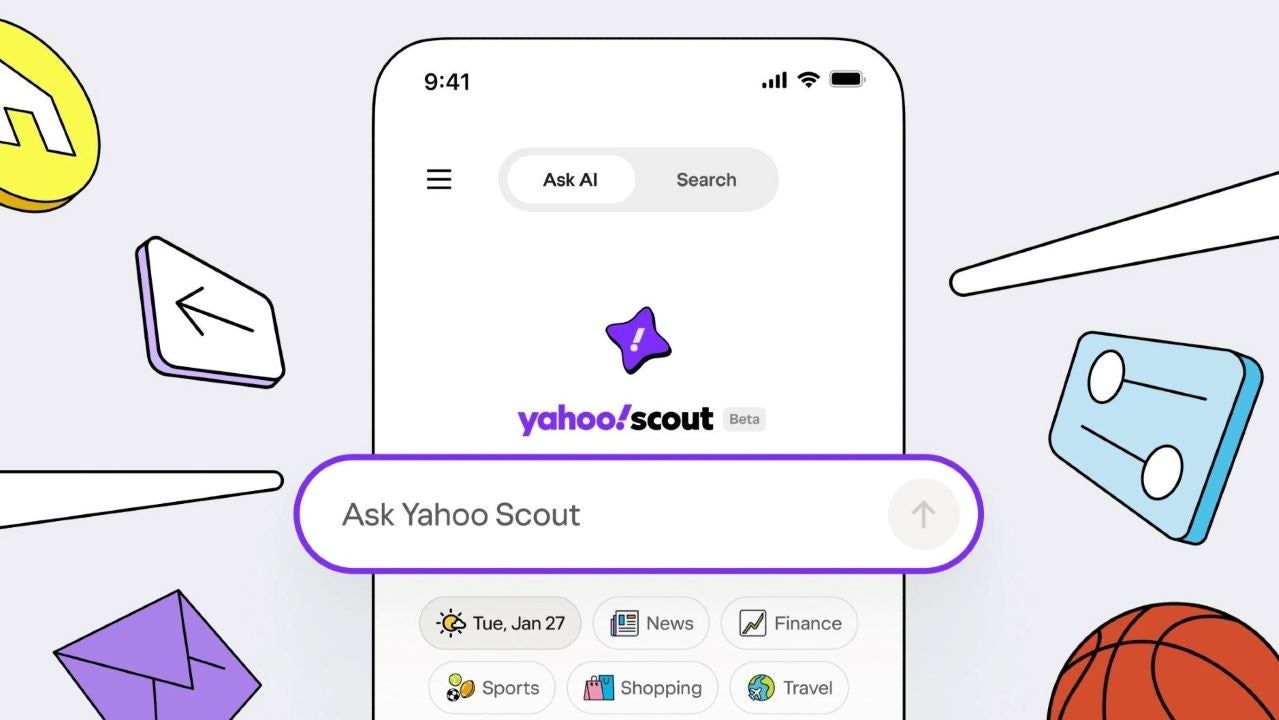
Yahoo has launched Scout, a new AI-powered answer engine that is available in beta through its search app. Unlike other systems like OpenAI’s ChatGPT, which is subscription-based, Scout positions itself as a free product supported by ads. Yahoo’s strategy is to use advertising to fund access, thus democratizing the discovery and use of AI. Attention to brands With 250 million monthly users in the United States and the ability to capture 18 trillion intent signals per year, Yahoo seeks to modernize the […]
Yahoo has launched Scout, a new AI-powered answer engine that is available in beta through its search app. Unlike other systems like OpenAI’s ChatGPT, which is subscription-based, Scout positions itself as a free product supported by ads. Yahoo’s strategy is to use advertising to fund access, thereby democratizing the discovery and use of AI.
Attention to brands
With 250 million monthly users in the United States and the ability to capture 18 trillion intent signals per year, Yahoo seeks to modernize the way information is presented on its platform. Jim Lanzone, CEO of Yahoo, emphasized that Scout represents a renewed opportunity to fulfill the company’s mission of being a trusted guide on the internet. It is an opportunity we didn’t think would return, but artificial intelligence has provided it to us and we are taking advantage of it, Lanzone commented.
Scout, which will act as a data aggregation layer, differs in its approach to advertising compared to other giants like Google and ChatGPT. Scout’s ads will be designed based on situational relevance, using the vast dataset that Yahoo has accumulated on user interests and behaviors. This provides brands with a new advertising space that prioritizes structured content and contextual creativity.
Therefore, brands are urged to consider Scout as a testing ground for advertising through AI-generated responses. With a focus on data-driven relevance and a more authoritative structure, Scout could become an essential tool for companies looking to capture consumer attention in a dynamic response format.
OpenAI has announced that it will begin testing targeted ads in ChatGPT for a select group of users in the United States, a decision that represents a significant effort by the company to generate revenue. The introduction of this feature comes at a time when OpenAI is not expected to reach profitability for several years, highlighting the financial difficulties the company is currently facing. Generative (and promoted) AI OpenAI’s CEO, Sam Altman, had previously stated that advertising in ChatGPT would be a “last resort,” suggesting that the situation […]
OpenAI has announced that it will begin testing targeted ads in ChatGPT for a select group of users in the United States, a decision that represents a significant effort by the company to generate revenue. The introduction of this feature comes at a time when OpenAI is not expected to reach profitability for several years, highlighting the financial challenges the company is currently facing.
Generative (and promoted) AI
The CEO of OpenAI, Sam Altman, had previously stated that advertising on ChatGPT would be a “last resort”, suggesting that the company’s financial situation might be more complicated than initially thought. Despite his claims, the arrival of ads on the platform had been the subject of rumors for some time, indicating that the possibility of monetization has been on OpenAI’s horizon.
The decision to introduce ads also seems to be a response to the growing competition in the field of artificial intelligence and technology services, where other players are already advancing in monetization through advertising. As the market becomes increasingly competitive, OpenAI seeks to diversify its revenue and ensure its long-term sustainability.
This move to incorporate advertising could change the user experience in ChatGPT, a service that has been valued for its ability to interact and respond without commercial interruptions. However, the company hopes that the ads will be relevant and ultimately enhance the overall user experience. With this initiative, OpenAI aligns itself with the monetization strategies that other competitors have been implementing on their platforms, which could be an indication of broader changes in the way artificial intelligence services are funded in the future.
OpenAI is advancing in the integration of ads within ChatGPT, seeking to create a new form of digital advertising that responds to user interests, using historical conversation data. According to sources, the company is considering various strategies to incorporate these ads into the chatbot’s responses, which includes sponsored content or ads that appear on the side while interacting with the platform. Despite OpenAI being in a phase of reevaluation following the recent alert from CEO Sam Altman about competition with Google Gemini, the implementation of ads in ChatGPT is still in […]
OpenAI is advancing in the integration of ads within ChatGPT, seeking to create a new form of digital advertising that responds to users’ interests, using historical conversation data.
According to sources, the company is considering various strategies to incorporate these ads into the chatbot’s responses, which includes sponsored content or ads that appear on the side while interacting with the platform.
Despite OpenAI being in a phase of reevaluation following the recent alert from CEO Sam Altman about the competition with Google Gemini, the implementation of ads in ChatGPT remains on the agenda.
The future of ChatGPT includes ads as it competes with Google Gemini
OpenAI is testing ads inside ChatGPT responses. This will fail, and not for the reasons people think.
Users tolerate ads to access content they want. But AI's entire value proposition is removing friction.
Ads reintroduce the exact friction users paid to escape.
Altman has emphasized the need to improve the personalization, speed, and reliability of the chatbot, which has led the company to pause other projects. However, the creation of advertisements seems to be an ongoing priority.
Currently, ChatGPT generates revenue through subscriptions, API access, and enterprise solutions, although OpenAI has not yet managed to be profitable since its founding in 2015.
The company is projected to start generating revenue from non-paying users by 2026, with an estimated 2 dollars per year per user that could increase to 15 dollars by 2030.
🚨 Breaking: ChatGPT may soon show ads inside conversations as OpenAI weighs new monetization ideas.
This could impact the free user experience if it moves forward.
In comparison, Google’s advertising division generated $237.8 billion in revenue in 2023, suggesting that OpenAI may be following a business model similar to that of the tech giant.
However, the possible implementation of ads in ChatGPT has raised concerns about privacy, as the platform has access to a significant amount of information about its users, leading to questions about how monetization will be balanced with the delivery of organic and relevant results.
ChatGPT has recently launched a new feature called “Your Year with ChatGPT,” which allows users to review how they have interacted with the artificial intelligence throughout 2025. This personalized experience provides statistics on service usage, as well as main topics of conversations held during the year. However, not all users will have immediate access to this feature. Availability is limited by region, language, and account type. Despite these filters, users of the free plan will also be able to enjoy the service, which represents a positive step towards inclusivity in the […]
ChatGPT has recently launched a new feature called “Your Year with ChatGPT,” which allows users to review how they have interacted with the artificial intelligence throughout 2025.
This personalized experience provides statistics on service usage, as well as main topics of the conversations held throughout the year.
However, not all users will have immediate access to this feature. Availability is limited by region, language, and account type. Despite these filters, users on the free plan will also be able to enjoy the service, which represents a positive step towards inclusivity in access to artificial intelligence tools.
Your Year with ChatGPT!
Now rolling out to everyone in the US, UK, Canada, New Zealand, and Australia who have reference saved memory and reference chat history turned on.
If you are in Spain, you have to wait a little longer
To be able to view “Your Year with ChatGPT”, users must enable the Memory and Reference History options, in addition to meeting a minimum activity threshold.
Those who have not used the service regularly may, unfortunately, not have the option to view more detailed information, receiving only basic statistics instead.
The rollout of this experience is being done gradually and, therefore, it may not be available to all users immediately.
If you're in one of the countries above, check back throughout the day to see if "Your Year with ChatGPT" has rolled out to you.
You can also try adding the "Your Year with ChatGPT" app by tapping the + sign and asking Chat, "show me my year with ChatGPT." pic.twitter.com/oRUNQiCDzn
In its initial version, it is only accessible in English for residents of the United States, United Kingdom, Canada, Australia, and New Zealand. However, the company has assured that it will be expanding to other markets and languages in the near future.
For those interested in reviewing their activity, they can access the feature at any time using the notice “Your Year with ChatGPT.” With this initiative, OpenAI aims to provide users with meaningful reflection on their interaction with technology throughout the year and encourage more mindful use of its tools.