From Servant to Superstar: Unveiling the Extraordinary Journey of Nancy Green, the First-Ever Influencer

There was a pioneer to all these anonymous people who ended up being the visible face of a product: the proto-influencer, the first person who decided to be a kind of “mascot” of a product, was Nancy Green.

We live in a world of influencers: the word entered our lives a few years ago and has stuck with us ever since. Fashion influencers, film influencers, micro-influencers… Right now, ads featuring people who seem real are effective, and marketing agencies are well aware of this. But this is not new, nor is it a recent phenomenon: Do you not remember celebrities putting their face to advertise all sorts of products? Well, it started even before television.

TikTok DOWNLOAD

The original influencer

There was a pioneer among all these anonymous people who ended up embodying a product: the proto-influencer, the first person who decided to be a kind of “mascot” for a product, was Nancy Green, who would ultimately become the first face that would simultaneously be a brand. Now it seems like everyday life, but in 1893 it was not so common. And beware, because the story is full of racism, plot twists, and sadness: hard to believe.

Nancy Hayes was born in 1834 as a slave on a farm in Kentucky, at a time when things were starting to change but it would still be another forty years before everything exploded (literally). During her childhood, she cultivated tobacco and took care of the Walker family’s livestock, who later used her as a servant, cook, and housekeeper. She got married, had four children, which was normal for the time. And then the Civil War came.

Nancy lost her husband and children during the war. As sad as it sounds, she ended up working as a nanny and housekeeper (no longer a slave) for the Walkers in Chicago in the early 1870s after living in a sad and lonely cabin. One of the family’s sons became a judge and, almost out of the blue, brought a twist to her life when a pancake and breakfast product brand that was born in 1889 asked him if he knew someone for the role of a character named Aunt Jemima.

Aunt Jimema

Aunt Jemima was founded purely by chance: Chris L. Rutt and his friend Charles G. Underwood purchased a flour mill in Missouri and, facing an oversaturated market at that time, they sold the excess in small bags for making pancakes. They were the pioneers and succeeded like no one else. “Aunt Jemima” was actually a name they came across outside a vaudeville show and decided to appropriate. But, of course, they needed a face. Who could it be?

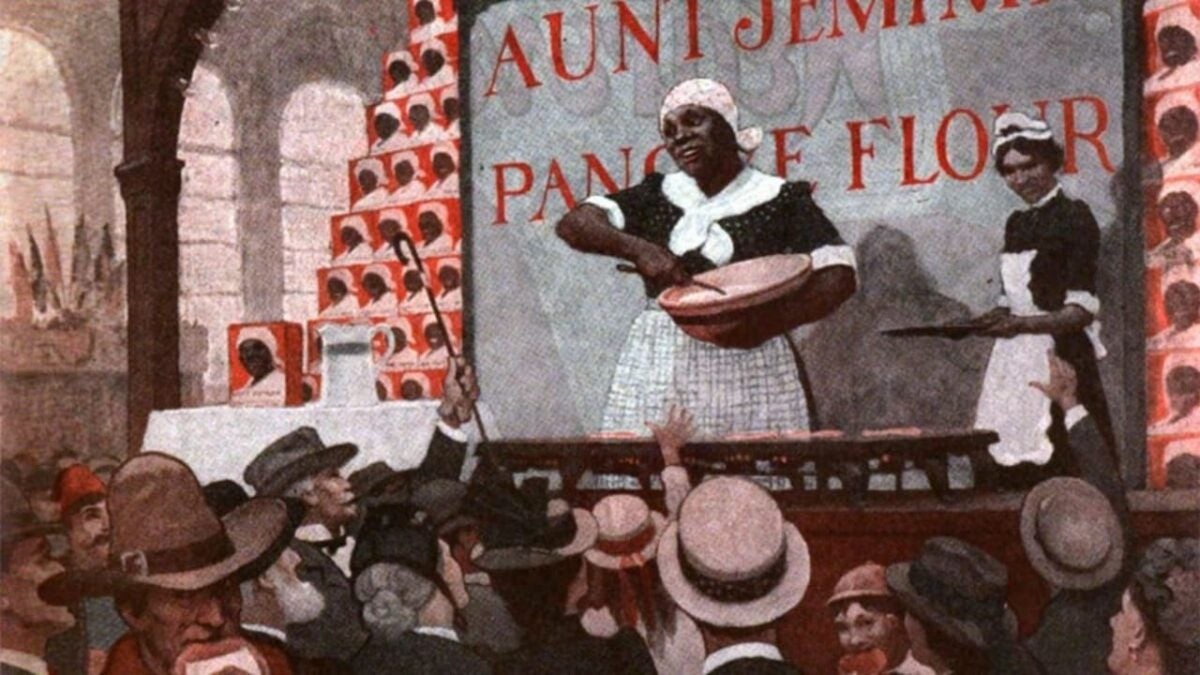
Nancy Green was 59 years old and had dressed again as a slave for the purpose of marketing. In 1893, at the World’s Columbian Exposition in Chicago, our protagonist sang songs, told made-up stories about racial equality and the joy of everyone during slavery in the South, and served breakfast using Aunt Jemima’s prepared mix. The exhibition’s advertising featured the phrase “I’se in town, honey!”, which was a racist way of imitating the speech of slaves.

Immediately after the fair, the owners of Aunt Jemima offered her a lifetime contract to portray the character. However, it is more likely that what they wanted was the rights to caricature her rather than her as a person. She traveled throughout the United States for years until, at the age of 66 in 1900, she refused to cross the Atlantic to attend the Paris Exposition and was replaced by another African American woman, indicating that they cared more about the character itself than about her.

Slavery stories

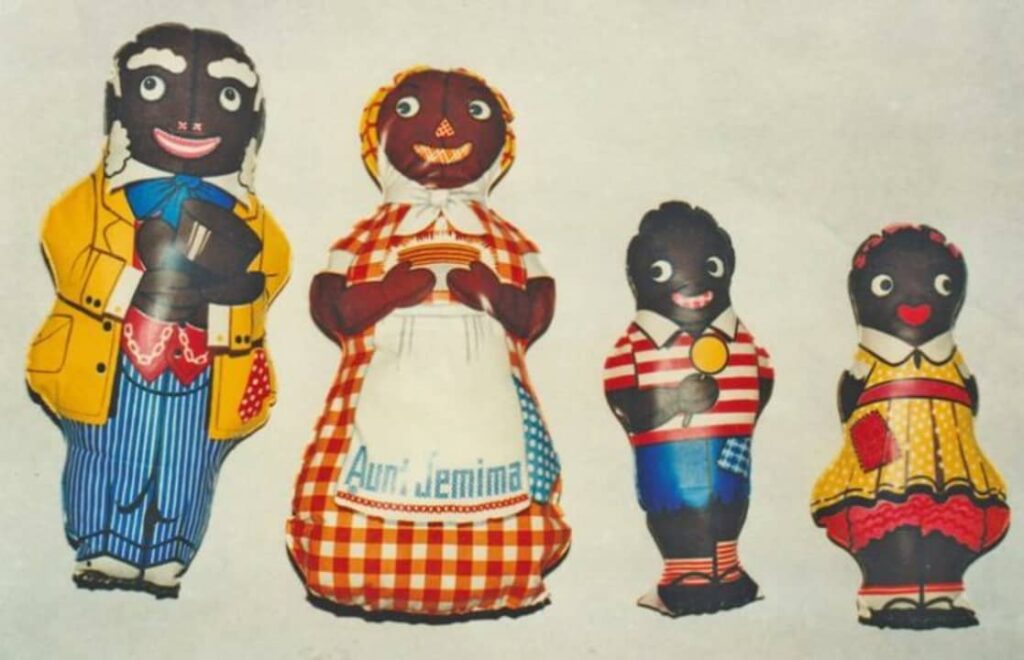
To give you an idea of what it was like, Aunt Jemima was presented as a loyal cook on a Mississippi colonel’s plantation, and stories were invented about her flavor (“The recipe is from the South, from before the Civil War”), with nostalgia for the days of slavery. Another story claimed that she had revived a group of shipwreck survivors with her food. Merchandising with her face was widespread, including cut-out dolls from the product box and clothing for those dolls.

Aunt Jemima soon had a family: Uncle Rastus (later renamed “Uncle Mose”) and four children, in whose design Green had no say. The influencer, who helped put the brand on the map, continued working with the Walkers as if her face wasn’t in every supermarket until she passed away at the age of 89 in a house in Chicago with her nieces and nephews. By that time, Aunt Jemima was launching rag dolls of her character with oversized mouths, missing teeth, and torn pants.
The story of the “happy slave” was very common among brands created by white men after the Civil War, although it added even more pain to the racism in the United States. The last actress to portray Aunt Jemima did so in 1964 at Disneyland. She was even friends with Walt Disney! In 2020, the brand removed the racist caricature from its packaging, and in 2021 it was announced that its new name would be Pearl Milling Company, the original company that was founded in that flour mill. It took them nearly 150 years to realize that a narrative based on slavery only reopened wounds. How things change.

Paula Gonu ate her own meniscus with bolognese: Long live the Mediterranean diet!

Paula Gonu, the 30-year-old influencer who has confessed that, as part of Mediterranean gastronomy, she once ate her meniscus. With a bolognese, yes. What are we? Monsters?

Every day miracle diets appear on social networks, those that promise that you will lose twenty kilos in a week and a half eating bread, rice and pastries. It sounds impossible (because it is) but they will always be healthier than the diet that, it seems, has chosen Paula Gonu, the 30-year-old influencer who has confessed that, as part of Mediterranean cuisine, she once ate her meniscus. With a bolognese, of course. What are we, monsters?

TikTok DOWNLOAD

More or meniscus

It all started when he had to go to the doctor for an operation because his meniscus was too big. As it was a more or less normal operation, he was chatting with the doctor and in the end he encouraged him to take it home in a small jar with formaldehyde. “It’s yours,” he told her. It’s not a lie, of course: some have Chinese vases, others Rubik’s cubes, Paula Gonu has menisci in formaldehyde. About tastes…

A week later, Gonu was with her partner of the moment and confessed to him that she wanted to eat him. “Just kidding” she says, excusing herself that it was hers. Con la coña normally you order a pizza with pineapple or eat more spice than you should, but Gonu eats a knee sandwich. Not the Knee, no, you read that right.

We hope the bolognese sauce came out great, because you don’t always want to eat your own body parts. “It’s mine and it was clean, it was a piece. I’m sure you’ve eaten worse,” he said on the Club 113 podcast, with all of his callers aware of having eaten at Taco Bell at one time or another. So, just like the protagonists of ‘¡Viven!’ but in its Madrid bourgeoisie version, the influencer can now say that she has innovated like Daviz Muñoz. He has eaten semen, she has eaten meniscus. What doesn’t occur to one occurs to the other.

Is the reconciliation between Dulceida and Alba Paul real… Or a very well faked fake?

We live fascinated by reconciliations like the one between Dulceida and Alba Paul. We want to believe his return with all our might. And yet, a question dwells in the back of our heads: Is it real?

The end of ‘Sálvame’ has to serve to make us realize one thing: the world of the heart never ends, it only transforms. Since the “mundane chronicles” appeared in the ‘Black and White’ at the end of the 19th century until today, we have never stopped being interested, not even for a single moment, in the life of celebrities. We have changed the sets and shouting for Instagram and Stories, but the result remains the same: we live fascinated by reconciliations like that of Dulceida and Alba Paul. We want to believe their return with all our strength. And yet, a question dwells in the back of our head: Is it real?

Instagram DOWNLOAD

Target: love

Dulceida and Alba’s relationship began under the protection of a camera and has always lived around it. Videos at events, photos on the beach, flashes of an aspirational idyllic lifestyle in which they themselves were dedicated to sell, whoever paid, the same, their star and differential product: themselves. They were the star couple of Instagram, a new way of understanding the world, a spark of hope in the hurried and depressive millennial life.

In the same way that we want to believe that Romeo and Juliet kill each other for love on stage and they are not two actors who then go home, the curtain of Dulceida and Alba‘s life only falls when the camera goes down and the lens goes off. As if the real life always happens facing others, looking for the ideal shot that says, at the same time, “This can happen to you” and “Our life is perfect”. A relationship so believable and so beautiful that its ending left a whole generation with a knot in the stomach.

Any normal couple, when breaking up, suffers for a while but does everything possible not to see the other person and get over it. Dulceida and Alba couldn’t give themselves that privilege: they had contracts, deadlines, dates, photos. Always showing themselves perfect and ideal, even when their hearts are broken and their souls are somewhere else. Or maybe, accustomed to the daily soap opera and to always show their lives live, neither the relationship was such a relationship nor the breakup such a breakup.

Reconciliations

In Madrid you never see your ex, unless you’re an influencer: Dulceida and Alba were seen in every event, every party and every preview without stopping looking ideal smile, perfect photo and luxury stories. And from the very moment they broke up, there was talk of a return that, as real as they feel, it can’t have been. When a normal person breaks up with your partner, you don’t have fans and journalists asking about her and theorizing, analyzing every sentence for a veiled reference to her. In the end you think you have to go back to that person, if only to silence all the voices and be able to live in peace.

And, why deny it, to get a handful of new contracts and stratospheric likes on Instagram. The now famous photo of the two of them together accumulated 609,000 likes: photos in which they do not appear together have six times less engagement, however paradisiacal they may be. The love of the two sells, as hypocritical as it may sound. And they know it perfectly well. It’s not that they have signed a contract or anything like that, but the announcement of their relationship is anything but spontaneous: it has a team behind it that prevents it. Love? Sure, at six o’clock in the evening, remember to upload a Story announcing it.

Accustomed to tell absolutely everything about their lives, practically scheduling their day-to-day life openly to their followers, Alba and Dulceida know they can’t afford not to smile in front of their dream breakfast, not to kiss each other when the sun goes down, not to hold hands in the streets of Madrid while trying to create a Reel that seems natural within its absolute artificiality. And yet.

Love in the age of Instagram

Who hasn’t ever dreamed of being an influencer? It doesn’t matter if it’s through Twitter, Instagram, TikTok or even Facebook: we all share our life through social networks, we all make a play out of it, representing reality in our own way to followers. It can be sarcastic, endearing or idyllic, but almost all of us end up gratuitously falling into the same trap that Dulceida and Alba have learned to capitalize on. They know perfectly well that their relationship makes money, yes, but… Who’s to say it’s not true?

Jorge Javier Vázquez said that he met them both on a plane and that they were genuinely happy. On Twitter there are people commenting that they have seen them walking around Madrid holding hands. When the camera falls and the lens closes, that’s what counts. And if what’s left are walks, coffees, smiles and trips, they both come out on top. There will always be doubts, as there are about so many other people in the celebrity world: we have seen too many pacts and falsehoods to believe in love between celebrities.

However, there is something in Alba and Dulceida that transcends the posts eating a croissant or sleeping in a hammock next to an infinity pool: there is rapport, laughter and affection. They may want to sell us the perfect life, yes, but they may also have it and all the doubts come from our most hidden envy. I guess someday, maybe, we’ll know everything. Hopefully, it won’t be in an Instagram Story and their relationship will survive the app of the noses.

“The tip is visible”: Paula Gonu suffers a sexist attack due to a taxi driver being too insistent on her breasts”

It’s a bit like what happened to Paula Gonu, who between extremely uncomfortable laughs couldnt believe the delirious conversation that she had had to endure and that, of course, she posted on TikTok.

Riding in a cab requires luck, expertise and conversational skills that not everyone has. Depending on the day, the conversation can revolve around city traffic, soccer, one’s experiences or, if you get the worst possible choice on the destination dice, politics. And you’re lost. You don’t want to contradict the person who is taking you somewhere, after all. This is a bit what happened to Paula Gonu, who, amidst the most uncomfortable laughter, could not believe the delirious conversation she had to endure and which, of course, she has posted on TikTok.

TikTok DOWNLOAD

Just the tip

Faced with the education of some, who have been in the profession for years and know perfectly well how to treat anyone who gets into the car, there is the rudeness of a few who, if they touch you, can ruin your day. When Gonu, the 30-year-old Catalan influencer, got into that cab, she didn’t imagine that the driver would be one of the latter.

Neither short nor lazy, the cab driver thought that the best topic of conversation was not the weather or work, but the breasts. More specifically, hers. “It hasn’t been in fashion for long,” the man insisted, trying to bring up conversation in the most unexpected place, “it’s a new fad of not wearing a bra”. Gonu, normalizing the scene and, we suppose, trying to calm down for not calling him everything, tried to conclude with “I don’t know, I’ve never had one”. And since there was a reply, the driver suddenly felt free to insist on the subject.

@paulagonu

me reía de nervios, con lo de la puntita vomit0, llevaba un top de algodón normalísimo del zara quiero decirte

♬ sonido original – Paulagonu

“Never? Really? Well, you’re comfortable like that, aren’t you? Let her air, right?” You know those times when the most awkward, cutting silence would be more pleasant than anything that could be said? Well, that was one of them. And alas, the boy filled it in with more words harping on the subject, just in case it hadn’t been clear: “But it looks like it depends on how it looks, the little tippy tip looks”. Ah, yes, I have read this one: a love poem by Gustavo Adolfo Becquer, right?

Crazy Taxi

If you still haven’t taken your hands to your head (or have had some retching), wait, there’s more: “It depends, some of them wear very… thin clothes, you can see the tip”. Someone should have reminded the gentleman (whom you can imagine saying “I am not a sexist” at the bar) that FakeTaxi is fiction.

The influencer herself wrote about the incident, saying “I laughed nervously, with the ‘tip’ comment I wanted to vomit. I was wearing a plain cotton top from Zara, just so you know”. The video has half a million views and around 416 comments, mixing words of encouragement with those from people who try to imitate or even surpass the disgust of the taxi driver. It seems that sometimes in real life, there are people who are even more repulsive than those hiding behind a pseudonym.

The next time you get into a taxi and the driver shows you photos of their pets, talks about how well Atlético Madrid is doing, or brags about their family, remember that anything is better than having a conversation about bras, breasts, and “tips”. Sometimes it’s better to have nothing to talk about.