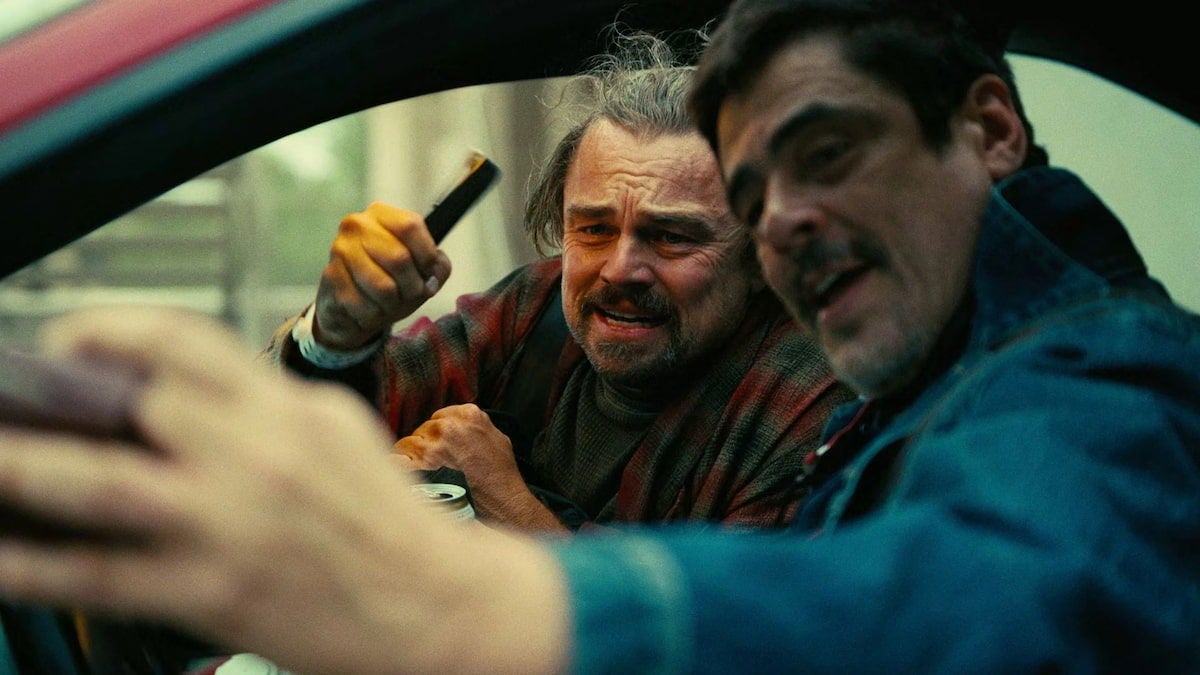
This year, cinema has been filled with blockbusters dominating the box office, especially at the end of the year, and audiovisual experiences that have little to do with traditional cinema. However, we have not been devoid of great films in the old-fashioned way. Both spectacular and visually captivating films, as well as films with great scripts and even greater performances that catch the attention of cinephiles and attract a more general audience.
This has been the case for one of the most celebrated films, if not the most celebrated, of Leonardo DiCaprio. An authentic surprise that has caused a sensation, has swept through, and despite costing a fortune, has managed to be a box office success. Being a strong contender for the 2026 Oscars. Because One Battle After Another is one of those must-see films of the year.

A Movie of Proper Names
One battle after another is a film, to say the least, with an interesting premise. The protagonist, “Ghetto” Pat Calhoun, is a pothead with a sixteen-year-old mixed-race daughter. Except that the daughter is from another man, a military man who had a romance with his partner and who now, when he tries to enter a secret sect of secret supremacists, will attempt to kill her to hide what he considers a shameful past. Something that will set in motion a story of paranoia, secret groups, assassination attempts, and terrorist groups that will go far beyond all the characters involved.
How can such a crazy argument be explained? Basically, through two groups of proper names. On one hand, the names of its two main actors: Leonardo DiCaprio and Sean Penn. On the other hand, the names of the creators of the story: Paul Thomas Anderson and Thomas Pynchon.
Leonardo DiCaprio plays an ex-member of a revolutionary group, now a pothead without benefits, who will do anything to protect his daughter. Except perhaps quit smoking pot. Sean Penn plays a deranged far-right military man to the point of being willing to join a cult. And in both cases, they are able to give meaning to two characters that border on caricature, bringing them to life with constant tiny nuances, which could easily be the best performances of the year. Something that undoubtedly has a lot to do with who is behind the camera.
Thomas Pynchon is a writer who, for lovers of postmodern literature, needs no introduction. For those who don’t, Pynchon is considered the father and patron saint of paranoid literature, with a maximalist and absolutely deranged style, featuring characters always on the brink of schizophrenia. Combining cults, secret plans, wars in the shadows, and a poetic vein with constant references, he is regarded as one of the best, if not the best, living American writers. This also comes with something: he has also been considered absolutely impenetrable for the average person, even if he is not that difficult to read, and impossible to adapt to film, which is something that is more accurate.
At least, until the arrival of Paul Thomas Anderson. Who has successfully adapted it to film twice already.
Adapting the extremely unhinged Inherent Vice in 2014, considered Pynchon’s most accessible novel, he has now embarked on adapting another of his novels deemed simpler, Vineland, in this One Battle After Another. Or to be exact, a part of the novel. One Battle After Another offers a modulated version, much less unhinged and leaving out a large part of the novel, turning it into a grand odyssey about a father and daughter’s struggle against a society that hates them for their prejudices.
The result is a film that has taken both critics and audiences by storm. With a 95% on Metacritic, it has grossed over 200 million dollars at the box office with a budget of 130 million. All of this positions it as one of the top favorites for the Oscars, both for its lead actors and for its director, as it sits at the perfect intersection for these awards: popular enough to justify the award, but cultured enough to make it sensible to award it.
If all of this has left you curious to see it, you won’t have to wait long to do so. A battle after another arrives on December 19 on HBO Max. So get ready and set aside 162 minutes to watch it, because if a movie has the potential to be talked about throughout 2026, it’s this one.