You may not have noticed, but the world around you is changing because of social media. Here’s how.
Flawless skin against pastel backdrops, beautiful food in abundance, and travel shots to die for. The rise of image-based social media means we’re constantly scrolling through a digital catalog of how life is supposed to look.
But, it’s worth pointing out how spending time online has changed the way things look in the offline world. Our perception of beauty is changing on the whole. Sure, trends come and go, dictated by what’s going on in the world.
But, on the broad scale, we’re looking at something new. The way we take in life’s aesthetic experiences is changing. Just the fact that we call everything from eating to looking at clothes “an experience” is a relatively new development.
From museums to filtered beauty and how we think about food—here are some ways that social media aesthetics have changed our perception of the real world.
How social media is changing the way our world looks
Social and our cultural institutions
A 2017 La Placa-Cohen report says our definition of culture is changing. We’d rather be entertained than educated, it says.
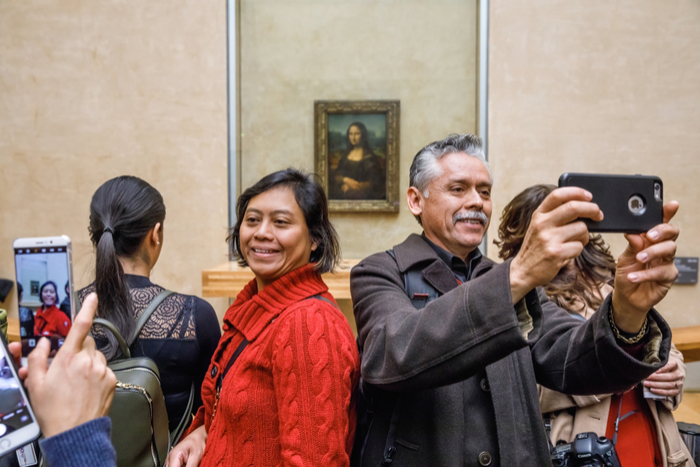
Look at the museum culture now. Hot exhibits have people standing in line to take selfies.
There’s been an influx in several social media-centric galleries, museums, and popups like the Color Factory, the Museum of Ice Cream, and the Museum of Selfies.
For traditional museums, once photo-free zones, norms are changing. Exhibits that photograph well are becoming a source of revenue for these institutions, so museums are increasingly forced to get on board with Instagram.
On the one hand, it’s cool that there’s a renewed interest in the museum. There’s also the question of how we’ll judge the real-life version of a painting. Or, whether those pieces that don’t photograph well still have merit — will they be passed over for those with the right color schemes?
Makeup industry has exploded
Makeup is undeniably having a moment. From Glossier to Kylie Cosmetics to all things Korean beauty and face masks — it’s safe to say, social has had a major hand in our collective obsession.
The why is pretty obvious: cosmetic brands have a huge advantage on visual platforms. They can now show how products look, instead of rattling off a list of benefits. There’s also something soothing about watching people draw swatches on their arms or explain how to use a product.
Self-made makeup gurus have created a culture that thrives on the internet, offering tutorials on how to create these elaborate, full-faced looks. Or, what influencer Patrick Starr calls, the Full Beat Face. You’ve seen it, even if you don’t know the name, filled in eyebrows, contoured cheeks, elaborate eye makeup, fake lashes, the whole shebang.
This look is seen in selfies across the globe — and has perhaps contributed to a changing standard of beauty. Look at the rising demand for plastic surgery or the massive numbers of women attempting to recreate the Kardashian face.
On a more hopeful note, social media has broadened our idea of what’s beautiful — it’s a democratic platform that allows more diversity than traditional advertising.
Interestingly, this ability to share favorite looks so easily has contributed to a new, somewhat cringeworthy phenomenon, fake #sponcon. It’s a response to the fact that brand deals are a hot commodity–but it also shows how much power tops brands wield over a young audience.
Design trends are merging
Restaurants participate a ton on Instagram and Pinterest. It makes sense, you need to play the social game if you want to attract diners, critics, and food bloggers into your establishment.
Neon lights, murals, open spaces, and succulents. Restaurants decorate with social media in mind — some replace countertops with white surfaces that better highlight the food. Others add elaborate accent walls. These things come together to create an experience.
On the home decor front, there’s this fast-paced cycling of trends happening. Journalist Kyle Chayka says design trends get overexposed instantly — and they almost become meme-like as a result. It makes sense — scroll through Instagram, then consider the trendy boutiques and cafes in your neighborhood.
Chances are, you’ll see a similar blend of industrial chic, pastel-hued walls, and minimalism. Life has become a catalog that really stays on brand.
Eating has changed
And, speaking of restaurants, it’s not just the decor that social media is changing — it’s also the food itself.
You’re not even going to see certain foods anymore. Brown foods like meatloaf, hearty stews, and casseroles aren’t exactly hot these days — they look bad in photographs.
In some cases, chefs are developing dishes exclusively for the benefit of being extremely photogenic. Foods with bright colors and contrasting hues take precedence over taste in some cases — which of course, impacts what we order or consider “good.”
Final thoughts
Whether we want to admit it or not, many of our IRL decisions are influenced by influencers. Our desire to create a certain look on social media does have an impact on how we conduct ourselves in the real world—playing a role in the restaurants we select, the clothing, makeup, and decor we purchase, and the places we go.
Trends like fake branded content may be seen as uncomfortable to the outside observer, but it could also be seen as a way into the influencing game. Our museums might now be defined by the long lines of selfie-takers, but it also means more people visit these institutions.
On the whole, it is hard to say whether these changes are positive or negative.
But, it is worth questioning — what do we gain from documenting everything? And how does the “pics or it didn’t happen” mentality shape our expectations for analog experiences?