Alan Wake 2 has been one of the most popular and celebrated games of recent years. No wonder. Its perfect blend of horror, action, and a deep narrative perfectly integrated into its gameplay makes it an absolutely exceptional game. Something that has made its developers, Remedy Entertainment, a much more well-known and influential studio than they were up to that point. Which has led people to reassess their earlier works, such as Control.
That’s why it shouldn’t surprise us that one of the big games of this early autumn is Control: Resonant. The sequel to the very peculiar and fascinating Control, which completely switches genres, but not setting or style. Because if Control was a third-person horror shooter, Control Resonant is an action RPG, but both share the same elements: brutalist architecture, weird fiction, and a world that connects to Alan Wake’s, with which they seek to create something deeper than it seems at first glance.
A Strange New York
In Control Resonant we control Dylan Faden, Jesse Faden’s brother and the antagonist of the first Control. Possessed by the Hiss during the events of the first game, he has now managed to break free from its control, finding himself in a desperate situation. New York has been cut off from the rest of the world while two otherworldly entities battle each other, with Dylan being the only person able to wield different Objects of Power to fight them. Even when all he wants is to flee and find his sister, who is desperately searching for him.
With this premise the game creates a vast and deep open world in which New York City is presented as enormous and frightening. Like a vast concrete jungle, its brutalist architecture rises everywhere, highlighting one of the game’s biggest strengths: traversal.
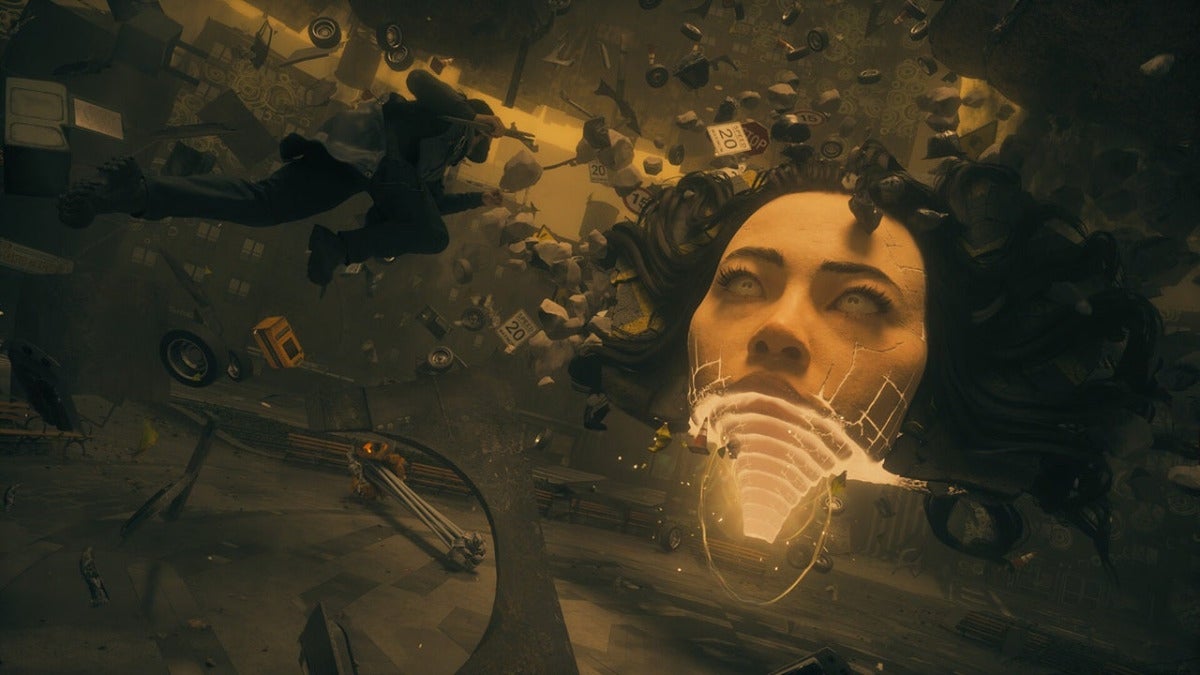
With gravity only a minor obstacle, in Control Resonant what is floor, wall, and ceiling can often change from one moment to the next. And Dylan can move through it with great ease. Making movement through the world one of the game’s strengths and one of its standout features. Giving it one of its most compelling features: navigating an enormous world that seems to open up without end.
Even if that also comes with the problems of collectibles that don’t always make much sense and excellent side quests, but repetitive secondary objectives. Which seem to exist only to justify open worlds that don’t need excuses to make us want to explore them.
Different Combat
But where the game truly stands out is in the combat. Fluid, spectacular, and forceful, it makes each weapon feel completely different and distinct from the rest. Which makes it easy to find one we not only feel comfortable with, but that feels like the weapon we want to spend the rest of the game with. Making it easy, after a day-one patch, to respec your skill points to try things out.
The scale of the bosses and the level design contributes to all this. By forcing us to keep moving constantly and to take into consideration who poses a threat and which ones we should prioritize, the game knows how to turn the screws on us so that you have to fight smart. Not letting us breathe for a single second. Something that gives it that special something that gives meaning to action games.
Add the spectacular graphics and art design and a narrative that links not only with Control, but also with Alan Wake 2, Control Resonant has everything to make not only action game fans fall in love, but Remedy fans too. Because here we have one of the best games of the year, one that could very well slip under the radar. Which would be a shame, because there are few games this polished on the market.
