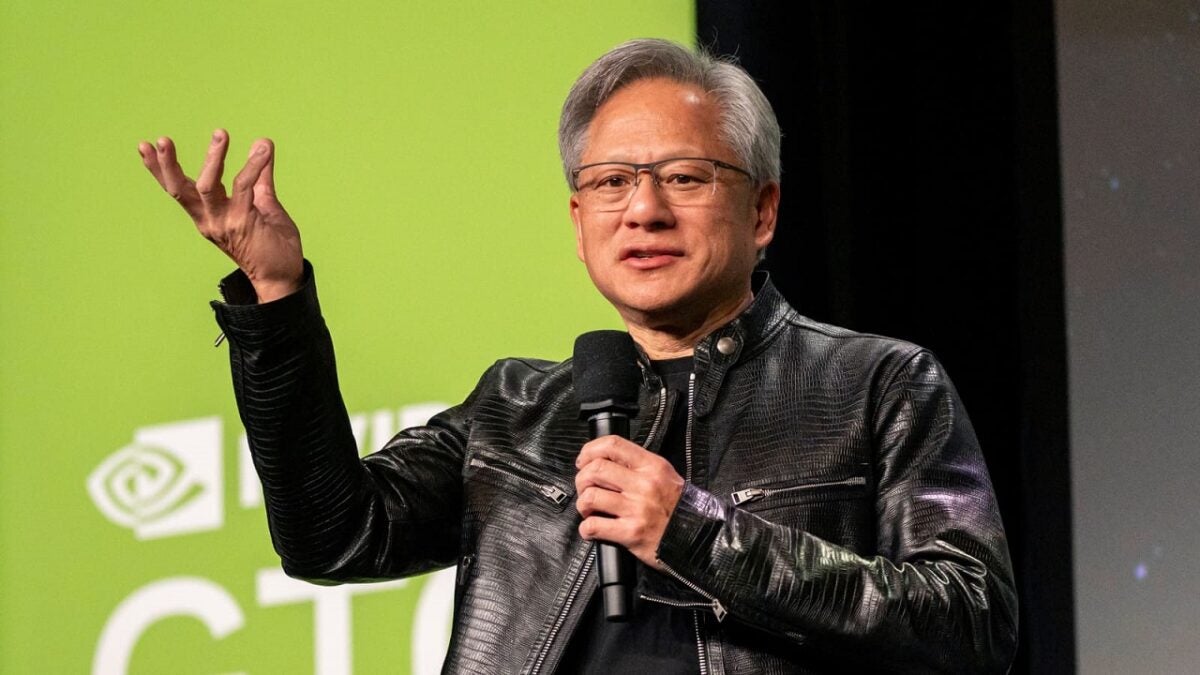
The CEO of Nvidia, Jensen Huang, claims that Washington has lost its edge in artificial intelligence and warns that China will win the AI race. But before continuing, keep in mind that there are always vested interests behind any statement of this kind. In this case: a veiled request for deregulation of AI and cheaper energy. And having said that, let’s continue.
The CEO of Nvidia cites as reasons the cynicism of the West, export controls, and China’s favorable energy circumstances, claiming that companies find it much easier to access energy in that country.
The CEO of the world’s most valuable company by market capitalization has long claimed that the U.S. ban on chip exports is a failure and that the spread of its advanced semiconductors is vital to maintaining its competitive edge globally, as we read in Tom’s Hardware.
Message to the world or message to Donald Trump?
However, the ongoing trade war between the two powers has resulted, on one hand, in the ban on exporting Blackwell chips by the White House and, on the other, in the ban by the CPC on foreign AI chips in state-funded data centers.
As a result, Nvidia’s market share in China has fallen to almost zero, which likely led Huang to make that statement to the Financial Times.
“China is going to win the AI race,” Jensen commented. He also added that “we need more optimism,” stating that the cynicism of the West is holding it back. Huang posted a statement on Nvidia’s Twitter account just hours after FT published his words: “As I have been saying for a long time, China is nanoseconds away from the United States in AI. It is vital that the United States wins by getting ahead and winning over developers from around the world.”
The CEO of Nvidia mentioned this at the end of September in a podcast, reinforcing his stance, which he has been advocating for over a year, that the export restrictions on his company’s AI chips are detrimental to the long-term interests of the United States.
Huang argues that if China loses access to the latest AI GPUs from Nvidia, its tech companies will be forced to buy domestic alternatives, which will inject money into its chip manufacturers and further boost research, development, and innovations in the local semiconductor industry.
In addition, it will also reduce these companies’ dependence on Nvidia’s software ecosystem, making it easier for them to migrate to a Chinese AI processor. On the other hand, other industry leaders argue that the United States is heavily dependent on China and is only using Nvidia’s products as a stopgap solution until it builds a credible competitor to the AI chip giant.
These comments come just days after the administration hinted that China could have access to Nvidia’s Blackwell chips, but only once they are obsolete.
Aside from the export controls, Nvidia’s CEO also highlighted China’s focus on energy subsidies, which make it easier for companies to create energy-intensive data centers, compared to the patchwork of regulations that different U.S. states are imposing on AI, which could lead to “50 new regulations.”
Experts have been saying for some time that electricity generation is the next bottleneck that the AI industry must solve, and it seems that Beijing is far ahead, as it has already addressed the energy problem of its AI infrastructure.
On the other hand, U.S. tech companies continue to invest in alternative energy sources, such as small modular reactors and space data centers, which will take years to materialize, if they ever do. Recently, Microsoft revealed that it has millions of GPUs that it simply cannot connect because it lacks the necessary power.
