In a recent debate about the use of Nvidia’s DLSS 5 technology, senior animator Mike York expressed his deep criticism regarding its effects on video game characters. York, known for his work on titles like GTA 5 and Death Stranding 2, argues that this new technology, which is based on a real-time neural rendering model, distorts the appearance of characters in an unrealistic way. His analysis has gained relevance following the controversy generated by the use of DLSS 5 in Resident Evil Requiem, where he highlighted the transformation of the […]
In a recent debate about the use of Nvidia’s DLSS 5 technology, senior animator Mike York has expressed his deep criticism regarding its effects on video game characters. York, known for his work on titles like GTA 5 and Death Stranding 2, argues that this new technology, which is based on a real-time neural rendering model, distorts the appearance of characters in an unrealistic way. His analysis has gained relevance following the controversy generated by the use of DLSS 5 in Resident Evil Requiem, where he highlighted the transformation of the protagonist Grace Ashcroft into an image that he considers comparable to a TikTok filter.
Consider that there is nothing good here
York’s criticisms come at a time when the debate over DLSS 5 is intensifying among players of other franchises. In particular, the Assassins Creed Shadows community has begun to protest against the new DLSS 5 filter, warning that it could harm the historical reputation of the saga. Gamers argue that the implementation of this technology could lead to results similar to those observed by York, which would create widespread discontent among the fanbase.
On the other hand, Digital Foundry’s initial response to DLSS 5 was more enthusiastic, although the publication has revised its stance, acknowledging that performance under certain conditions may not be as expected. This disagreement in perceptions highlights the current tension in the industry regarding the direction that graphics technology is taking and its impact on gameplay. While developers seek to innovate, the opinion of veterans like York brings to the forefront the need for a balance between technology and the player experience.
NVIDIA is at the center of controversy following the launch of DLSS 5, an image scaling technology that aims to deliver photorealistic graphics in video games. However, it has received criticism from players and industry professionals, who question both its visual impact and artistic integrity. Some believe that this tool acts as an aggressive artificial intelligence filter that could sacrifice the artistic intent of developers. Their explanations give reason to everyone One of the most critical voices belongs to Steve Karolewics, a rendering engineer at Respawn, who expressed on social media […]
NVIDIA is at the center of controversy following the launch of DLSS 5, an image scaling technology that aims to deliver photorealistic graphics in video games. However, it has received criticism from players and industry professionals, who question both its visual impact and its artistic integrity. Some believe that this tool acts as an aggressive artificial intelligence filter that could sacrifice the artistic intent of developers.
Your explanations make everyone right
One of the most critical voices belongs to Steve Karolewics, a rendering engineer at Respawn, who expressed on social media that DLSS 5 seems like an “exaggerated filter” that alters the original visual quality, generating “radically different” frames. This argument has resonated among many within the community, sparking a debate about the technology’s aspiration to achieve photorealism at the expense of the artistic aesthetics of video games.
In response to these criticisms, Jensen Huang, CEO of NVIDIA, vehemently defended the new technology during his appearance at GTC 2026. He stated that DLSS 5 is not simply a post-processing technique, but an advancement that allows developers to “control geometry, textures, and other aspects through generative artificial intelligence.” Huang emphasized that development studios have detailed control over the use of this technology, ensuring that the unique aesthetic of each game is maintained.
Despite the concerns raised by the community and some experts, NVIDIA maintains that this innovation represents a significant step forward in the pursuit of more realistic graphics, opening the door to new creative possibilities for developers. There is still time to address the criticisms and make improvements to the DLSS 5 tools, which means that the conversation about its impact on the industry will continue in the coming months.
Nvidia had a special presentation yesterday. Brief, but with a lot of fanfare, they made a special presentation for a select few specialized technology media, unveiling their new upscaling technology: DLSS 5. Everyone was eagerly anticipating it because, with its flaws, DLSS is a great tool. It allows computers with lower capabilities to run cutting-edge video games at resolutions higher than they normally could with minimal compromises. The problem is that DLSS 5 has not been that. What they presented is something very different from DLSS 4.5 and that, almost universally, has been […]
Nvidia had a special presentation yesterday. Brief, but with a lot of fanfare, they held a special presentation for a select few specialized technology media, showcasing their new upscaling technology: DLSS 5. Everyone was eagerly anticipating it because, despite its flaws, DLSS is a great tool. It allows computers with lower capabilities to run cutting-edge video games at resolutions higher than they normally could with minimal compromises.
The problem is that DLSS 5 has not been that. What they have presented is something very different from DLSS 4.5 and that, almost universally, has been hated for its results. But why has it been? For that, we need to understand what DLSS is and what it is not. And what they are trying to sell us.
What is DLSS?
DLSS, Deep Learning Super Sampling, is a technology that Nvidia launched in September 2018 as a key feature of the GeForce RTX 20 series GPUs. Its greatest contribution was the ability to, through deep learning, upscale lower resolution images to a higher resolution without losing fidelity or graphical quality. This allowed for increased graphical settings and FPS, as it enabled setting a relatively low resolution that the system could handle comfortably, upscaling it to the resolution of the TV or monitor being used.
Each new iteration has introduced new elements. Version 2.0 introduced its own anti-aliasing, which smoothed out the jagged edges in the first iteration. Version 3.0 introduced the ability to invent frames between the existing frames to gain fluidity in the image. And version 4.0 reduced both memory usage and emphasized light detail, particularly through the use of ray tracing.
Although DLSS has obvious advantages, allowing relatively modest computers to run current games, it has also had some disadvantages that cannot be overlooked. The generation of frames causes input lag, meaning that the commands we give to the controller take a certain number of frames to translate into images, which can be fatal for both competitive games and games that require reflexes or precision. And because DLSS is capable of doing a very good job running the game, many developers have stopped efficiently optimizing their games, relying on DLSS or other forms of upscaling technologies to do the work for them to make their games run.
That’s why there was great enthusiasm to know what the new version of DLSS would bring. Each new version has improved upon the previous one, even if there have been some issues since 3.0 that perhaps haven’t been discussed in the detail they should have. And now, with the presentation of 5.0, people have erupted.
The disaster of DLSS 5
Nvidia presented DLSS 5 with a series of videos and explanations that can be summarized in that the new thing in DLSS is that it is less efficient, more resource-demanding, and the contribution it makes is to add a generative AI filter over the games. Although they have rushed to assert that developers still have control over their images, that is neither what was seen in the presentation video nor what has been sold to us: DLSS 5 completely changes the scenes, making us play a very different game. And for the vast majority of the audience, a much uglier one.
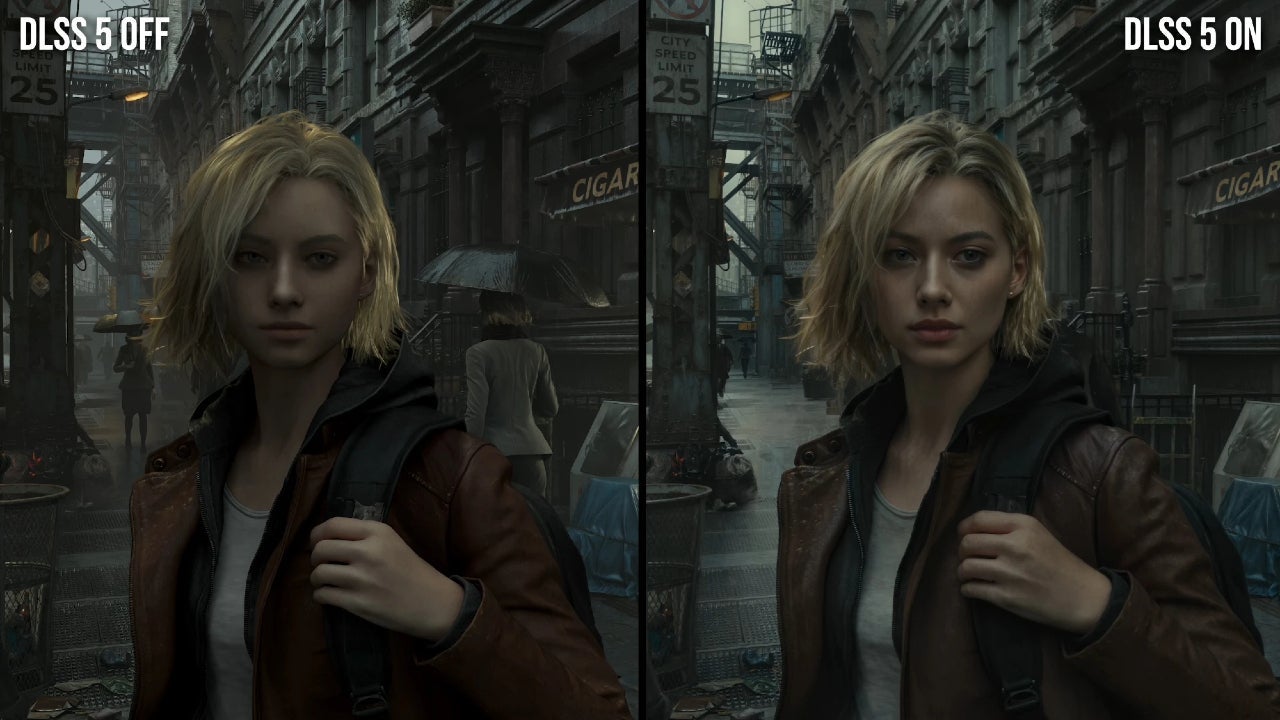
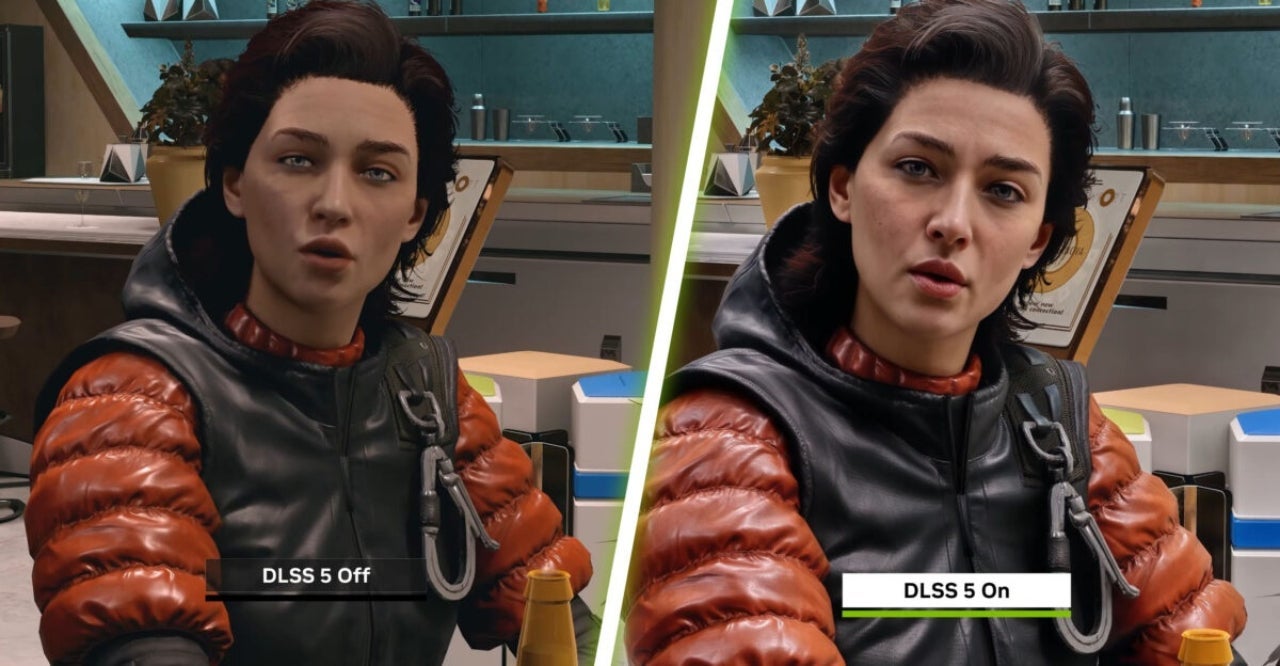
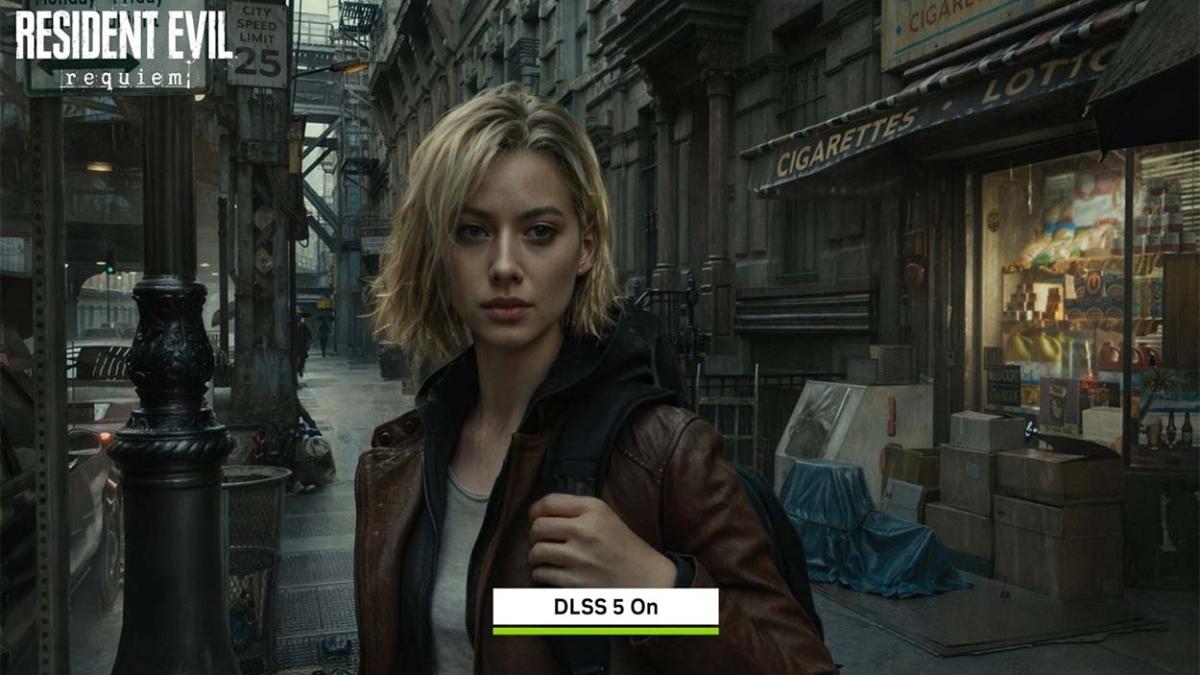
The most obvious thing is the faces. Presenting their technology with Resident Evil Requiem, Hogwarts Legacy, Starfield, and EA FC 26, among others, if something stood out throughout the presentation, it was that when activating DLSS 5, the characters looked different. It changed their physical features, reinterpreted their appearance, and provided a supposedly hyper-realistic version, but it is not.
Hyperrealism is a very specific form of art. It is a meticulous recreation of a photo or a scene from reality to which non-existent details are added to enhance its narrative qualities. Hyperrealism is, by definition, not realistic: it does not aim to reproduce reality, but rather to extract what is hidden in reality, betraying its small details. But DLSS 5 is not that. DLSS 5 is a layer of generative AI that makes an approximation based on algorithms to change images according to what is essentially a random calculation: there is no intention behind the changes. It is not enhancing what is hidden through its real reproduction, nor is it based on anything that exists in reality; it is not hyperrealistic, it is just ugly.
That’s why all faces look the same and are, very clearly, AI-generated faces. Because it has biases. Because it does not seek to enhance what already exists. It turns all women into models with infantilized faces and all men into subjects with defined bones and muscles. If someone has dark skin, hair, or eyes, it lightens them, and if a man is young or a woman is an adult, it ages or rejuvenates them due to its biases. Because it does not interpret and does not understand. It only applies the biases that have been given to it.
That’s why it’s not better when we talk about lighting effects or the settings, something that some people have defended more. The lighting lacks shading and is inconsistent, each scene fixture seems to be illuminated by its own LED spotlight, and instead of realistic, it looks like something else: as if filmed in a photography studio.
That’s why it produces the effect of the uncanny valley and why it has received such a negative reception. There is nothing here that is attractive, eye-catching, or interesting. The faces are strange, identical to each other; the scenes are unnatural, like very, very detailed models filmed in a studio. But furthermore, it is not even coherent. The face of Grace Ashcroft, the protagonist of Resident Evil Requiem, appears three times during the presentation, and each time it is a different face when DLSS 5 is activated. When it is not activated, Grace Ashcroft only has one face. Grace Ashcroft’s.
A Terrible Reception
Despite Nvidia presenting it with all the fanfare possible, even inviting Digital Foundry to their offices to release a fifteen-minute video praising the technology —and even then, unable to avoid stating that it didn’t do a good job with the faces—, the reception has been disastrous. And everyone has gone out to do damage control.
According to Nvidia, it is just a prototype, they are working on it and it will improve, because artists will still have control over the final result. They will be able to say how aggressive the filter will be. Moreover, that is not having control, because they will literally still not be able to decide how the changes are made and to what extent, that just leaves us with a question mark. So why have they presented it then? If it is just a prototype, if it is flawed, if artists will have more control, if they know all this, why have they presented it? Because they thought people would applaud it. Because Nvidia has interests in it.
They have thought about it, in part, because DLSS has been celebrated almost uncritically until now. It is a technology with disadvantages that, more often than not, any criticism made of it is disregarded. This has given them the confidence to release this product. But Nvidia, thanks to AI, is now the most valuable publicly traded company in the world. If anyone is interested in introducing AI and ensuring that AI succeeds in all aspects of life, including gaming, it is Nvidia. Their business and their superiority over the rest of humanity depend on it. That is why it should not surprise us: we have handed them the opportunity to do whatever they want, and on top of that, they have every reason to do so.
But it is normal for people to have reacted violently against DLSS 5. It makes games look worse, requires an obscene investment —as of today it works with two 5090s, one solely dedicated to DLSS 5; but Nvidia has also thought about that, why not use their cloud gaming service, Geforce NOW?— and moreover, it tarnishes a technology that everyone liked. But that’s why we need to be more critical. And that’s why we must not refuse to listen when others talk about the possible problems of a technology or a company. Because DLSS 5 is a disaster, but it is a disaster that was foreseeable.
NVIDIA has implemented unusual payment terms for the sale of its H200 chips in China, requiring full payment in advance with no possibility of cancellation, refunds, or changes to orders. This measure comes amid uncertainty, as although the Trump administration has allowed the sale of these chips with a 25% tariff, Beijing has yet to provide its official approval for imports. The Chinese market is crucial for NVIDIA, which has received orders for more than 2 million H200 chips, each priced at approximately $27,000. Nvidia does not […]
NVIDIA has implemented unusual payment terms for the sale of its H200 chips in China, requiring full payment in advance with no possibility of cancellation, refunds, or changes to orders.
This measure comes in a context of uncertainty, as although the Trump administration has allowed the sale of these chips with a 25% tariff, Beijing has not yet offered its official approval for imports.
The Chinese market is crucial for NVIDIA, which has received orders for more than 2 million H200 chips, each at an approximate price of 27,000 dollars.
Nvidia is demanding full upfront payment from Chinese customers ordering its H200 artificial intelligence chips, as the company hedges against ongoing uncertainty over Beijing's approval of the shipments, according to two people briefed on the matter https://t.co/p6SULiwtlPpic.twitter.com/bIWqOK8CCi
Nvidia does not trust China and calls for an unprecedented measure
However, the company only has an available inventory of 700,000 units. This dynamic has created a complex financial landscape for customers, who must commit capital without certainty about whether Beijing will give the green light to shipments.
Among the Chinese tech companies that have shown interest in acquiring the H200 are giants like ByteDance and Alibaba, which plan to request more than 200,000 units each, attracted by the superior performance of the new chip. The H200 has the potential to deliver approximately six times the performance of the H20, which is currently locked for the Chinese market.
Despite the fact that NVIDIA has historically required upfront payments, the new conditions reflect greater caution in light of the lack of regulatory clarity. This is partly due to the company’s experience last year when it had to write down $5.5 billion in inventory after the Trump administration’s ban on the sale of H20.
JUST IN: 🇨🇳 China to approve NVIDIA H200 chip purchases as soon as this quarter. pic.twitter.com/FeozWF1exH
Currently, the company plans to fulfill initial orders using its existing stock and has begun coordinating with TSMC to increase production of the H200, scheduled for the second quarter of 2026.
With the growing local competition from manufacturers like Huawei and Cambricon Technologies, the pressure on NVIDIA is intensifying. A definitive statement from China regarding imports is expected in the coming days, while NVIDIA’s CEO, Jensen Huang, assures that the demand for the H200 is “quite high” and that the company is ready to meet it.
In recent weeks, Windows 11 users have experienced performance drops in several games due to a bug introduced by the cumulative update in October. This issue, which particularly affects titles that use DirectX 12, has led many players to seek solutions to improve their experience. The performance drops have been particularly noticeable in popular games like Assassin’s Creed, Battlefield 6, and Call of Duty: Black Ops 7, where stuttering has been a recurring problem. A patch that fixes everything In response to this situation, NVIDIA has released a hotfix driver, the […]
In recent weeks, Windows 11 users have experienced performance drops in several games due to a bug introduced by the cumulative update in October. This issue, which particularly affects titles that use DirectX 12, has led many players to seek solutions to improve their experience. The performance drops have been particularly noticeable in popular games like Assassin’s Creed, Battlefield 6, and Call of Duty: Black Ops 7, where stuttering has been a recurring problem.
A patch that fixes everything
In response to this situation, NVIDIA has released a hotfix driver, version 581.94, aimed at restoring lost performance and, in some cases, even improving frames per second (fps) in certain titles. For example, some users have reported an increase in fps in Assassin’s Creed, going from 55 to over 90 with the installation of the new driver. However, NVIDIA has clarified that this hotfix is considered a beta version, which means that users should proceed with caution when installing it.
NVIDIA indicates that this hotfix driver is recommended only for those gamers who have clearly noticed performance drops after updating to version KB5066835 of Windows 11. For those who have not experienced issues, installing the new driver is not mandatory. Additionally, it is mentioned that the problem may also affect users with AMD or Intel GPUs, highlighting the scope and severity of the issue.
The error highlights once again the complications that PC players often face with each operating system update. With Windows 11 being known for its tendency to cause errors in games after regular patches, many are wondering if Microsoft will address these types of issues more promptly in the future. In this context, NVIDIA’s intervention seems to have been a temporary, but necessary, solution.
INF Tech, a Chinese startup based in Shanghai, has gained access to 2,300 banned Nvidia GPUs through the Indonesian operator Indosat Ooredoo Hutchison. This deal, which represents a transaction of approximately $100 million, has raised concerns about the legality and transparency of Chinese companies accessing U.S. technology, especially in a context of political tension between the United States and China. According to reports, INF Tech has collaborated with Aivres, a partner of Nvidia, which is rumored to have links to Inspur, a Chinese company on the U.S. government’s blacklist. A business that […]
INF Tech, a Chinese startup based in Shanghai, has gained access to 2,300 banned Nvidia GPUs through the Indonesian operator Indosat Ooredoo Hutchison.
This agreement, which represents a transaction of approximately $100 million, has raised concerns about the legality and transparency of access to U.S. technology by Chinese companies, especially in the context of political tension between the United States and China.
According to reports, INF Tech has collaborated with Aivres, a partner of Nvidia, which is rumored to have ties with Inspur, a Chinese company on the U.S. government’s blacklist.
WSJ just dropped another strong investigation on how China is exploiting loopholes in U.S. export controls. To summarize what is happening and the loopholes that China is exploiting:
1️⃣ Nvidia ships Blackwell AI chips to Aivres Systems, a U.S.-based company that is 100% owned…
Aivres, which has not revealed a clear ownership structure, acquired 32 racks of Nvidia GB200 servers, each with 72 Blackwell chips, later selling them to Indosat. This move has sparked criticism, as there is a perception that Chinese companies may be circumventing regulations to gain access to sensitive technologies.
Despite the concerns, legal experts assert that access is legal, given that the contracts were signed between entities that are not on the U.S. trade restrictions list.
USA restrict buying AI chips to china. So, Indosat, the Indonesian telecom company, the joint venture between Qatari and Hong Kong ones, buy Blackwell chips of Nvidia from Aivres then do bisness with INF Tech- the Shanghai based company. The world is so complicated to regulate. pic.twitter.com/DcttrP3oQl
Indosat has defended its decision, emphasizing that it follows regulations and that any international customer, whether from the United States or China, must comply with the established norms.
Nvidia, for its part, has advocated for more flexible export controls, arguing that allowing access to its technology is essential to maintain its leadership in the sector. The company has stated that its compliance team has approved its partners before shipments are made, asserting that current restrictions hinder innovation and benefit foreign competitors.
SoftBank has made a significant shift in its investment strategy by selling 32.1 million shares of NVIDIA for a total of $5.83 billion, completely liquidating its stake in the chipmaker. This move, which experts say reflects a strong bet on the future of artificial intelligence, also includes the sale of part of its stake in T-Mobile for $9.17 billion. The Japanese giant is abandoning its focus on physical infrastructure, such as semiconductors, to concentrate on investing in artificial intelligence models. Are they expecting a drop in Nvidia’s stock? SoftBank […]
SoftBank has made a significant shift in its investment strategy by selling 32.1 million shares of NVIDIA for a total of $5.83 billion, completely liquidating its stake in the chipmaker.
This move, which experts say reflects a strong commitment to the future of artificial intelligence, also includes the sale of part of its stake in T-Mobile for $9.17 billion.
The Japanese giant is abandoning its focus on physical infrastructure, such as semiconductors, to concentrate on investing in artificial intelligence models.
Japanese giant SoftBank said Tuesday it has sold its entire stake in tech giant Nvidia for $5.83 billion.
SoftBank has committed a total of 40 billion dollars to OpenAI, where it anticipates that true profitability lies in the application layer of AI, rather than in chip manufacturing.
This strategy is reinforced by a recent report detailing benefits of $16.3 billion in its second fiscal quarter, primarily driven by its investments in OpenAI through the Vision Fund.
This is not the first time that SoftBank has made controversial decisions regarding NVIDIA. In 2019, it sold shares at a time when prices were under pressure, facing criticism for the timing of its sale.
Japanese technology company SoftBank Group Corp. says it has sold all the Nvidia Corp. shares that it owned for $5.83 billion. https://t.co/qs8qT4WZiR
Currently, NVIDIA is at historical highs, a context that makes SoftBank’s decision to divest its shares during this wave of advancements in artificial intelligence even more surprising.
As an extension of its commitment to OpenAI, SoftBank will lead the Stargate initiative alongside the organization, which aims to attract 100 billion dollars to develop data centers.
Each entity will contribute 19 billion, positioning itself in a rapidly growing market. However, SoftBank’s investment track record, which includes notable failures like WeWork and FTX, raises the question of whether this new direction will be its salvation or a costly slip.
Nvidia’s CEO, Jensen Huang, claims that Washington has lost its edge in artificial intelligence and warns that China will win the AI race. But before continuing, keep in mind that there are always vested interests behind any statement of this kind. In this case: a veiled request for deregulation of AI and cheaper energy. And having said that, let’s continue. The CEO of Nvidia cites as reasons the cynicism of the West, export controls, and China’s favorable energy circumstances, arguing that companies find it […]
The CEO of Nvidia, Jensen Huang, claims that Washington has lost its edge in artificial intelligence and warns that China will win the AI race. But before continuing, keep in mind that there are always vested interests behind any statement of this kind. In this case: a veiled request for deregulation of AI and cheaper energy. And having said that, let’s continue.
The CEO of Nvidia cites as reasons the cynicism of the West, export controls, and China’s favorable energy circumstances, claiming that companies find it much easier to access energy in that country.
The CEO of the world’s most valuable company by market capitalization has long claimed that the U.S. ban on chip exports is a failure and that the spread of its advanced semiconductors is vital to maintaining its competitive edge globally, as we read in Tom’s Hardware.
As a result, Nvidia’s market share in China has fallen to almost zero, which likely led Huang to make that statement to the Financial Times.
“China is going to win the AI race,” Jensen commented. He also added that “we need more optimism,” stating that the cynicism of the West is holding it back. Huang posted a statement on Nvidia’s Twitter account just hours after FT published his words: “As I have been saying for a long time, China is nanoseconds away from the United States in AI. It is vital that the United States wins by getting ahead and winning over developers from around the world.”
The CEO of Nvidia mentioned this at the end of September in a podcast, reinforcing his stance, which he has been advocating for over a year, that the export restrictions on his company’s AI chips are detrimental to the long-term interests of the United States.
Huang argues that if China loses access to the latest AI GPUs from Nvidia, its tech companies will be forced to buy domestic alternatives, which will inject money into its chip manufacturers and further boost research, development, and innovations in the local semiconductor industry.
JUST IN:
🇨🇳🇺🇲 China is ordering new state-funded data centers to use only domestically made AI chips, forcing removal of foreign chips like Nvidia, AMD, and Intel – Reuters pic.twitter.com/d9Pp5LnmM1
In addition, it will also reduce these companies’ dependence on Nvidia’s software ecosystem, making it easier for them to migrate to a Chinese AI processor. On the other hand, other industry leaders argue that the United States is heavily dependent on China and is only using Nvidia’s products as a stopgap solution until it builds a credible competitor to the AI chip giant.
These comments come just days after the administration hinted that China could have access to Nvidia’s Blackwell chips, but only once they are obsolete.
Crazy stat of the day:
Nvidia’s market cap is now greater than the GDP of every country in the world except US and China
Aside from the export controls, Nvidia’s CEO also highlighted China’s focus on energy subsidies, which make it easier for companies to create energy-intensive data centers, compared to the patchwork of regulations that different U.S. states are imposing on AI, which could lead to “50 new regulations.”
Experts have been saying for some time that electricity generation is the next bottleneck that the AI industry must solve, and it seems that Beijing is far ahead, as it has already addressed the energy problem of its AI infrastructure.
In the gaming world, graphics cards are a fundamental pillar in the experience of players. The GTX 1080 Ti, acclaimed at the time for its performance and versatility, remains relevant despite its age. However, its longevity may be compromised by external factors, such as temperature and humidity, as demonstrated by a Reddit user known as ‘Oedius_Rex’. This enthusiast acquired his 1080 Ti three years ago for 90 dollars, an attractive investment considering its still competitive performance. However, from the beginning, he faced a critical problem: the card reached temperatures […]
In the world of gaming, graphics cards are a fundamental pillar in the experience of players.
The GTX 1080 Ti, acclaimed at the time for its performance and versatility, remains relevant despite its age. However, its longevity may be compromised by external factors, such as temperature and humidity, as demonstrated by a user from Reddit known as ‘Oedius_Rex’.
This enthusiast purchased his 1080 Ti three years ago for 90 dollars, an attractive investment considering its still competitive performance. However, from the beginning, he faced a critical problem: the card reached temperatures of up to 90 degrees Celsius, which exceeds the manufacturer’s recommended limit.
The GeForce GTX 1080. 9 Teraflops. 8GB GDDRX5 $699 Founders edition. $599 MSRP. Available May 27th. pic.twitter.com/9dRgun2tXa
It’s not easy to make a GPU last more than 10 years
This situation has worsened due to a tropical environment, with average temperatures ranging from 28 to 32 degrees and humidity at 80%, characteristics that are challenging for PC components.
To mitigate overheating, ‘Oedius_Rex’ installed a liquid cooling system that managed to reduce the temperature to 70 degrees. Although this level is safer, the cooling did not address the overheating of the VRAM modules, which continued to be susceptible to heat.
To solve it, the user invested in heat sinks and thermal pads, but after three years of intense use, he discovered corrosion on the components, including the motherboard and the CPU, damage exacerbated by the proximity to the sea.
Despite his efforts to preserve the 1080 Ti —installing a corrosion-resistant motherboard and applying protective material— ‘Oedius_Rex’ admits that his solution is not ideal.
Their goal is to extend the lifespan of their GPU until 2032, demonstrating that gamers’ dedication to their equipment can go beyond the conventional, even if it involves facing significant challenges.
Nvidia is preparing to launch its new series of RTX 50 SUPER graphics cards, which will include the RTX 5080 SUPER, RTX 5070 Ti SUPER, and RTX 5070 SUPER models. According to rumors, these new models are expected to be announced between October and December 2025, just before CES 2026, which keeps the community excited about the significant improvements they will bring. The RTX 50 SUPER graphics cards are designed to offer a remarkable performance increase compared to their predecessors. There is talk of an increase in CUDA Cores and, most notably, a considerable increase […]
Nvidia is preparing to launch its new series of RTX 50 SUPER graphics cards, which will include the models RTX 5080 SUPER, RTX 5070 Ti SUPER, and RTX 5070 SUPER.
According to rumors, these new models are expected to be announced between October and December 2025, just before CES 2026, which keeps the community excited about the significant improvements they will bring.
The RTX 50 SUPER graphics cards are designed to provide a significant performance boost compared to their predecessors. There is talk of an increase in CUDA Cores and, most notably, a considerable increase in video memory (VRAM).
RTX 50 SUPER series dropping in Q4 2025 has to be the quickest SUPER series launch ever.
With 5070 Super rumored to feature 18GB VRAM and 5080 & 5070 Ti featuring 24GB, this will make for some amazing confusion when it comes to purchasing new GPUs.
The RTX 5070 Ti SUPER and RTX 5080 SUPER would feature 24GB of GDDR7, allowing them to handle AAA games at maximum settings and optimize FPS at 4K resolutions.
Despite the fact that the RTX 50 models were launched in early 2025, the introduction of the SUPER series in such a close timeframe to their initial release is unusual, with Nvidia following a trend that has become common in its previous launches. This has generated expectations in the gaming community, which is looking for more powerful and accessible options.
Regarding the price, although there are no definitive figures yet, current market trends suggest that the RTX 50 SUPER could be offered above the official price, which could discourage some users from waiting for its release.
Likewise, reports indicate that the increase in VRAM could mitigate complaints related to insufficiency in previous Nvidia models, making them more appealing to those looking to enhance their gaming experience.
It is a crucial moment for video game and technology enthusiasts, as, if the rumors are accurate, the RTX 50 SUPER will be available in a few months, promising notable improvements for PC gaming.