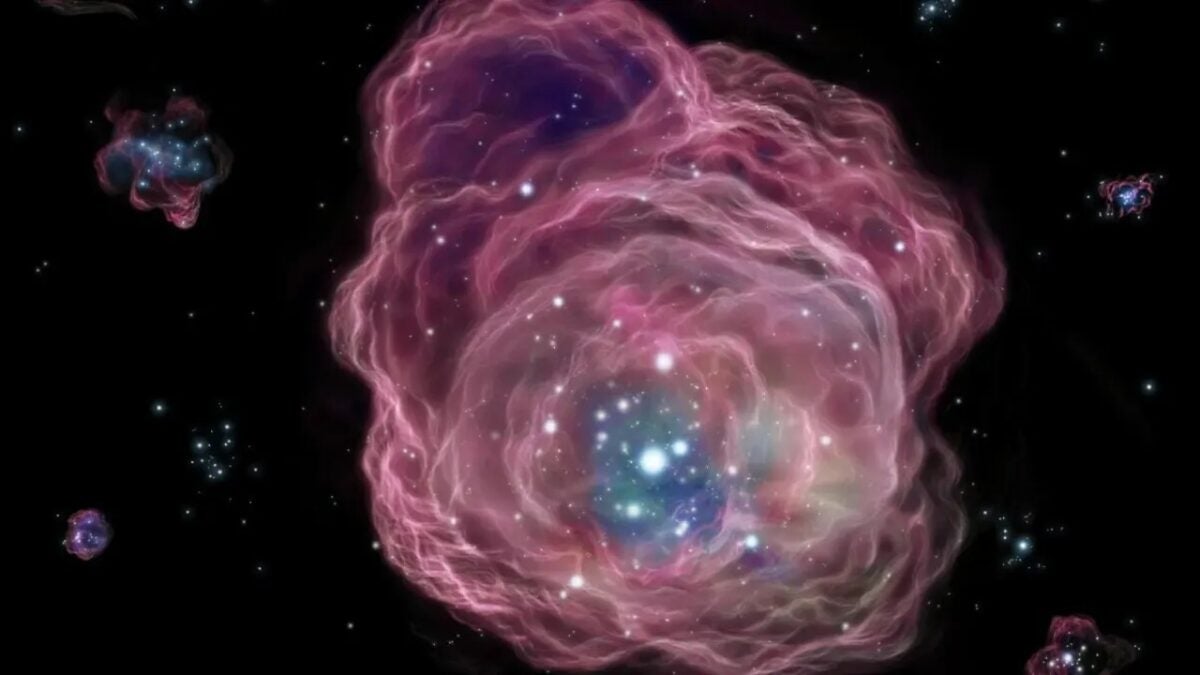
Surely you have never thought about the first stars after the Big Bang, unless you are an astronomer and that is your job. Despite this, now that you have read the headline, surely you have wondered: how were they and what were those first stars made of?

Since it is believed that most of the metals in the universe come from dead stars that exploded, scientists have rationalized that the firstborns must be composed almost entirely of hydrogen and helium, the primitive material that emerged from the Big Bang.
The fact is that no one has yet seen one of these pure stars. But a team using the James Webb Space Telescope, a result of collaboration between NASA and the European and Canadian space agencies, may have something on their hands.
Have we been able to observe the first stars of the universe?
While studying the galaxy GN-z11, which existed when the universe was only about 430 million years old, they found a group of helium in the halo that surrounds it.
The new research, accepted for publication by the scientific journal Astronomy & Astrophysics, could lead to one of the most important discoveries in modern astrophysics.
In theory, scientists expected to find clusters like this around massive galaxies from early epochs. The idea is that these pristine gas pockets could collapse and form the so-called Population III star clusters.
Población III stars are the stars that, according to theories, should have formed in the early universe before metals existed, an astronomical term that refers to all elements heavier than helium. It is believed that these stars are very massive, luminous, and hot.
The reason they are called “Population III” is that, in the 1940s, stars were divided into two main categories: metal-rich and metal-poor, according to Swinburne University of Technology (Australia). But even the latter have much more metal content than would have been possible from the leftover primordial gas from the Big Bang.
Finally, astronomers began to think about a third population of stars yet to be seen, formed by the pure material of the Big Bang that had not been processed by previous generations of stars.
The cores of stars are considered factories of elements: They produce carbon, for example, the same chemical substance that humans and much of life on Earth are based on. Then, through supernova explosions, they spread heavy elements such as calcium from bones and iron from blood into interstellar space. This dispersion gives rise to new generations of stars and planets, but scientists admit that they still have much to learn about the early stages of the process.
Astronomy is the James Webb Frontier
In astronomy, looking further means observing the past, because light and other forms of radiation take longer to reach us. The James Webb was built to study an extremely early period of the cosmos, detecting invisible light in infrared wavelengths.
In short, a large amount of dust and gas in space obscures the view of extremely distant and inherently faint light sources, but infrared waves can penetrate through the clouds.
